49 works in this view — arrow keys or swipe to move between them.
Dance in Art
Theatre costume
Unknown
- Collection:
- Theatre costume
- Source:
- Victoria and Albert Museum
- Rights:
- Rights vary by item — check the source record before reusing this image. Source record ↗
- Recorded as:
- V&A — check rights per item
Costume jewelry of this caliber illuminates the material splendor of historical theatre and court dance, particularly the visual spectacle that surrounded performers. The piece documents the investment in visual magnificence that framed dance performance in elite contexts, where movement was inseparable from jeweled dress and precious ornament.
What you are looking at
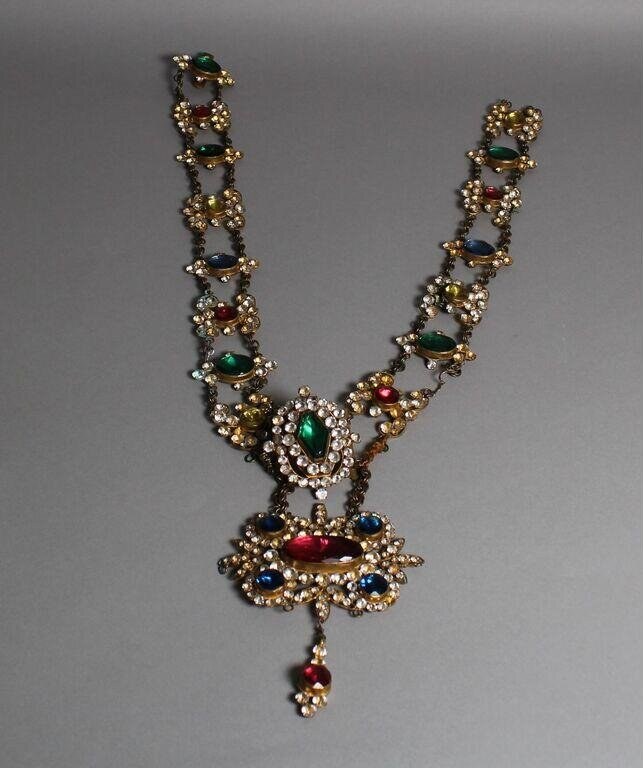
A jeweled ornament forming a U-shaped pendant necklace is displayed against a neutral grey background. The piece consists of two parallel chains of alternating decorative knots and oval cabochon stones—emeralds, sapphires, and rubies in deep greens, blues, and reds—connected at the base by an elaborate brooch-like centerpiece. The centerpiece features a large emerald-cut stone surrounded by a dense mounting of smaller stones and intricate goldwork, with small pearl or diamond accretions throughout. A single pear-shaped stone hangs from the lowest point of the centerpiece as a final drop. The symmetrical, formal composition and the richness of the materials suggest a high-status ornament designed for ceremonial or court wear.
The dancing
No human figures are present in this image.
The dance depicted
This object does not depict dance. It is a costume ornament or jewelry piece, likely designed to be worn during formal or theatrical occasions. Without evidence of dancers, choreography, or movement, no dance style or genre can be identified from the image alone.
How it was made
This appears to be a piece of jewelry or costume adornment made from gold or gilt metal set with cabochon gemstones (emeralds, sapphires, rubies) and smaller pearls or diamonds. The construction suggests skilled metalwork and stone-setting typical of high-value decorative arts, possibly from the 16th–18th century based on the style of the settings and the density of ornamentation. The formal presentation photograph suggests this is a museum or collection piece documented for scholarly or curatorial purposes.
About this work
This is a U-shaped pendant necklace fashioned from precious metals and gemstones, designed as a luxurious ornament for formal or ceremonial dress. While the catalogue identifies it as a 'theatre costume,' the object itself is pure adornment—the kind of jewel worn by actors playing royal or aristocratic roles, or by high-status individuals in court performance contexts. Its presence in a dance collection likely reflects its association with the pageantry and spectacle of historical theatrical performances, which often included danced sequences and courtly entertainments.
How to look at it
Attend to the precision and expense of the craftsmanship: every surface is occupied by gemstones or gold work, leaving no plain metal showing. The symmetry of the two chains emphasizes the formal hierarchy of the piece, with all visual weight concentrated at the base where the largest stones cluster. This is a garment accessory designed to catch light and draw attention to the wearer's body in motion—the pendant would swing and flash during any movement on stage.
The period
The style of the metalwork and stone-setting, with its densely clustered smaller stones surrounding larger cabochons and the formal symmetry of the design, is consistent with decorative practices of the 16th–18th centuries, periods of elaborate court entertainment and theatrical performance across European courts. Such jewels were commissioned for actors and noble performers in masques, court ballets, and other staged spectacles where visual magnificence was a primary component of the production.
Where it lives
The catalogue record identifies this as a theatre costume, held in a collection indexed as 'va' (likely Victoria & Albert Museum or similar institutional holding). No artist, date, or additional provenance details are recorded.
Questions about this work
Is this a piece of jewelry or a costume prop?
It is both: a real piece of jewelry made from precious materials, designed specifically to be worn as part of theatrical costume. High-value ornaments like this were commissioned for actors and performers, particularly in court entertainment, where the visual splendor of dress was integral to the performance itself.
What dances would have been performed by someone wearing this?
The piece gives no direct evidence of a specific dance style. However, jewels of this type were worn in 16th–18th-century court contexts where court dances (minuets, galliards, and masque entertainments) were performed. The pendant's design—with a long drop—suggests a wearer who moved with controlled, formal bearing rather than vigorous footwork.
Why is jewelry in a dance collection?
Theatre and dance history encompasses the total visual presentation of performance, including costume, jewels, and adornment. Costume jewelry documents how performers were dressed, the investment in spectacle, and the aesthetic values of the period. This piece is evidence of the material context of historical dance.
More dance artwork





