49 works in this view — arrow keys or swipe to move between them.
Dance in Art
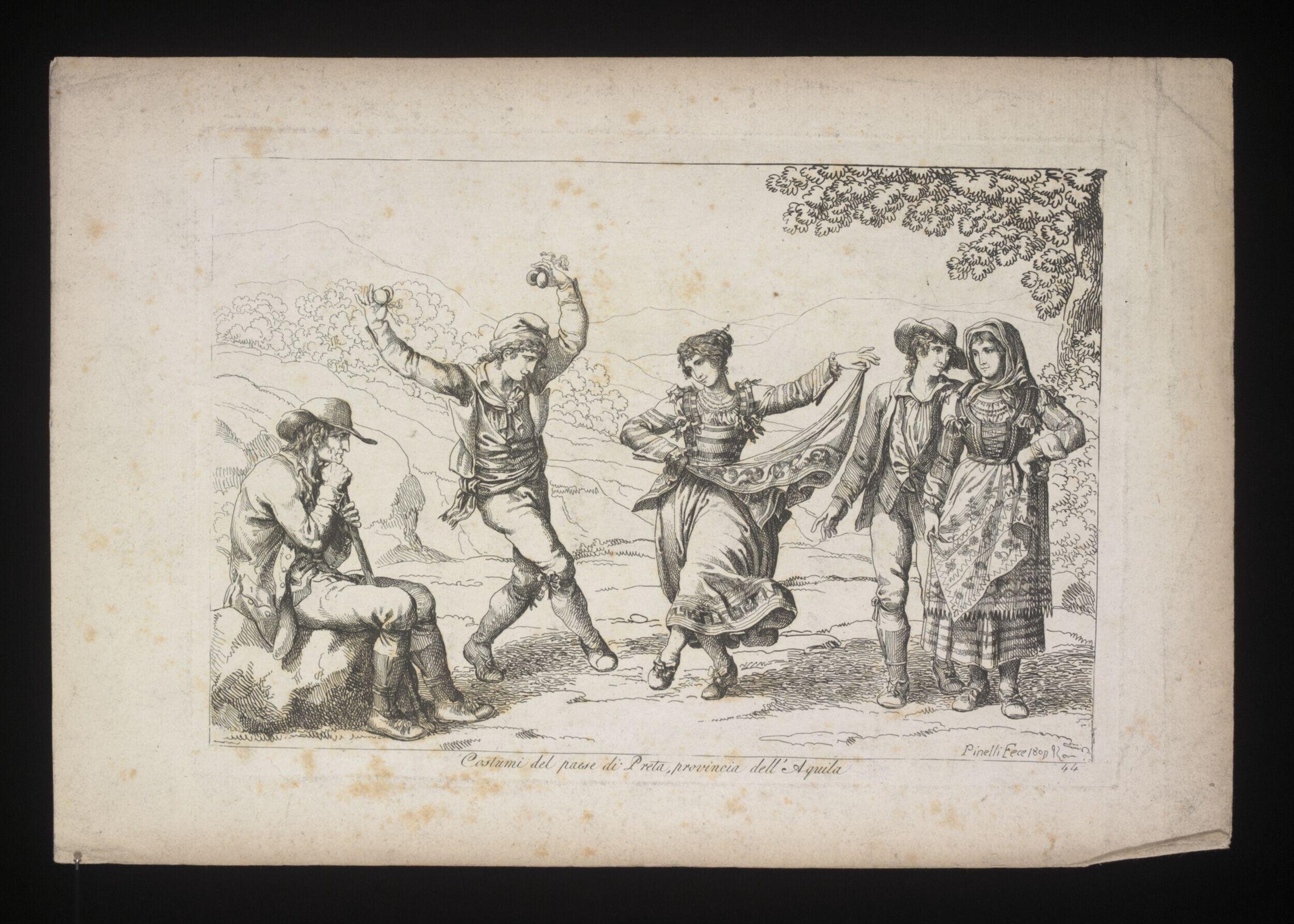
"Costumi del paese di Preta, provincia dell'Aquila"
Pinelli, Bartolomeo
- Collection:
- Source:
- Victoria and Albert Museum
- Rights:
- Rights vary by item — check the source record before reusing this image. Source record ↗
- Recorded as:
- V&A — check rights per item
This work is a rare early-19th-century visual record of Italian regional dance practices before systematic ethnographic documentation became common. For historians of folk dance and the tarantella tradition, Pinelli's attention to body position, group participation, and setting provides evidence of how these dances were actually performed in their original social context. It also demonstrates how Romantic-era artists used printmaking to valorize and circulate the cultural life of rural and non-elite communities.
What you are looking at
A lively outdoor gathering in a mountainous Italian landscape depicts villagers from Preta in the province of Aquila engaged in social dance. The scene is composed in a clearing framed by trees—dense foliage masses frame the right side and background. Six figures occupy the foreground: two women on the right, one covered in a draped shawl, stand at the margin of the action; a standing man in the center-right gestures expansively with one arm raised; two men in the middle ground—one seated or crouching on the left, one actively dancing with raised arms and bent knees—appear to be performing; and additional figures suggest a gathering or audience. The clothing is regional and rural: simple tunics, wrapped garments, and head coverings typical of early 19th-century Apennine communities. The engraving's light, delicate hatching creates a warm, informal mood appropriate to village festivity rather than formal ballroom ceremony.
The dancing
The dancer in the center-right displays an exuberant, unbounded physicality: both arms are raised, the body appears in a springing or hopping posture with bent knees, and the stance suggests explosive upward energy rather than the controlled frame of ballroom dance. The crouching or seated figure on the left may be observing, clapping, or preparing to join. The two women on the right stand as spectators or bystanders, their posture reserved. The composition suggests spontaneous, participatory movement—neighbors joining or waiting their turn—rather than partnered couple dance or formal choreography. The gestural vocabulary is open, centrifugal, and joyful.
The dance depicted
This appears to document folk or regional village dance of the Apennine region, likely a tarantella or similar southern Italian folk form, though no specific step or style can be confirmed from the posture alone. The image records a living social practice rather than a theatrical performance: the gathering is outdoors, the participants are dressed in working clothes, and the movement is characterized by individual expression within a community context. The raised arms, springy leg action, and apparent use of alternating feet suggest a rhythmic hopping or jumping motion common to Neapolitan and Abruzzese folk traditions. This is ethnographic observation rather than artistic fantasy—Pinelli's stated intent was to document the actual customs of the Preta region.
How it was made
This is a line engraving, executed with fine parallel hatching to suggest volume and shadow. The technique allows precise, detailed rendering of costume and physiognomy while maintaining the lightness and immediacy characteristic of early 19th-century travel documentation and costume studies. Engravings of this type were relatively economical to reproduce and circulate, allowing scholars, artists, and the curious public to access visual records of regional life without traveling. The delicate line work and careful composition suggest this was created as a finished work of art for publication or collection, not a preliminary sketch.
About this work
This engraving by Bartolomeo Pinelli documents the folk dance of Preta, a village in the Abruzzi region of southern Italy, around 1809. Pinelli was an accomplished illustrator and printmaker fascinated by Italian regional life, and his work captures a moment of community festivity with ethnographic precision and artistic sympathy. The image records not a codified dance form but a lived practice—the spontaneous, joyful movement of villagers gathered in an outdoor clearing. The open-armed, high-energy physicality suggests the tarantella family of southern Italian dances, characterized by rapid footwork, hand-clapping, and alternating partners, though the image alone cannot confirm the specific form or name used locally.
How to look at it
Attend to the body position of the central dancing figure: the raised arms, the bent knees, the apparent upward and outward energy. This posture is neither the closed partnered frame of ballroom dance nor the geometric precision of ballet, but something more exuberant and less constrained. Notice also the composition: the dancers occupy a clearing, surrounded by community, with the movement radiating outward from the center rather than progressing in a line or a closed circuit. The artist has chosen a moment of apparent peak energy, not a preparatory stance or a transition, and has arranged the figures to suggest both the individual dancer's absorption and the collective participation of the group. The rural setting—the trees, the hillside, the outdoor light—is integral, not merely decorative.
The artist
Bartolomeo Pinelli (1781–1835) was a Roman printmaker, draughtsman, and illustrator celebrated for his vivid scenes of Italian everyday life, carnival, and folk culture. He worked primarily in engraving and etching and was admired for his technical skill and his ability to capture gesture, character, and regional specificity. Pinelli's output included large narrative prints, book illustrations, and costume studies; he was part of the early Romantic movement's embrace of vernacular culture and picturesque regional difference. His work circulated widely across Europe and influenced later ethnographic and travel illustration.
The period
In the early 19th century, Napoleonic and post-Napoleonic Europe saw a surge of interest in folk culture, regional costume, and 'authentic' national traditions as a counterweight to cosmopolitan classicism and French cultural dominance. Printmakers like Pinelli capitalized on this appetite, documenting the dress, customs, and social practices of Italian villages and urban neighborhoods. At the same time, European Romantic dance was beginning to incorporate folk idioms and peasant themes into theatrical ballet—a process that would accelerate through the 1830s and 1840s. Pinelli's work sits at the intersection: it records actual village practice while participating in the artistic elevation and aestheticization of folk material.
Where it lives
The work is recorded as a print in the VA (Victoria and Albert Museum) collection. It is part of a larger body of Italian costume and folk-life studies by Pinelli, many of which were published or circulated as educational and aesthetic documents during the artist's lifetime and after.
Dance in this work
Questions about this work
Is this a specific named dance?
The title indicates only that it documents the customs of Preta, in the Aquila province. The movement style—hopping, arm-raising, apparent rhythmic footwork—is consistent with tarantella and related Apennine traditions, but Pinelli does not name the dance, and village practices often had local names and variations unknown to outside observers. The image records a social practice rather than a formal dance with a single canonical form.
Why are the figures dressed so simply?
These are working villagers in their everyday clothes, not performers in costume or people attending a formal ball. The simplicity of dress is itself significant: it documents how people actually dressed in rural Abruzzi around 1809. The shawl, the tunics, the head coverings are practical garments, and their presence in the dance image indicates that this was vernacular social movement, not a theatrical or elite practice.
How do I know this is dance and not just people moving around?
The title explicitly identifies it as customs (costumi) and the composition frames the scene as a social gathering centered on movement. The central figure's posture—raised arms, bent knees, apparent propulsion—displays the deliberate, rhythmic physicality of dance rather than casual standing or walking. The arrangement of spectators and participants, the outdoor setting chosen for the purpose, and the artist's clear focus on the movement all signal that this is a documented social dance practice, not incidental motion.
More dance artwork





