49 works in this view — arrow keys or swipe to move between them.
Dance in Art
Poster
A. E. King & Jackson Ltd.
- Collection:
- Poster
- Source:
- Victoria and Albert Museum
- Rights:
- Rights vary by item — check the source record before reusing this image. Source record ↗
- Recorded as:
- V&A — check rights per item
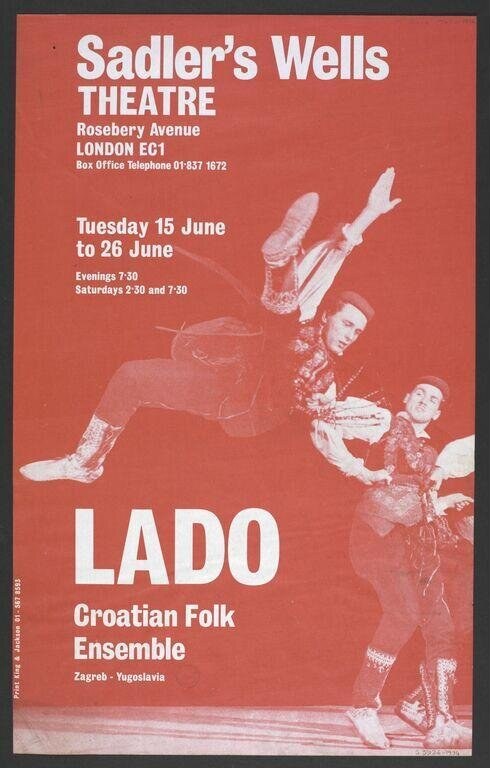
This poster documents the circulation of Yugoslav folk dance in Western Europe during the Cold War era, when state-sponsored ensembles were key instruments of cultural diplomacy. The visual language used to advertise it—explosive athleticism, bright costume, individual virtuosity—shaped how British audiences understood Eastern European and Balkan dance traditions, often as exotic spectacle rather than living social practice.
What you are looking at
This is a theatre poster for the Sadler's Wells Theatre in London, printed in red and white. The composition features three dancers in folk costume arranged diagonally across the lower half of the poster. The figure at top left wears a red embroidered jacket and patterned stockings, with one leg raised high in a dynamic leap. Below and to the right, two more dancers in traditional dress strike dramatic poses, one with arms extended and the other in a wide stance. The costumes show Central European or Balkan characteristics: embroidered vests, patterned textiles, and ornate boots. The setting is theatrical rather than documentary—the poses are clearly choreographed for performance, with strong verticality and open body positions. Text at the top identifies the venue and dates (Tuesday 15 June to 26 June), with evening times listed. The visual emphasis is entirely on the dancers' bodies and their spectacular, high-energy movement vocabulary.
The dancing
Three solo dancers occupy the space, none in closed holds or ensemble formation. The uppermost figure executes what appears to be a high leg lift or jump, torso upright and controlled, with arms in a raised but not extended position—suggesting either mid-flight or a held position at the peak of elevation. The lower left dancer stands with a wide, stable base and arms gesturing outward. The lower right dancer is in a similar spread-legged, open stance. All three maintain upright spines and appear weightless or defiant of gravity—characteristic of virtuosic folk dance performance built on jumping, turning, and rapid footwork rather than sustained balances.
The dance depicted
This poster advertises the Lado Croatian Folk Ensemble from Zagreb, Yugoslavia. The three figures exemplify the virtuosic male solo vocabulary of Croatian and broader South Slavic folk dance, which emphasizes high jumping, rapid footwork, and sharp, athletic attack. The elevated leg position, wide stable stances, and explosive energy are hallmarks of men's solo variations in Balkan folk traditions—dances built for public celebration, often competitive in character. The poster presents this as a spectacular Western theatrical event: professional, touring, staged rather than participatory.
How it was made
This is a letterpress or offset lithographic poster, a commercial print medium that allowed mass reproduction for public distribution. The design uses bold, high-contrast red and white—economical to print and visually striking for street display and venue advertising. The photographer (credited as A. E. King & Jackson Ltd., a London printing firm) worked from performance photographs to create a dynamic composition that prioritizes movement over clarity of individual steps. The medium allowed the image to circulate widely: this is a working advertisement for a paying audience, not a documentary record or fine art print.
About this work
This is a theatre advertisement for a 1970s touring performance by a professional Yugoslav folk ensemble. It captures the moment of British engagement with European folk dance traditions through the framework of the theatrical stage—a tradition Sadler's Wells had pioneered in the mid-twentieth century. The poster is a document of how folk dance was packaged, marketed, and consumed in London venues: as spectacular, virtuosic solo performance rather than participatory community practice. The image itself—the high jumps, the open gestures, the formal theatrical composition—constructs folk dance as a display of bodily prowess and national culture for a paying audience.
How to look at it
Notice the moment captured: not a static folk tableau but explosive, airborne movement. The upper figure is frozen in a jump, defying the usual weight and stability associated with folk dance in Western imagination. The wide stances of the lower figures suggest they are either preparing for or recovering from equally dynamic movement. The poster does not show folk dance as quaint or nostalgic; it shows it as athletically demanding, modern, and theatrical. The red-and-white high contrast mimics the clarity and drama of stage lighting.
The artist
A. E. King & Jackson Ltd. was a London commercial printing and lithography firm, one of many mid-twentieth-century design studios that produced theatre posters, playbills, and promotional materials for London venues. The work is anonymous—credited to the firm rather than an individual designer or photographer—and represents industrial design practice rather than fine art.
The period
The 1970s saw increased cultural exchange between Eastern Europe and Western Europe, including touring by state-sponsored folk ensembles. Sadler's Wells Theatre had established itself as a venue for both ballet and international dance; the Lado ensemble represented the British appetite for non-Western and non-classical dance on the London stage. This was also the era of World Dance—the institutional framework that would eventually position folk and traditional dances alongside ballet and contemporary as legitimate theatrical forms. The poster's design language—bold modernist sans-serif typography, high-contrast photography, dynamic diagonal composition—was standard commercial practice for mid-to-late twentieth-century theatre advertising.
Where it lives
This is a theatre poster held in a collection related to the V&A Museum (source code 'va' in the record). It belongs to the category of commercial printed ephemera—a working advertisement meant for street display and short-lived circulation, not preservation.
Dance in this work
Questions about this work
What is Lado?
Lado was a professional folk dance ensemble based in Zagreb, Yugoslavia (now Croatia). Founded in the 1950s, it became one of the most celebrated touring folk ensembles of the Cold War era, performing across Europe and internationally. The ensemble was state-sponsored and played a key role in presenting Yugoslav culture abroad.
Why would a London theatre show Yugoslav folk dance?
Sadler's Wells Theatre was a major venue for dance innovation in the twentieth century. By the 1970s, international folk ensembles were prestigious attractions: they offered London audiences access to non-Western traditions and demonstrated cosmopolitan taste. Touring ensembles also served as cultural ambassadors for their nations.
Is this dance actually from Croatia?
The Lado ensemble performed a curated repertory of South Slavic folk dances—including Croatian, Serbian, Bosnian, and other regional traditions. The costumes and movement vocabulary in this poster are consistent with Central Balkan folk dance, though the ensemble's specific program would have included multiple regional styles.
What are those jumps and poses?
Men's solo variations in Balkan folk dance emphasize high elevation, rapid footwork, and sharp athletic attack. These movements were developed in social contexts—celebrations, courtship displays, competitive performance—and were built for explosive impact. The theatrical staging amplified their virtuosic character.
More dance artwork





