49 works in this view — arrow keys or swipe to move between them.
Dance in Art
Bodice
Lancaster, Osbert (Sir)
- Collection:
- Bodice
- Source:
- Victoria and Albert Museum
- Rights:
- Rights vary by item — check the source record before reusing this image. Source record ↗
- Recorded as:
- V&A — check rights per item
Costume is a primary document of dance practice: the cut, materials, and decoration of this garment tell us what a mid-twentieth-century choreographer or collector understood about folk dance aesthetics, female roles, and the relationship between embroidered decoration and bodily movement. The distinctive pleated cuffs and the balance of bodice constriction and skirt freedom reflect specific choices about where a dancer's body should be visible, mobile, or held. For a historian or choreographer, this object is evidence of either regional dance tradition or of mid-century theatrical interpretation of that tradition.
What you are looking at
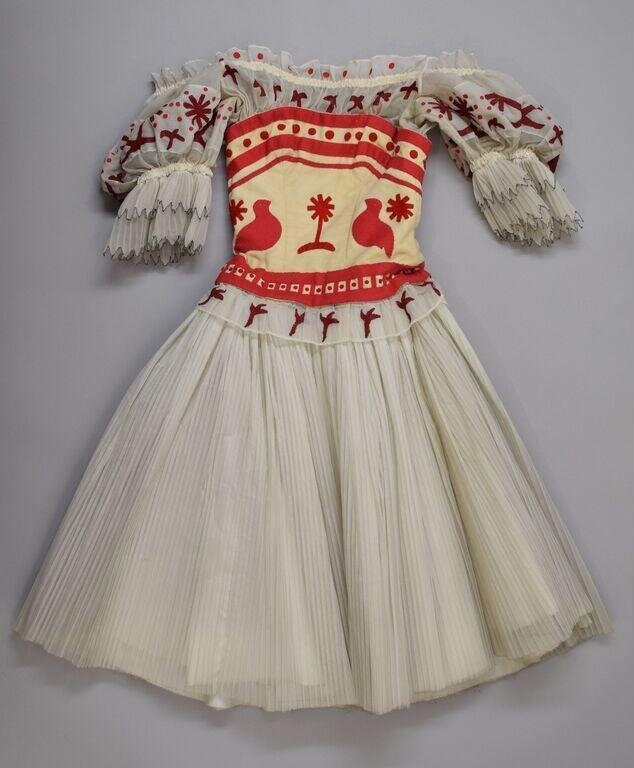
A constructed garment displayed flat against a neutral ground, shown as a complete dress rather than a stage scene. The bodice is a short cream-colored strapless corset or bustier top, approximately hip-length, with a cinched waist and decorative red embroidered detailing across the front: two stylized bird or pomegranate motifs flanking a central geometric pattern, with decorative borders above and below. The sleeves are puffed and short, with cream pleating gathered at the shoulder seam and terminating in red-trimmed cuffs of deep accordion pleats—a distinctive and potentially interpretable costume element. The skirt is a full, gathered cream linen or linen-blend fabric with regular vertical pleating throughout, creating a voluminous bell shape. The entire ensemble is shown as a complete garment laid flat for documentation or exhibition, the kind of object typically photographed in a textile or costume collection.
The dancing
No figures are present. This is a costume object, not a representation of dancing bodies. The dress is displayed as an artifact: the garment itself is the subject, laid flat and photographed frontally to show construction, materials, decoration, and silhouette. The pleated skirt suggests a full range of motion in the hips and legs; the short, puffed sleeves and low neckline suggest unobstructed arm movement.
The dance depicted
The garment's style, construction, and decoration suggest a folk or regional dance costume, most likely Eastern European, Balkan, or Central Asian in origin based on the color palette (cream with red), the embroidered bird or pomegranate motifs, and the specific pleating technique of the sleeve cuffs. The full gathered skirt, short bodice, and decorative puffed sleeves are consistent with women's dance costumes from historic folk traditions such as Serbian, Bulgarian, Hungarian, or Greek regional dances, or possibly a Russian peasant or folk ensemble costume. The garment is documented as a museum piece rather than depicted in use, and we cannot observe the dress in motion or in a narrative context.
How it was made
This is a three-dimensional textile object photographed in color, likely a color photograph or transparency. The medium is the costume itself: hand-embroidered linen or linen-blend fabric with red silk or wool thread, hand-pleated construction for the skirt and particularly for the distinctive accordion-pleated cuffs, and what appears to be machine or hand-stitched assembly. The photograph serves as a conservation and cataloguing document, a standard museum practice for textiles and costume artifacts. The frontal, flat-lay presentation and neutral background are convention for museum textiles photography, intended to show the object clearly without distortion or shadow.
About this work
This is a women's folk dance costume, a complete dress ensemble consisting of a short embroidered bodice with puffed pleated sleeves and a full pleated skirt. The garment survives as a museum artifact in the V&A collection, where it is catalogued by the artist or designer Lancaster, Osbert (Sir), dated 1960. The object represents either a historical regional costume collected or documented by Lancaster, or a designed costume created in the mid-twentieth century for a dance company or theatrical production drawing on folk traditions. The work belongs in a gallery of dance in art because the garment itself is material evidence of how bodies were dressed for structured, likely ensemble movement—the silhouette, construction, and decoration all communicate the expectations of the dance and the wearer's role within it.
How to look at it
Observe the distribution of decoration and constraint: the bodice is narrow and embellished, drawing the eye and emphasis to the upper body and the specific motifs (the birds or pomegranates), while the skirt is voluminous and undecorated, designed to move. Note the pleating technique of the sleeves, which creates a specific visual and kinetic effect—the accordion folds would catch light and create texture in movement. The short length of the bodice and the low neckline suggest a dance in which the arms move freely and the torso is visible. The overall silhouette—nipped waist, full skirt, short puffed sleeves—is consistent with nineteenth- and early twentieth-century European folk costume traditions, and the garment was likely designed or preserved to read immediately as "folk" or "regional."
The artist
Sir Osbert Lancaster (1908–1986) was a British cartoonist, theatre designer, and author known for his satirical work and extensive designs for theatre and ballet. He designed sets and costumes for numerous theatrical and operatic productions, particularly with the Ballet Theatre and other London companies, and was also a prolific book illustrator and newspaper cartoonist. His work was frequently rooted in historical and regional aesthetics, and he had a keen eye for period detail and cultural specificity. The attribution of this costume to Lancaster suggests he designed it for a dance production or curated it as a historical example.
The period
The work is dated 1960, a moment when mid-century British and European theatre was revisiting folk traditions and regional dance forms, both as source material for new choreography and as objects of historical interest. The postwar period saw renewed interest in European cultural heritage and folk performance, often mediated through theatrical and design practice. Simultaneously, the museum documentation of historical dance costumes was becoming more systematic, and the V&A was actively acquiring theatre and dance-related textiles. The garment may represent either a historical costume collected during this period or a newly designed costume created for a folk-inspired dance production of the 1950s–60s.
Where it lives
The object is held in the Victoria and Albert Museum (V&A), catalogued under the record title "Bodice" with attribution to Lancaster, Osbert (Sir), dated 1960. It is listed as a textile or costume object but with no medium recorded. The source code "va" indicates the V&A as the holding collection. The work is documented as a discrete museum artifact, preserved and catalogued as an example of dance costume or theatrical design.
Dance in this work
Questions about this work
Is this a historical costume or a theatrical design?
The record does not distinguish, and the photograph does not clarify. The garment could be a historical regional costume collected and documented by Lancaster around 1960, or a costume he designed for a mid-century dance or theatre production based on folk traditions. The embroidery technique, pleating methods, and materials would require expert textile analysis to determine whether they are consistent with nineteenth-century folk production or mid-twentieth-century theatrical making.
What dance would this costume have been worn for?
The style, decoration, and construction suggest an Eastern European, Balkan, or Central Asian folk dance tradition—possibly Serbian, Bulgarian, Hungarian, Greek, or Russian based on the embroidered motifs and color palette. The full skirt, short bodice, and free arm movement suggest a dance with significant hip and leg action and visible torso and arm choreography. Without additional documentation or context, a precise attribution cannot be made from the garment alone.
Why is the artist listed as Osbert Lancaster?
Lancaster may have designed the costume for a theatrical or dance production, collected the historical garment and overseen its documentation, or contributed to its interpretation or adaptation. The record does not specify his role. His known work in theatre and ballet design makes attribution as designer plausible; his work as a cultural commentator and illustrator makes him a possible documenter or curator as well.
What is the significance of the pleated cuffs?
The accordion-pleated cuffs are a distinctive construction detail that would create visual movement and texture in performance. They suggest hand-intensive labor and regional craft knowledge, and they would be particularly visible in motion when the arms move. They are a hallmark of certain Central or Eastern European folk costume traditions and signal the designer's or maker's attention to historically specific detail.
More dance artwork





