49 works in this view — arrow keys or swipe to move between them.
Dance in Art
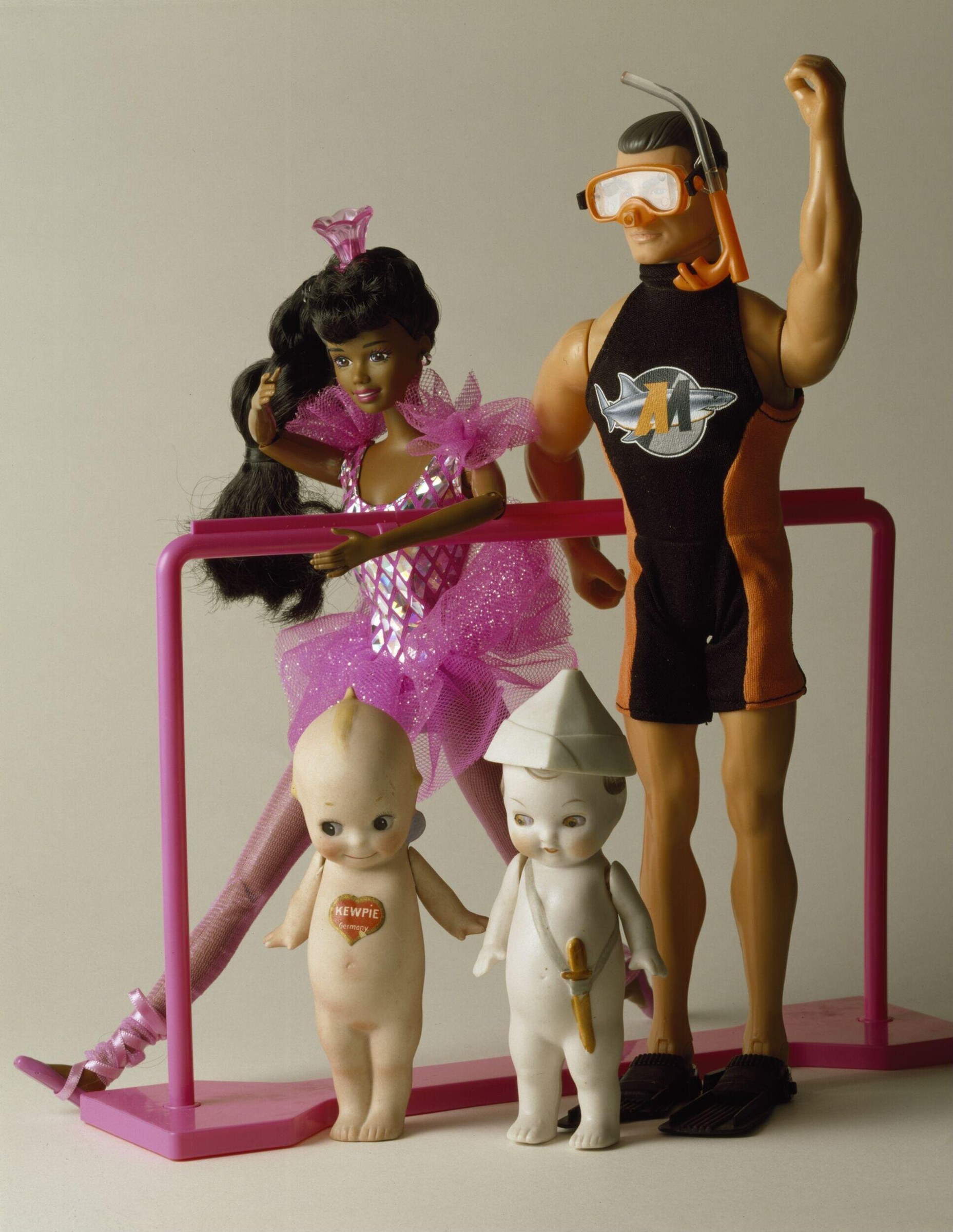
twirling ballerina barbie doll
Unknown artist
- Collection:
- Barbie doll
- Source:
- Victoria and Albert Museum
- Rights:
- Rights vary by item — check the source record before reusing this image. Source record ↗
- Recorded as:
- V&A — check rights per item
The work challenges what counts as 'dance imagery.' A naive reading of the title and frame promises ballet but finds only costume and posture—raising questions about whether the visual markers of dance (tutu, arabesque posture) constitute the thing itself, or whether dance requires actual trained movement. The work's collage of incongruous elements (snorkeler, conductor, infants) in formal theatrical composition may be a satire on how dance is commodified and packaged for consumption.
What you are looking at
A tableau of five dolls arranged within a bright magenta framework structure against a neutral background. At the center back stands a tall doll in a black sleeveless diving wetsuit with an orange fish graphic, wearing an orange snorkel mask and flippers, with one arm raised triumphantly. To the left is a female doll with black hair and a magenta crown, dressed in an elaborate sequined magenta gown with exaggerated tulle wings or fins extending from the shoulders, holding a conductor's baton. In front are two small unclothed infant dolls with painted faces—one with a simple painted expression, the other wearing a white paper cone hat and holding a small paintbrush or staff. The entire scene is mounted on a magenta metal frame that echoes the color of the female doll's costume, creating a unified theatrical composition that reads as deliberately surreal or absurdist.
The dancing
The tall diving-suited doll dominates through height and open posture—the raised arm suggests exuberance or victory. The female figure's arm holding the baton suggests conducting or orchestration, while the downward angle of her body and the spread tulle create a sense of performance or display. The two small dolls below are passive, unposed, and infantilized. The composition creates a hierarchy by scale and positioning: the back figures tower over and frame the front figures, establishing them as performers or observers rather than participants.
The dance depicted
This is not a representation of any identifiable dance tradition. The object uses the visual language of dance—costume, pose, theatrical framing—but recombines it into absurdist nonsense: a snorkeler cannot dance, an infant figure cannot execute movement, and the geometric frame has no analogue in actual performance space. The title "twirling ballerina barbie doll" promises ballet but delivers something else entirely. The work appears to be conceptual or ironic commentary rather than documentation of choreography.
How it was made
This is an assemblage of injection-molded plastic dolls (primarily Barbie and Kewpie dolls, identifiable by their proportions and the 'KEWPIE' branding visible on one figure) mounted within a fabricated metal frame. The dolls are commercial mass-produced objects; the assembly itself is hand-constructed. The technique is collage or assemblage art rather than traditional dance documentation. The preservation and presentation within a gallery context transforms mass-market toys into fine art through institutional framing.
About this work
This is a work of conceptual or assemblage art that appropriates the visual language of dance—costume, pose, theatrical staging—while systematically violating the premises of actual dance. It positions dolls in a tableau that evokes dance photography or narrative painting without depicting any coherent choreography or movement practice. The work sits at the intersection of Barbie culture, pop art, and institutional critique, using the absurdity of the combination to comment on dance as spectacle, femininity as performance, or perhaps the exhaustion of traditional representational modes. For a gallery of dance in art, it functions as a negative case: a work that gestures toward dance without engaging any actual dance knowledge or tradition.
How to look at it
Note the scale relationships: the tiny dolls below the tall figures create an uncomfortable power dynamic. Observe how the magenta frame echoes the female doll's costume, suggesting either orchestration of a unified spectacle or a constraint. The raised arm of the snorkeler mimics a victory pose or arabesque, but the flippers and mask anchor it firmly in an underwater (impossible) space. Read the title against what is shown—the gap between promise ('ballerina') and delivery (untrained dolls in costume) is the work itself.
The artist
The artist is not recorded. The work exists as a Barbie doll assemblage dated 1995, suggesting either commercial origin or individual creation during the height of Barbie collecting and appropriation art. The late 1990s saw significant feminist and pop art engagement with Barbie as a site of contested meaning. Without attribution, the work's intention remains ambiguous—whether it is commercial packaging, artist-made critique, or documentation of play.
The period
This object emerges from a moment (mid-1990s) when Barbie had become established as both children's commodity and serious art material. Artists including Kara Walker, Uta Barth, and others were engaging with dolls and miniature figures as a means to explore race, identity, and scale. Simultaneously, ballet as high art was being challenged by postmodern and conceptual dance practices that questioned virtuosity and formal beauty. The work's date places it after the postmodern turn in contemporary dance (1960s onward) when the very definition of dance—what counts, who dances, where it happens—was radically reopened.
Where it lives
Catalogued as a Barbie doll object dated 1995 with the source marked 'va.' The work is held as part of a Barbie doll collection. The minimal catalogue information suggests either archival documentation of a toy or secondary accession of artist-made or found material. The holding as 'Barbie doll' rather than as sculpture or assemblage art implies ambiguity about its status.
Questions about this work
Is this actually a dance image?
Formally, yes—it uses costume, posture, and theatrical framing that reference dance. But it does not depict any recognizable dance practice or trained movement. The work may be intentionally about the gap between dance as visual spectacle and dance as embodied practice, or it may simply be a collage of toy costume pieces. The ambiguity is the work.
What is the snorkeler doing in a dance assemblage?
The snorkel gear breaks the convention of stage costume. It suggests either absurdist humor, or a comment on how dance costumes (like tutus) are codes for 'spectacle' that can be applied to any body. The snorkeler's raised arm mimics an arabesque or victory pose, highlighting the fact that gesture and costume alone do not constitute dance.
Why are there infant dolls?
The two Kewpie-style infant figures are passive and unposed—they cannot dance. Their presence in a theatrical assembly with dancing-adjacent adults may comment on power, agency, and who gets to be a performer. Or it may simply be readymade absurdism.
More dance artwork





