49 works in this view — arrow keys or swipe to move between them.
Dance in Art
Fan
Unknown artist
- Collection:
- Fan
- Source:
- Victoria and Albert Museum
- Rights:
- Rights vary by item — check the source record before reusing this image. Source record ↗
- Recorded as:
- V&A — check rights per item
Fans were not neutral objects: their ownership, decoration, and use were bound up with the performance of gender, class, and refinement in the spaces where dance occurred. This fan's elaborate iconography and construction record how aristocratic women's bodies and identities were understood and adorned in the 18th century. Studying such objects broadens dance history beyond choreography and technique to include the material and social frameworks that made dance possible and meaningful.
What you are looking at
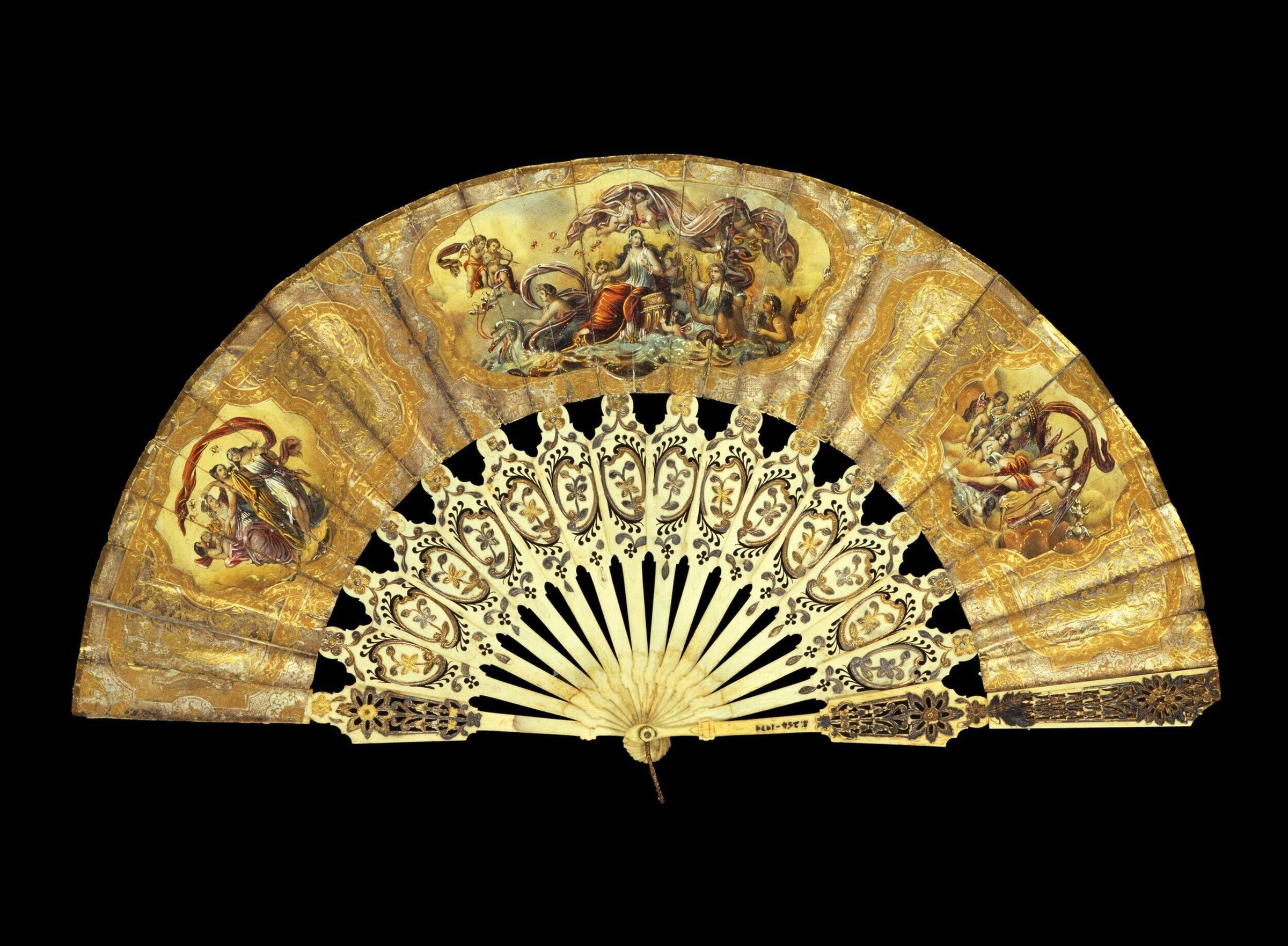
This is a folding fan with an ornate ivory or bone frame and applied paper or vellum leaf. The fan opens to a semicircular span of roughly 10–12 inches. The upper outer surface of the frame is decorated with gilt tooling and inlaid scenes in the Rococo manner: at the top, an oval vignette shows figures—possibly Muses or mythological personages—in a state house or Olympus-like setting, with cherubs and gilt clouds. To either side are smaller gilt-decorated reserves with allegorical or mythological figures. The central leaf is intricately pierced: it shows a radiating starburst of thin ivory or bone sticks, each carved with delicate foliate or palmette motifs and arranged in the classic brisé fan structure. Between the sticks are thin black lacquer or stained strips that create the negative space and define the geometric pattern. The lower case—the bottom of the frame—bears gilt metal ornaments at the pivot. The overall effect is deeply luxurious and labour-intensive: this is an object of aristocratic display, tooled and carved with conspicuous skill and expense. The monochromatic treatment of the pierced leaf (ivory or pale bone against black backing) throws the intricate geometry into sharp relief.
The dancing
The mythological or allegorical scenes on the outer frame show multiple figures—some in flowing drapery, some winged—in attitudes of repose, gesture, and interaction typical of Rococo religious or court painting. Figures recline, gesture expressively, and interact across the composition. The human body is rendered with the elongation and grace characteristic of mid-18th-century academic practice. No active dance postures are evident in the applied scenes; instead, the figures embody statuary grace and mythological narrative.
The dance depicted
This is not a depiction of an active dance, but rather a luxurious object used during the social and courtly rituals—especially balls and promenades—where dance took place. The fan was an essential accessory of aristocratic women in the 17th–18th centuries, used to regulate body temperature, signal romantic or social intent, and display wealth and refinement. Its presence in a gallery of dance in art rests not on depicting dance itself but on being central to the material culture and bodily practice of the social spaces in which dance occurred. The iconography—mythological and allegorical—would have been recognized by the owner and her circle as markers of education, taste, and access to elite culture.
How it was made
The fan is constructed using the brisé technique: a succession of narrow sticks (here carved from ivory or bone) are held in place at the base by a central rivet and decorative metal fitting, allowing them to fan and close. The sticks are pierced and carved with fine foliate motifs; the intervals between them are filled or backed with contrasting material (likely black lacquer, stained vellum, or horn). The outer frame is enriched with gilding and hand-painted or inlaid scenic vignettes in oils or watercolour on vellum or paper. This combination of carved bone/ivory, gilt metalwork, and applied painted scenes was labour-intensive and required the coordinated skills of fan-makers, carvers, gilders, and painters. The technique was well-established by the 1750s–1770s and is characteristic of European luxury production for the aristocratic market.
About this work
This is an 18th-century brisé folding fan with a carved ivory or bone leaf and an ornate gilt frame embellished with Rococo mythological scenes. Although it does not depict active dancing, it is a material artefact central to the lived experience of aristocratic women at balls and court assemblies. The fan was simultaneously a practical object (for cooling and hand occupation), a signal of social rank and education, and a vehicle for displaying artistic accomplishment and wealth. Its presence in a dance history collection reflects the recognition that the spaces, rituals, and material cultures of dance—not merely its visible movements—are subjects worthy of study and preservation.
The work exemplifies the Rococo taste for ornamental refinement, allegorical imagery, and the integration of fine craftsmanship across multiple media. The choice to decorate the fan with scenes of mythological leisure and feminine grace reflects the idealized femininity and aristocratic leisure that dance itself was meant to express and celebrate.
How to look at it
Attend to the contrast between the delicate starburst geometry of the pierced leaf (which displays technical virtuosity in carving and assembly) and the narrative richness of the applied scenes on the outer frame (which display artistic refinement and classical knowledge). The scale of the fan—intimate, held in the hand, yet intricate enough to repay close study—was designed to be examined at a conversational distance. The black-and-ivory colour scheme of the leaf, contrasted with warm gilt accents, creates visual sophistication without ostentation. Notice how the fan's structure mirrors the bodily performance of the woman who holds it: both the object and its user are meant to display controlled elegance, grace under restraint, and the effortless mastery of complex form.
The period
This fan dates to the mid-to-late 18th century, when the brisé fan with applied gilt and painted scenes was at the height of fashion among European aristocracy, particularly in France and England. The Rococo style—with its emphasis on curves, mythological ornament, and the aestheticization of leisure—dominated elite taste. Balls and assemblies were central to aristocratic social life; the fan was an indispensable accessory, often produced in workshops that brought together specialists in bone-carving, gilding, painting, and metalwork. The mythological and allegorical imagery on fans reflected Enlightenment education and the cult of sensibility; women were expected to be cultivated in the arts and to perform a refined, graceful femininity. Dance occupied an analogous position: it was a central marker of aristocratic identity, refinement, and femininity, taught from childhood and practiced at every formal assembly.
Where it lives
The work is held in the collection listed as "Fan" (source code "va"). No further provenance information is recorded in the catalogue.
Questions about this work
Why is a fan in a gallery of dance in art?
Fans were essential to the social rituals and material culture of aristocratic dance. Women used them during balls and assemblies to regulate temperature, occupy their hands, signal social interest, and display wealth and refinement. Although this fan does not depict active dancing, it is an artefact of the spaces and practices where dance occurred, and thus part of dance history in the widest sense.
What are the scenes on the outer frame?
The decorative vignettes show mythological or allegorical figures—possibly Muses, goddesses, or personifications of virtues—in states of repose and graceful gesture, typical of Rococo ornamental repertory. They reflect the classical education and taste of the owner and her circle, and the association of dance with the leisure and refinement of the elite.
How was this fan made?
The fan uses the brisé technique: narrow sticks of carved ivory or bone, held at the base by a metal rivet, fan open and close. Each stick is pierced and carved with delicate foliate ornament. The spaces between sticks are filled with black lacquer or stained material. The outer frame is enriched with gilt metalwork and hand-painted scenes on vellum or paper. The construction required coordinated work by carvers, gilders, painters, and metalworkers.
More dance artwork





