49 works in this view — arrow keys or swipe to move between them.
Dance in Art
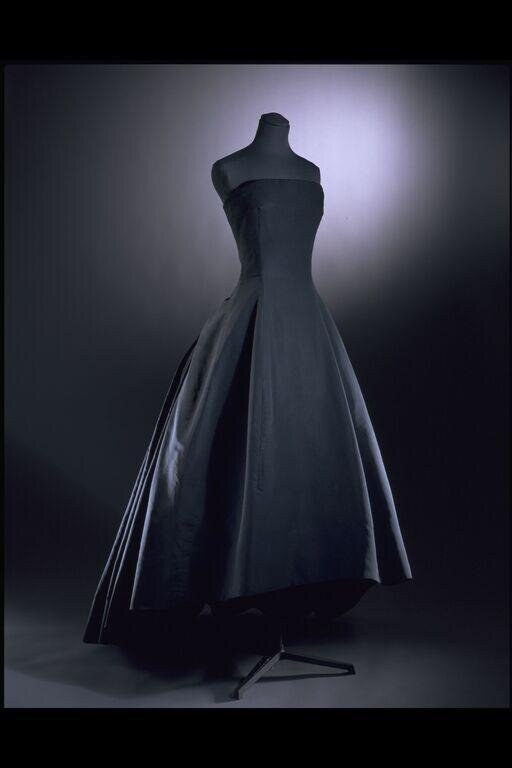
Soirée de Décembre evening dress
Christian Dior
- Collection:
- Evening dress
- Source:
- Victoria and Albert Museum
- Rights:
- Rights vary by item — check the source record before reusing this image. Source record ↗
- Recorded as:
- V&A — check rights per item
This photograph documents the relationship between fashion design and dance practice at the height of 1950s couture. The scale and construction of Dior's skirts directly enabled and shaped the movement of ballroom dancers and the figures they cut on dance floors and theatrical stages. Understanding how dance wore fashion is as important as understanding how fashion shaped dance.
What you are looking at
A dramatic evening dress is displayed on a dress form against a dark, moody background lit by a soft spotlight from above. The gown is constructed of dark fabric—appearing deep charcoal or black—and features a striking silhouette with a fitted bodice and an expansive skirt. The skirt sweeps outward in voluminous folds, creating a sculptural, architectural quality; the fabric appears to have been carefully arranged to show off its weight and drape. The form stands against a gradient background that shifts from dark on the sides to a pale, almost luminescent glow at the center top, creating a theatrical presentation. The photograph emphasizes the dress's three-dimensional form and the play of light across its surfaces, giving the garment an almost living presence.
The dancing
This is not a depiction of human movement or dance performance. The dress form is a headless mannequin, frozen and static. There are no dancers, no hold, no frame, no weight shift—only the carefully composed display of a garment's constructed form and volume.
The dance depicted
This work does not depict dance. It is a fashion photograph documenting a couture evening dress. While the garment is designed to be worn by dancers and performers, and its voluminous skirt suggests the kind of movement and drama that evening wear of this caliber would enable on a ballroom floor or theatrical stage, the image itself captures no movement, no dancers, and no choreography.
How it was made
This appears to be a professional fashion photograph, likely taken in studio conditions. The controlled lighting, the careful staging on a dress form, and the high contrast between the garment and the background are characteristic of mid-twentieth-century fashion photography. The photograph creates a gallery-like presentation of the dress as a sculptural object rather than as wearable clothing, a technique common in couture documentation and museum photography.
About this work
This is a fashion photograph of a Dior evening dress from 1955, presented as a museum-quality studio image. The work documents a moment in haute couture when evening wear was engineered to create dramatic silhouettes and facilitate the kind of movement and visual impact needed for formal ballroom dancing and theatrical presentation. The photograph itself is a document of 1950s design practice and photographic convention: the dress is presented not as a garment to be worn by a named wearer, but as an object of design and craft worthy of individual study.
How to look at it
Notice how the fabric is arranged to show not a single moment but the *potential* for movement: the skirt is deployed to suggest how it would move if the wearer danced, rather than capturing an actual turn or gesture. The lighting emphasizes the dress's three-dimensionality and the weight of the fabric, suggesting the kind of impact this garment would have in motion. The theatrical presentation—the spotlight, the dark surround, the mannequin as an abstract form—treats the dress as a design object first and foremost, prioritizing the viewer's understanding of its construction and silhouette over any sense of living wear.
The artist
Christian Dior (1905–1957) revolutionized post-war fashion with the 'New Look' introduced in 1947, which restored the full skirt and emphasized the waist after the austerity of wartime fashion. By 1955, when this dress was created, Dior was the world's most influential couturier. His atelier was known for meticulous construction and dramatic silhouettes designed to create visual impact in motion. Dior understood that his clients—wealthy women who attended galas, wore evening dress to social dancing, and appeared in theatrical contexts—needed garments that would photograph well, move beautifully, and command attention in a room.
The period
In 1955, ballroom dancing remained central to formal social life in Europe and North America, despite the emergence of new popular dances. The full skirt of Dior's designs was perfectly suited to the turns and figures of standard ballroom dances—the waltz, foxtrot, and quickstep. Simultaneously, the New Look silhouette was becoming a visual language of postwar feminine elegance and prosperity. In fashion photography of this era, garments were increasingly presented as sculptural objects worthy of individual study, a shift influenced by both modernist aesthetics and the growing prestige of haute couture as art.
Where it lives
The work is listed as held by the Victoria and Albert Museum (indicated by source 'va' in the record) as part of their costume and fashion collection. Evening dresses from this period are typically held as primary documents of fashion history and as examples of the craftsmanship of major design houses.
Questions about this work
Why is this in a gallery of dance?
The garment itself was designed for formal ballroom dancing and evening wear in social and theatrical contexts. The dress is an artifact of dance culture: it shaped how dancers moved, was worn to dance, and was engineered by a designer who understood dance. Fashion history and dance history are inseparable in the twentieth century.
Who would have worn this dress?
A wealthy, fashionable woman in the mid-1950s—likely someone who attended galas, formal balls, and social dances. Dior's clientele included European and American high society, performers, and celebrities. The cost of a Dior haute couture gown in 1955 would have been several thousand dollars, making ownership a marker of significant wealth.
What dance would be danced in this dress?
The full, voluminous skirt and fitted bodice are designed for the standard ballroom dances of the era: the waltz, quickstep, foxtrot, or slow foxtrot. The construction allows for the upright posture and rotational movement these dances require, while the skirt would create a dramatic visual line as the wearer turned and moved across the floor.
Why photograph the dress on a form rather than on a model?
The dress form allows the photographer to present the garment as a design object—to control the lighting, angle, and composition entirely. A human body would introduce personality, expression, and the specifics of an individual wearer. The dress form makes the dress itself the subject, emphasizing its construction and silhouette as matters of craft and vision.
More dance artwork





