49 works in this view — arrow keys or swipe to move between them.
Dance in Art
Felia Doubrovska
Albin of Monte Carlo
- Collection:
- Photograph
- Source:
- Victoria and Albert Museum
- Rights:
- Rights vary by item — check the source record before reusing this image. Source record ↗
- Recorded as:
- V&A — check rights per item
Felia Doubrovska was a crucial link between classical Russian training and the revolutionary modernism of the Ballets Russes; she originated roles that defined the company's aesthetic and influenced ballet worldwide. This photograph, made at the height of her career, is a rare intimate record of a foundational figure in twentieth-century dance, and Albin's Monte Carlo studio was a major hub for theatrical portraiture during the company's Riviera seasons.
What you are looking at
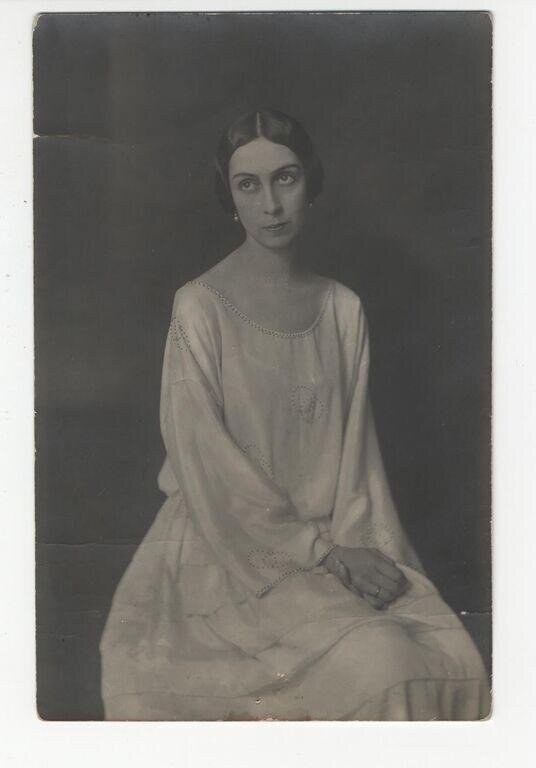
A portrait photograph of a young woman seated against a dark background, captured in three-quarter view. She wears a pale, high-waisted chemise or nightgown of fine linen with delicate drawn-thread embroidery detail around the neckline and down the front. The garment has long sleeves and falls loosely to her ankles. Her dark hair is parted in the centre and smoothed back from her face in the style of the 1920s. She sits upright with her hands folded in her lap, her gaze directed toward the camera with a composed, frontal presence. The photograph is printed on a card stock typical of professional studio portraiture of the period, with visible wear and a horizontal crease across the middle.
The dancing
The subject is a single figure in a seated, formal pose—upright posture, hands folded, head level and facing forward. There is no active movement or gesture; the body is still and composed. The placement suggests the photographer was accustomed to working with performers: the lighting is carefully managed to catch the planes of the face, and the pose allows full visibility of the garment's embroidered detail, which would have been important documentation if this was a costume or a professional photograph of a known dancer.
The dance depicted
This is a studio portrait photograph, not a depiction of dance in action. However, the sitter is identified in the catalogue record as Felia Doubrovska, who was a celebrated Russian prima ballerina of the 1920s and 1930s, known for roles in the Ballets Russes. The modest, elegant chemise or rehearsal dress she wears—far from theatrical costume—suggests this is a publicity or personal photograph rather than a performance record. Without visible dance notation or movement, the image documents the dancer as a person rather than as a performer in motion.
How it was made
This is a gelatin silver print or similar photographic process mounted on card stock, produced by a professional studio photographer identified as 'Albin of Monte Carlo.' The technique was standard for theatrical and society portraiture of the late 1920s and allowed for fine detail, particularly the embroidered edge-work on the garment. The soft focus and careful lighting are characteristic of studio portrait work intended for publicity, fan distribution, or press use. The mounting and wear pattern suggest this has circulated as a traded or archival print rather than remaining in studio hands.
About this work
This is a studio portrait photograph of the Russian ballerina Felia Doubrovska, dated 1928 and made by the Monte Carlo–based photographer Albin. It documents her not as a dancer in motion or in costume, but as a person—seated, composed, wearing a simple embroidered chemise. Doubrovska was one of the most celebrated soloists and character dancers of the Ballets Russes during the 1920s and 1930s, creating roles in works choreographed for her by Balanchine and Massine. This portrait belongs in the Gallery of Dance in Art not because it shows dancing, but because it is a primary-source record of one of the period's most influential dancers, captured during her years of greatest renown.
How to look at it
Look at the care taken in the composition: the sitter is positioned to show both face and the embroidered detail of the garment, suggesting this is documentation of costume or professional dress rather than casual portraiture. The pose is entirely conventional for the period—frontal, still, composed—yet Albin's lighting catches the structure of the face and the fine embroidery work. Note the absence of any prop or studio convention associated with dance (no pointe shoes, no tutu, no theatrical backcloth), which is the point: this is the dancer as a person, not as a performer.
The artist
Albin of Monte Carlo was a studio photographer active during the 1920s and 1930s, specializing in theatrical and society portraiture. The studio was based in Monte Carlo during the period when the Ballets Russes operated from the French Riviera, making Albin a de facto house photographer for the company. His portraits are characterized by controlled lighting, careful attention to costume and embroidery detail, and a formal aesthetic suited to publicity and archival use.
The period
In 1928, the Ballets Russes was in its most celebrated period, operating from Monte Carlo under Diaghilev's direction. Doubrovska was at the height of her career, having originated roles in Balanchine's neoclassical works and becoming known for her technical precision and dramatic presence. Portrait photography was the primary vehicle for theatrical publicity and the circulation of dancers' images to press, fans, and archives. This photograph dates to the era before the company was dispersed by Diaghilev's death in 1929 and captures a moment of institutional stability and cultural centrality.
Where it lives
The photograph is held in a collection identified only as 'va' in the catalogue record. It is a studio print on card stock, consistent with theatrical publicity material or archival holdings of the period.
Questions about this work
Was Felia Doubrovska a famous dancer?
Yes. She was a Russian prima ballerina and one of the Ballets Russes' most celebrated soloists during the 1920s and early 1930s. She originated roles in works choreographed by George Balanchine and Leonid Massine, and was known for her technical brilliance and dramatic intensity. She danced in many of the company's most famous productions and was a key figure in the transfer of classical Russian training to modernist ballet.
Why is she wearing such a plain dress in this photograph?
This is almost certainly a rehearsal dress, street dress, or personal photograph rather than a stage costume. Professional dancers' portraits were often made in simple, elegant garments that showed the body's line without theatrical spectacle. The fine embroidery detail suggests the dress was of quality, but the lack of decoration is deliberate—it presents the dancer as a person and professional rather than as a character in a narrative.
Who was Albin of Monte Carlo?
Albin was a professional portrait photographer based in Monte Carlo during the 1920s and 1930s, when the Ballets Russes operated from the French Riviera. He specialized in theatrical and society portraiture and was one of the main photographers documenting the dancers and personalities of the company during its most celebrated years.
More dance artwork





