49 works in this view — arrow keys or swipe to move between them.
Dance in Art
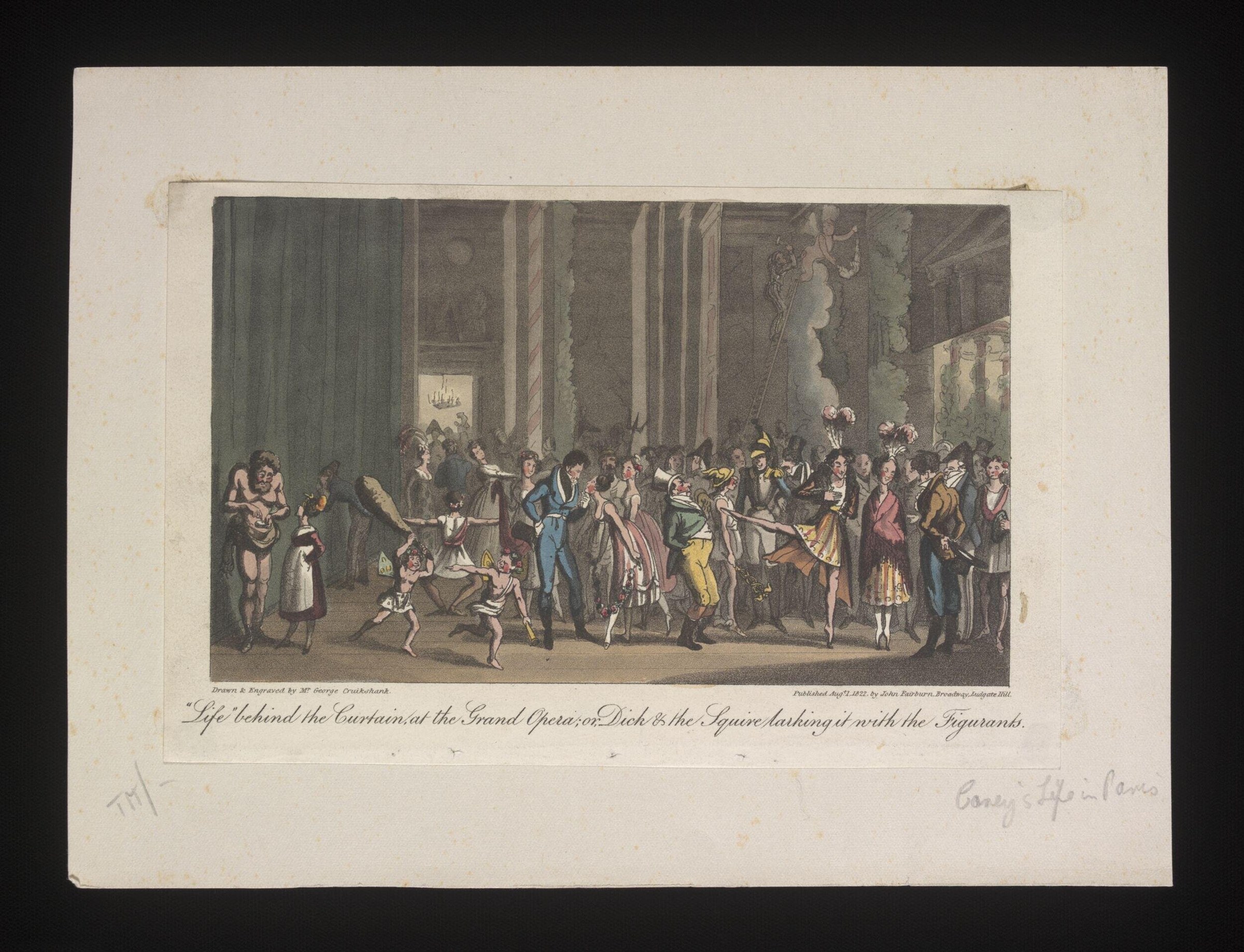
Life behind the Curtain at the Grand opera; or, Dick and the Squire larking it with the Figurants
Cruikshank, George
- Collection:
- Source:
- Victoria and Albert Museum
- Rights:
- Rights vary by item — check the source record before reusing this image. Source record ↗
- Recorded as:
- V&A — check rights per item
This print captures a specific moment in early 19th-century theater history when operatic performance and balletic spectacle were central to London's cultural life, and when satirical prints were a primary vehicle for public commentary on theatrical and social conventions. The image is valuable evidence of how the figurants (corps de ballet) were perceived, costumed, and positioned within opera productions, as well as how the boundaries between high art and popular buffoonery were negotiated on the Regency stage.
What you are looking at
A satirical theatrical scene set in a grand opera house interior, viewed from the stage looking toward the auditorium. The space is vast and columned, with heavy drapery and architectural grandeur rendered in muted greens and grays. Center stage, two near-naked male figures (labeled Dick and the Squire) perform exaggerated comic antics—one crouching in a grotesque posture, the other in an absurd contorted attitude—while a crowd of elegantly dressed opera-goers watches from around them. The crowd includes women in high-waisted Regency gowns, men in military dress and tailcoats, and young dancers or performers (the "figurants") in scanty classical costume interspersed among them. The figures are scattered informally across the stage floor rather than arranged in orderly formation, their postures ranging from distracted to amused. The hand-coloring emphasizes costume detail: pinks, blues, yellows in the clothing; pale flesh tones; the stage floor rendered in warm ochre. The overall tone is one of burlesque—dignified operatic pretense invaded by crude physical comedy.
The dancing
The two comic male figures occupy the visual center: one squats with legs splayed in an exaggerated stance, the other bends at an extreme angle, knees bent or legs crossed in ways that defy balletic grace. Both are rendered with exaggerated musculature and minimal clothing, emphasizing grotesquerie. Around them, the spectators stand or gesture in various attitudes of observation, some leaning inward, others maintaining formal distance. Several younger figures in the crowd appear to be dancers in classical dress (the "figurants"), identifiable by their scanty wrappings and lighter coloring, and they mingle with the clothed spectators. No unified ensemble movement is depicted; the bodies suggest individual reactions rather than coordinated performance.
The dance depicted
This is not a depiction of actual dance but rather satirical theater, specifically operatic farce or burlesque. The scene appears to reference the world of Italian opera seria and the corps de ballet (figurants), which were central to grand opera spectacle in the early 19th century. The two comic protagonists are crude physical comics playing against the refined setting and the presence of professional dancers. The "lark" (mischievous disruption) of Dick and the Squire among the serious world of opera suggests a commentary on social transgression—unmannered characters invading elite theatrical space. This is not a recognizable ballroom, social, or theatrical dance form but rather a scene of buffoonery set in an opera house.
How it was made
This is a hand-colored engraving or aquatint, executed with fine line-work for the architectural setting and figures and then colored selectively in translucent washes. The signature states "Drawn & Engraved by Mr. George Cruikshank," and the publication line reads "Published April 1822 by John Fairburn, Broadway, London." The technique is characteristic of early 19th-century English satirical prints—precise architectural and figural rendering combined with caricatural exaggeration of anatomy and gesture. The light hand-coloring suggests economical production: fully achieving the satire through line and composition, with color added afterward to enhance readable detail. This format—affordable, reproducible, widely distributed—was ideal for theatrical satire and political commentary aimed at urban audiences.
About this work
This is a satirical engraving by George Cruikshank depicting a scene of theatrical disruption at the Grand Opera House, published in 1822. The print documents a moment of burlesque comedy rather than legitimate dance, showing two crude comedians (Dick and the Squire) performing grotesque physical antics amid the refined world of opera singers, dancers (figurants), and fashionable spectators. The work is a commentary on class, propriety, and the social pretensions of high culture, rendered in the caustic visual language of early 19th-century English satirical prints. For dance historians, it documents the visual and social context of Regency-era theatrical performance—the mixing of elite balletic forms with popular comedy, the presence and appearance of professional corps de ballet, and the architecture within which these performers worked.
How to look at it
Note the precise architectural rendering of the opera house interior—the grand columns and drapery establish the elite setting before any figures are observed. Then examine the contrast: the dignified bystanders in fashionable dress are rendered with anatomical correctness, while Dick and the Squire are distorted into anatomically impossible postures, the exaggeration increasing their visual comedy. The figurants (professional dancers) are identifiable by their scanty classical costume and are spatially integrated with the crowd rather than separated as performers, suggesting a comment on their ambiguous social status. The composition freezes a moment of theatrical chaos—not a coordinated performance but a disruption—which is precisely the satire's point.
The artist
George Cruikshank (1792–1878) was the preeminent English satirical cartoonist and illustrator of his era, known for his extraordinarily prolific output and his sharp social and political commentary. He succeeded James Gillray as the leading caricaturist of Regency and early Victorian England. Cruikshank's work was distributed through print shops as affordable hand-colored engravings, reaching a broad urban audience. He was equally skilled at rendering architecture, crowd scenes, and the grotesque exaggeration of human anatomy, and he turned these skills toward theatrical, social, and political subjects throughout his long career.
The period
In 1822, when this print was published, Italian opera seria was at the height of its popularity in London, and the visual spectacle of opera—particularly the corps de ballet and elaborate stage machinery—was a central attraction. Regency society was intensely engaged with theater, and the social life of the opera house rivaled the performance itself as a subject of interest and satire. Cruikshank's print belongs to a rich tradition of satirical commentary on theatrical pretension; it also captures the particular visual codes of Regency dress, stagecraft, and architectural taste. The juxtaposition of refined operatic performers with crude comedy reflects both the actual variety of entertainment offered in the era and the satirist's skepticism toward claims of cultural refinement.
Where it lives
The print is held in the collection of the Victoria and Albert Museum (indicated by the source code "va" in the catalogue record). It is a hand-colored engraving from a series of theatrical satirical prints by Cruikshank distributed through commercial print shops in London.
Questions about this work
Who were the figurants, and why does this print single them out?
Figurants were members of the corps de ballet in opera productions—professional dancers who performed ensemble work and were essential to operatic spectacle. In this satirical print, they appear in their scanty classical costume (which was the theatrical norm) interspersed with clothed spectators, highlighting both their visibility as performers and their ambiguous social status. Cruikshank's satire may be commenting on the fact that figurants were both integral to opera's appeal and somewhat marginalized within its social hierarchy.
Is this a real scene or purely invented satire?
This is purely satirical fantasy. The comic disruption by Dick and the Squire—crude, naked, physically grotesque—never literally occurred at the opera house. However, the setting, the presence and appearance of figurants, and the costumes of the fashionable spectators are all rendered with documentary accuracy, anchoring the absurdity in the recognizable world of Regency opera to make the satire bite.
What is Cruikshank satirizing here?
The print satirizes the pretensions of high culture and the elite world of opera, suggesting that refined artistic claims mask a world of spectacle and social disorder. The intrusion of crude physical comedy (Dick and the Squire) into the grand operatic setting implies skepticism toward the cultural status of opera itself. The social mixing depicted—figurants in minimal dress alongside wealthy patrons in expensive clothing—may also be commenting on the sexual and social transgression implicit in the opera house as a space.
More dance artwork





