49 works in this view — arrow keys or swipe to move between them.
Dance in Art
Purse
Unknown artist
- Collection:
- Purse
- Source:
- Victoria and Albert Museum
- Rights:
- Rights vary by item — check the source record before reusing this image. Source record ↗
- Recorded as:
- V&A — check rights per item
Accessories like this one are rarely preserved or exhibited, yet they are essential material evidence of how dancers and ballgoers dressed and what they carried. The meticulous beadwork suggests an object of real cost and status, connecting economic value, gender, and social dancing in the 1870s.
What you are looking at
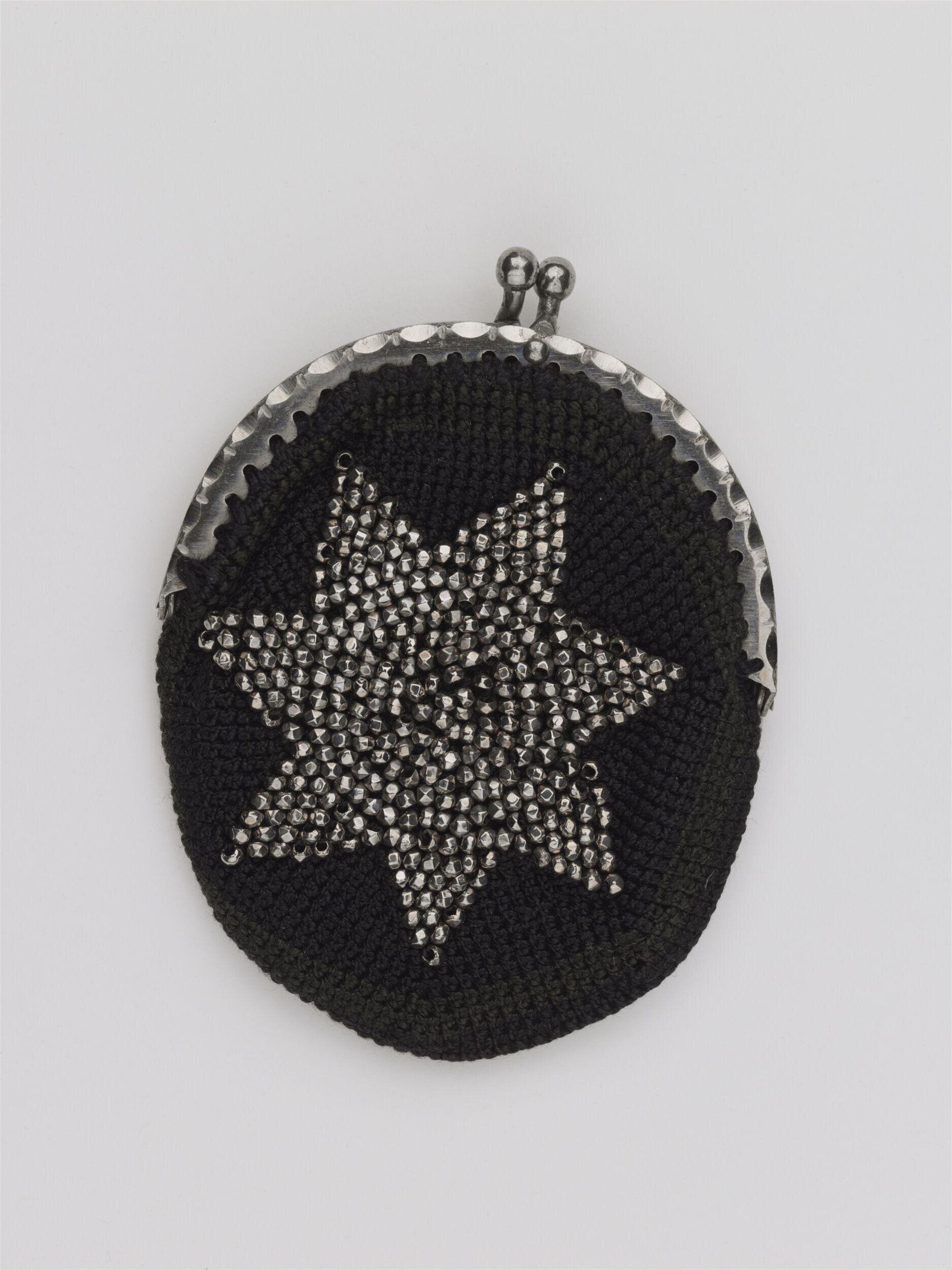
A black knitted purse or reticule with a metal frame and clasp, photographed against a neutral background. The body is a dense, finely worked black textile, possibly silk or wool, in an oval or rounded shape typical of small evening bags of the period. The frame is silver or silvered metal with a decorative scalloped or gadroon edge. A pair of spherical finials crowns the clasp mechanism. The principal ornament is a bold five-pointed star worked entirely in small faceted metal beads—likely cut steel or paste rhinestones—densely set across the front. The star dominates the composition, its geometric precision and glitter contrasting sharply with the matte black ground. The beadwork shows careful planning and execution; the beads catch light distinctly, suggesting the star would have been a striking focal point on a dancer's costume or evening dress.
The dancing
No figures or gesture are present. This is a decorative object, not a depiction of dance or dancers.
The dance depicted
The purse itself does not depict dance. However, the object is consistent with accessories worn at formal balls and social dances in the 1870s—the Gilded Age period when dancing was central to social ritual among the classes who could afford such elaborately embellished accessories. A dancer or guest at a formal evening event would have carried such a purse; its presence at a dance is likely but not depicted here.
How it was made
This is a knitted textile object with applied metalwork. The purse body is hand-knitted in a dense gauge, probably in silk or fine wool. The beaded star is appliqué: individual faceted beads have been sewn or set into the knit surface in a predetermined pattern, a labour-intensive technique requiring precision and skill. The metal frame is die-struck or cast and hand-finished, with applied finials. The whole represents mid-nineteenth-century luxury manufacture—items of this caliber were expensive and typically owned by affluent women.
About this work
This is a formal evening purse or reticule from the Gilded Age, approximately 1870. It is a functional luxury object: small, decorated with fastidious care, and designed to be carried at balls and social events. The star motif in cut steel or rhinestones suggests allegiance to a particular dance style, venue, or social group, though the exact significance is now obscure. Its inclusion in a dance archive implies recognition that dress and accessories are material traces of dance culture and social ritual. The purse embodies the intersection of textile craft, personal adornment, and the formal social world in which Gilded Age dancing took place.
How to look at it
Observe the precision and density of the beadwork: each bead is individually set and faceted, catching light from multiple angles. The star shape is regular and symmetrical—the artist-maker was working from a pattern. Look at the contrast between the matte black knit and the brilliant, faceted star; in gaslight or lamplight at a ball, this object would have glinted noticeably. The scalloped metal frame is finished with care; the spherical finials suggest this purse was meant to be noticed and appreciated as a handcrafted luxury item.
The artist
Unknown. The object was likely manufactured by a specialist purse-maker or accessories firm, possibly in collaboration with a beader or metalworker. Attribution to an individual artist is not customary for objects of this type.
The period
The 1870s were the height of Gilded Age wealth and formal social dancing in America. Waltz, polka, and quadrille dominated ballrooms; evening dress was formal and highly codified. Women's accessories were items of conspicuous consumption and display. The cut-steel or paste-rhinestone star, with its geometric precision and sparkle, exemplifies Victorian taste for dense, jewel-like ornamentation. Beadwork and metal-bead appliqué on textiles were fashionable and required significant skilled labor, making such items status markers.
Where it lives
Held in a collection identified only as "Purse" in the source record. The source is designated "va," which may indicate a Virginia institution, though the record provides no further information on acquisition, donor, or institutional context.
Questions about this work
Why is a purse in a dance archive?
Dance history includes the material culture of dancers and ballgoers—costume, accessories, and objects that shaped social dancing. A formal evening purse from 1870 is evidence of how women dressed for and participated in balls and dances. The object itself may have been carried by a dancer or ball attendee and is thus a trace of dance practice and social ritual.
What does the star on the purse mean?
The significance of the star motif is not documented in the archive record. It may have been decorative only, a symbol of a particular venue or dance organization, a mark of allegiance to a cause or group, or simply a fashionable design choice. Without further provenance, its meaning remains uncertain.
Who made this purse?
The maker is not recorded. Objects of this type were typically produced by specialized purse or accessories manufacturers, often in urban centers like New York or Boston. The beadwork may have been done by a separate artisan or workshop. Such items were manufactured for sale to wealthy women, not usually signed or attributed to an individual maker.
How much would this have cost?
In the 1870s, a hand-beaded purse with a silver frame was an expensive accessory, likely costing between $5 and $20 depending on materials and craftsmanship—equivalent to $150–$600 in modern currency. Such an object would have been a luxury purchase for a woman of means.
More dance artwork





