49 works in this view — arrow keys or swipe to move between them.
Dance in Art
Belphegor Quadrilles
Montgomery,
- Collection:
- Sheet Music
- Source:
- Victoria and Albert Museum
- Rights:
- Rights vary by item — check the source record before reusing this image. Source record ↗
- Recorded as:
- V&A — check rights per item
This image documents a specific moment when theatrical dance and ballroom social dance were deeply intertwined—dancers performed fashionable quadrilles on stage, and audiences then performed the same dances at home using published sheet music. It is a rare visual record of mid-Victorian theatrical dance costume and staging, showing how dance was presented and perceived in the era when the quadrille dominated fashionable society.
What you are looking at
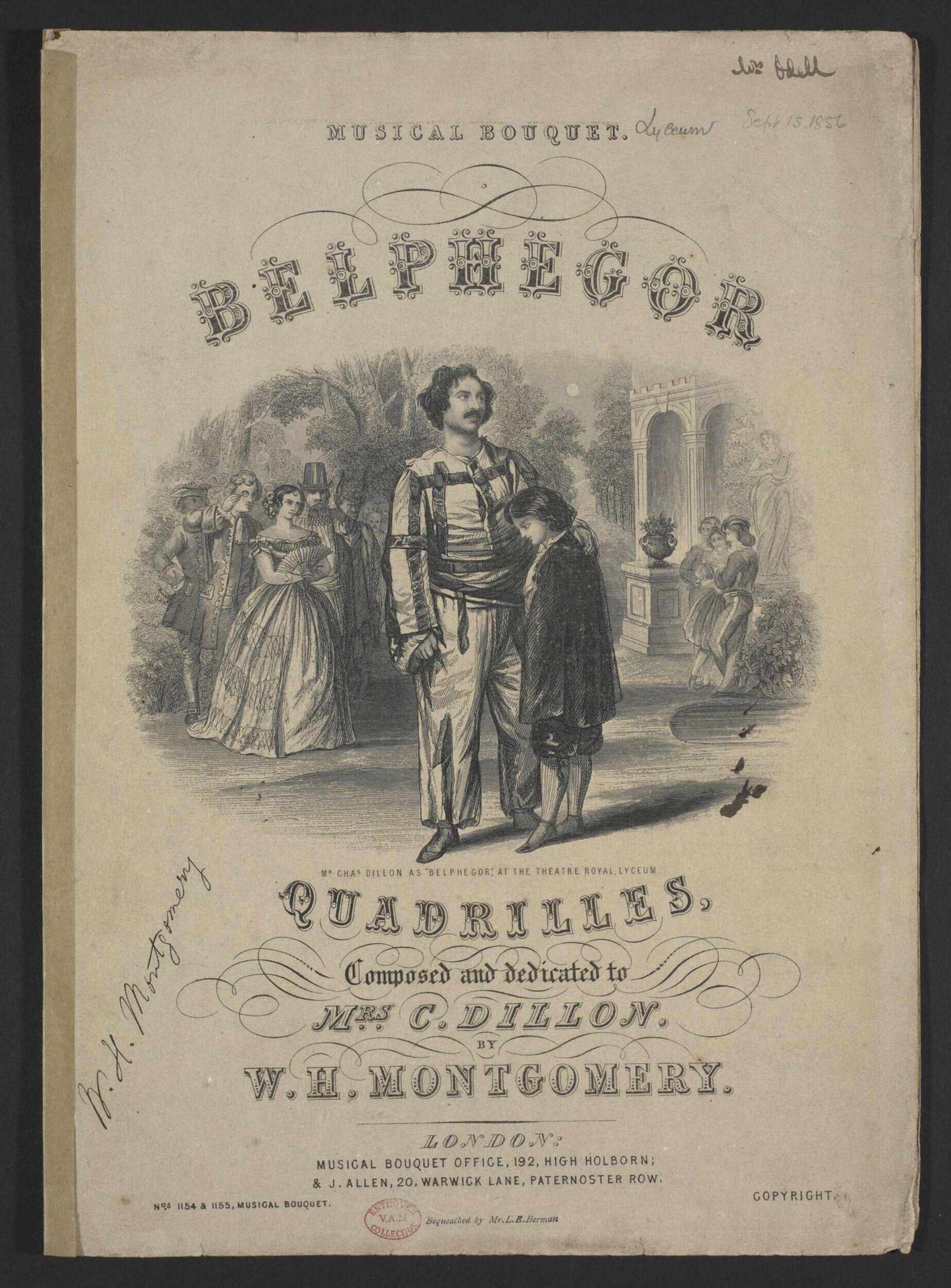
This is the title page of sheet music for a quadrille composition dedicated to Mrs. C. Dillon. The engraved design presents a theatrical scene set in what appears to be a classical interior with architectural elements—a columned arcade and decorative pedestal are visible on the right. A military or court figure in ornate dress uniform dominates the center foreground, his posture erect and formal. To his left stands a woman in an elaborate ball gown with a full skirt, characteristic of mid-nineteenth-century formal wear. Additional figures populate the background and middle distance—women in similar formal gowns and men in dark dress—suggesting a ballroom or grand social gathering. The scene is rendered in fine engraving with careful attention to the textures of fabric, the architectural setting, and the social hierarchy implied by spatial arrangement. A caption beneath the central figures identifies this as depicting "Mr Chas Dillon as 'Belphegor' at the Theatre Royal Lyceum," establishing this as a theatrical dance scene rather than a ballroom gathering.
The dancing
The central male figure (Mr. Dillon) stands in a stiff, upright military posture with one arm at his side and the other slightly raised; his body is presented frontally to the viewer in a formal stance rather than an active dance position. The woman beside him adopts a formal courtly posture, her arms positioned with restrained elegance and her full skirt arranged symmetrically. The background figures are arranged in loose groups suggesting social interaction and conversation rather than active dancing. The overall geometry of the composition is symmetrical and staged, with figures distributed across the picture plane in a manner that emphasizes spectacle and social order rather than dynamic movement or close partner connection.
The dance depicted
The quadrille was the dominant ballroom dance of the nineteenth century—a square dance for four couples executed in a series of distinct figures. This sheet music title page documents a theatrical variant, specifically music for a quadrille from the ballet or theatrical piece "Belphegor" as performed at the Theatre Royal Lyceum. The theatrical context and the ornate military dress suggest this was likely a grand choreographic spectacle incorporating social dances into a narrative work, rather than a recording of ballroom practice. The composition and formal arrangement of figures reflect the quadrille's emphasis on geometric pattern, social order, and the display of fashionable dress.
How it was made
This is a steel engraving, a technique that allowed for fine detail, wide circulation, and affordable mass production of sheet music covers in the mid-nineteenth century. The precision of the engraved lines and the subtle modeling through cross-hatching are characteristic of the medium's capabilities. The quality of the engraving and the elaborate decorative typography indicate this was a commercial publication of some standing, intended for middle-class domestic performance and the fashionable amateur musician. The title appears in decorative display type, and the publisher information at the base (Musical Bouquet Office, London; J. Allen, Warwick Lane) confirms this as a commercial print product.
About this work
This is a title page for a set of quadrille compositions associated with a theatrical production of "Belphegor" at London's Theatre Royal Lyceum. The quadrille was the quintessential ballroom dance of the nineteenth century—a structured social dance for four couples arranged in a square. This example is notable for documenting the intersection of theatrical spectacle and ballroom dance, showing how fashionable social dances were incorporated into large-scale dramatic productions. The engraving captures not the actual movement of the dance, but rather the theatrical presentation of dancers in costume, emphasizing the social display and hierarchical arrangement characteristic of Victorian-era ballroom culture.
The work is significant as a record of mid-nineteenth-century entertainment and the circulation of dance through print culture. Sheet music covers like this served multiple functions: they advertised theatrical performances, provided music for home performance, and documented fashionable dances and fashions for a broad audience. The careful engraving of the ballroom setting and the fashionable dress of the figures reflects the importance of visual spectacle and sartorial display in the quadrille's social function.
How to look at it
Observe the rigid, formal posture of the central figures—this is not dynamic movement but rather a posed, theatrical presentation. The symmetrical arrangement of figures, the careful rendering of architectural space, and the emphasis on costume detail reveal that the artist's concern was with spectacle and social order rather than kinetic energy. Notice how the female figure's elaborate skirt is given prominence, arranged to display the fashionable silhouette of the 1850s–1870s. The military dress of the male figure and the courtly setting suggest this is a theatrical interpretation of the quadrille rather than documentation of ballroom practice. The overall composition follows print-culture conventions for theatrical publicity: frontal presentation, symmetrical balance, and the integration of narrative text and figural image.
The artist
W. H. Montgomery was a composer of popular dances and theatrical music in mid-nineteenth-century London. The composition is dedicated to Mrs. C. Dillon, likely the wife or family member of the performer Charles Dillon, a prominent actor and theatrical figure of the period. Montgomery worked within the commercial music publishing industry, producing quadrilles and other social dances for both theatrical performance and domestic amateur musicians.
The period
The quadrille was at the height of its fashionable dominance in the 1850s–1870s, when it was performed in ballrooms across Europe and North America. Theatrical productions frequently incorporated quadrilles and other social dances into dramatic and ballet works, blurring the boundary between social dance and staged performance. In mid-Victorian theatre, choreographed dances served both as spectacle and as narrative or atmospheric devices. The detailed rendering of fashionable dress in this engraving reflects the centrality of fashion to the ballroom dance experience; attending a ball was as much about displaying fashionable clothing as about dancing itself. This print dates to the era when illustrated sheet music covers became a major medium for circulating dance knowledge and documenting theatrical performances.
Where it lives
This work is part of the collection of sheet music held by the source marked "va" (likely the University of Virginia or similar American institution). Sheet music covers like this were published as commercial products and circulated widely through music retailers and subscription services. The presence of publication information on the page (Musical Bouquet Office and J. Allen, both London addresses) indicates this was part of the extensive mid-Victorian sheet music publishing trade.
Dance in this work
Questions about this work
What is a quadrille?
A quadrille is a structured social ballroom dance for four couples (eight people total) arranged in a square formation. It consists of a series of distinct figures or movements, each danced to a specific section of music. Quadrilles were the dominant fashionable ballroom dance throughout the nineteenth century. This piece is a musical composition to accompany those choreographed figures.
Who was Charles Dillon and why is he depicted here?
Charles Dillon was a prominent Victorian actor who performed at the Theatre Royal Lyceum. This title page documents his performance as the character "Belphegor" in a theatrical production that incorporated a quadrille dance. The image serves as a record of both the theatrical production and the fashionable dress of the era.
Why does this look like a ballroom scene rather than a stage performance?
Victorian theatrical dance often imitated fashionable ballroom dance, and theatrical productions incorporated real quadrilles and other social dances into their narratives. The engraver has depicted the theatrical presentation of a ballroom setting on stage, complete with fashionable dress and architectural elements suggesting a grand interior.
What can we learn from this image about how the quadrille was performed?
The formal postures and the emphasis on symmetrical arrangement show that the quadrille prioritized geometric precision, clear social order, and the display of fashionable costume. The figures' restrained arm positions and upright carriage reflect the ballroom dance aesthetic of the era, which valued elegance and propriety over dynamic or virtuosic movement.
More dance artwork





