49 works in this view — arrow keys or swipe to move between them.
Dance in Art
Gipsy Quadrilles
Robert Cocks & Co
- Collection:
- Sheet music
- Source:
- Victoria and Albert Museum
- Rights:
- Rights vary by item — check the source record before reusing this image. Source record ↗
- Recorded as:
- V&A — check rights per item
This image is one of thousands of Victorian quadrille covers, yet it preserves specific evidence about who danced what, in what dress, and in what settings. The scene shows dancers as they understood themselves: not as performers executing a visible technique, but as fashionable participants in a social ritual. The Gypsy theme also documents nineteenth-century attitudes toward otherness and costume play in ballroom culture.
What you are looking at
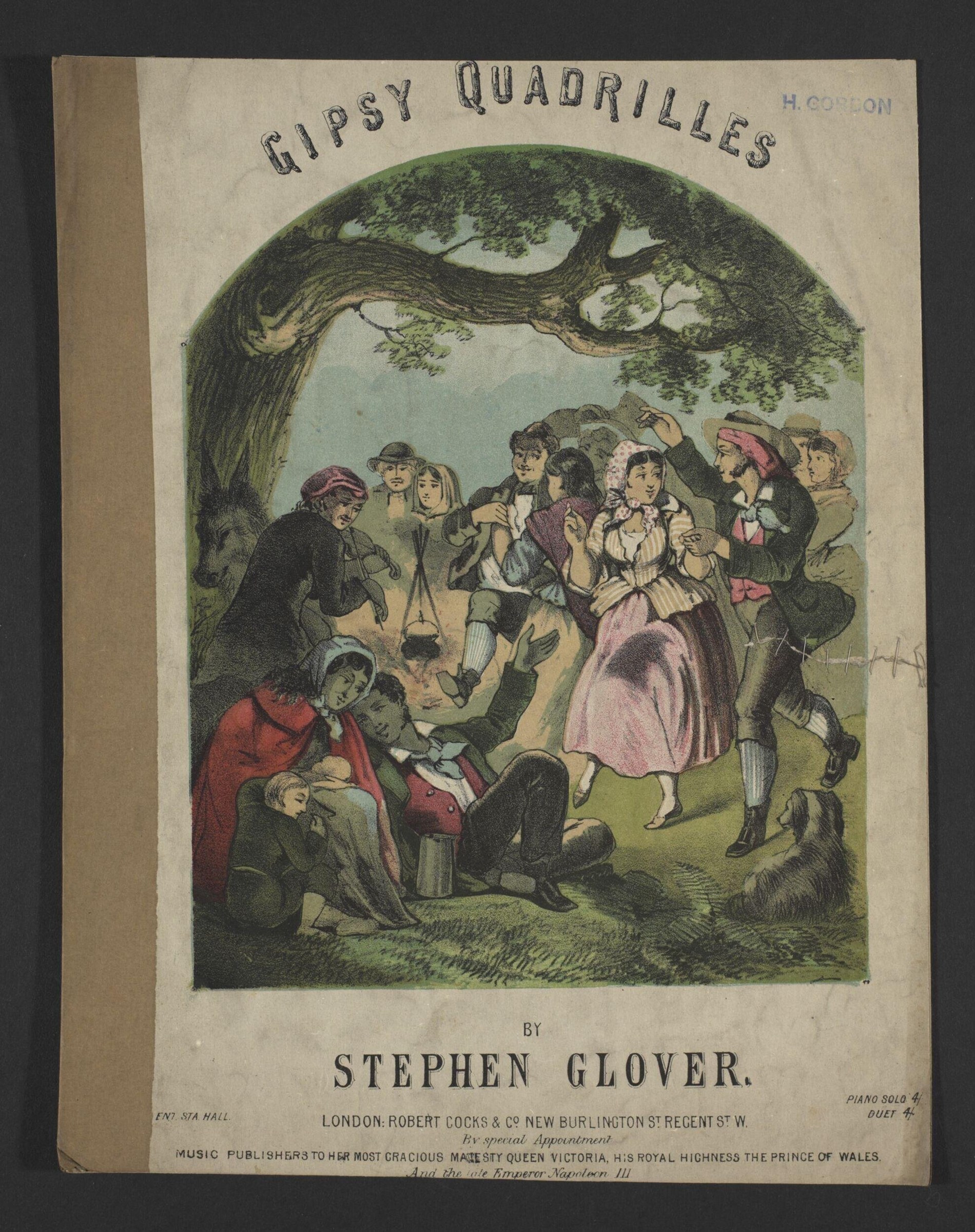
A hand-colored engraving showing a fashionable outdoor gathering beneath a large gnarled tree. The scene depicts approximately twelve figures in Victorian-era dress arranged in the informal groupings typical of social dance instruction or performance. At left, a woman in a red cloak bends toward two seated children; at center and right, standing figures in elaborate dress—women in pink and cream, men in dark jackets and hats—form loose clusters suggesting the moment before or during a dance figure. The ground is rendered in pale green with careful cross-hatching to suggest grass; the sky is pale blue. The tree's twisted trunk frames the entire scene from above, its heavy foliage creating a natural canopy. The engraving shows the careful hand-coloring typical of mid-Victorian sheet music covers, with colors applied in distinct, separate areas rather than blended.
The dancing
The figures stand and sit in the relaxed, upright postures of social dancing rather than theatrical performance. No couple is in closed ballroom hold; instead, individuals face outward or toward neighbors, some with arms at rest, others with gentle hand gestures. A child sits on the ground at lower left. The women wear full skirts suitable for twirling; the men wear tailored jackets. The composition suggests a moment of pause or social mingling between dance figures, with no single focal couple but rather a scattered group beginning or having just finished a coordinated movement.
The dance depicted
The title *Gipsy Quadrilles* and the publication as sheet music indicates this was a dance for social performance, likely a quadrille with "Gypsy" styling or theme—a nineteenth-century parlor dance type that often borrowed exotic costume or narrative elements. Quadrilles were set dances performed by four couples in formation, and the engraving shows the heterogeneous grouping typical of that format. The outdoor setting beneath a tree suggests either a picnic or garden party context, or a theatrical staging of rustic romance. The Gypsy theme was fashionable in mid-Victorian entertainment and often involved costume and character play rather than technically challenging footwork.
How it was made
This is a hand-colored wood or steel engraving, a standard format for mid-Victorian sheet music covers. The primary image was printed from an engraved plate, then individually colored by hand using watercolor or gouache—visible in the soft edges and slight variations in tone. This technique allowed cheap mass production of sheet music while maintaining aesthetic appeal for the middle-class market. The engraver's signature does not appear on the visible portion, but the publisher Robert Cocks & Co., a major London music house, is clearly credited. The technique and circulation model indicates this was a popular commercial work, not a limited or expensive art print.
About this work
This is the cover illustration for a quadrille choreographed to piano music and published by a major Victorian music house. It depicts the social context of mid-nineteenth-century ballroom dancing: a fashionable gathering of mixed couples in outdoor or garden-party dress, arranged in the loose groupings that would execute the set figures of a quadrille. The Gypsy theme signals the taste for exotic styling and picturesque costume that characterized Victorian social entertainment. As sheet music, this object documents not fine art but vernacular dance culture—the actual music and pictures that appeared in middle-class households and guided amateur dancers.
How to look at it
Notice the composition: no single dancing couple dominates. Instead, the figures are scattered in a social grouping, some seated, some standing, none in the closed embrace of ballroom dancing. This reflects how quadrilles were actually taught and danced—as a series of social positions and transitions, not continuous movement. The Gypsy costume (the red cloak at left) and outdoor setting beneath a tree signal that this is a styled, themed dance, not an ordinary ball. The engraver has chosen a moment of pause or transition, which is more typical of how instructional dance images worked: they show positions and figures, not the moment of greatest movement.
The artist
Robert Cocks & Co was a London music publisher active from the mid-nineteenth century, based in New Burlington Street, Regent Street. The firm published thousands of piano pieces, dances, songs, and instructional works for the Victorian amateur market. The engraver of this particular cover is not named on the visible portion of the print. Sheet music covers of this era often employed different engravers for different titles, and attribution is difficult without archival records.
The period
The quadrille was the dominant social dance in European ballrooms from the 1830s through the 1890s. It combined French elegance with a reproducible, teachable format that made it ideal for middle-class dancing masters and households. By the 1870s, when this cover was likely produced, the quadrille was already yielding to the waltz and polka in fashionable circles, but it remained standard at provincial balls and in instruction books. The Victorian taste for exotic themes—Gypsy, Spanish, Oriental—was reflected in quadrille titles and costume; these dances offered a safe, choreographed way to play with otherness and fantasy.
Where it lives
This is a sheet music cover from the Victor Adler collection at the Library of Congress. It belongs to the class of Victorian dance music—a vast archive of commercially published works for parlor and ballroom use. The collection contains thousands of similar covers, making individual copies relatively common despite their fragility.
Dance in this work
Questions about this work
What is a quadrille and how was it danced?
A quadrille is a set dance for four couples arranged in a square formation. Each couple took a position (top, bottom, right, left), and the music guided them through a series of coordinated figures—chassés, turns, circles, promenades. The entire dance lasted several minutes and required coordination but not the continuous movement of a waltz. It was the standard social dance for ballrooms across Europe and America from the 1830s to the 1890s.
Why is it called a Gypsy quadrille?
Victorian composers and publishers titled dances with exotic or narrative themes to appeal to middle-class audiences. A Gypsy quadrille would have featured Gypsy costume (as seen in the red cloak here), perhaps Gypsy-inflected musical motifs, and a rustic or picturesque setting. The theme was theatrical window-dressing to an otherwise conventional dance form; it did not require special footwork or technique.
Who danced quadrilles and where?
Quadrilles were danced at middle-class and aristocratic balls, at provincial assemblies, and in drawing rooms and dancing schools. They were taught by professional dancing masters and learned from instruction books and sheet music like this one. Both men and women danced; quadrilles required partners but were fundamentally social, not competitive or spectatorial.
What does the engraving tell us about how the dance was understood?
The casual grouping, the absence of extended arms or dramatic gesture, and the mix of seated and standing figures suggest that quadrilles were seen as social coordination rather than physical expression. The dancers are upright and composed, not in mid-movement. This reflects the Victorian ideal of ballroom dancing as a display of refinement and proper form.
More dance artwork





