49 works in this view — arrow keys or swipe to move between them.
Dance in Art
The Tyne and Wear Quadrilles
Ions, T
- Collection:
- Sheet Music
- Source:
- Victoria and Albert Museum
- Rights:
- Rights vary by item — check the source record before reusing this image. Source record ↗
- Recorded as:
- V&A — check rights per item
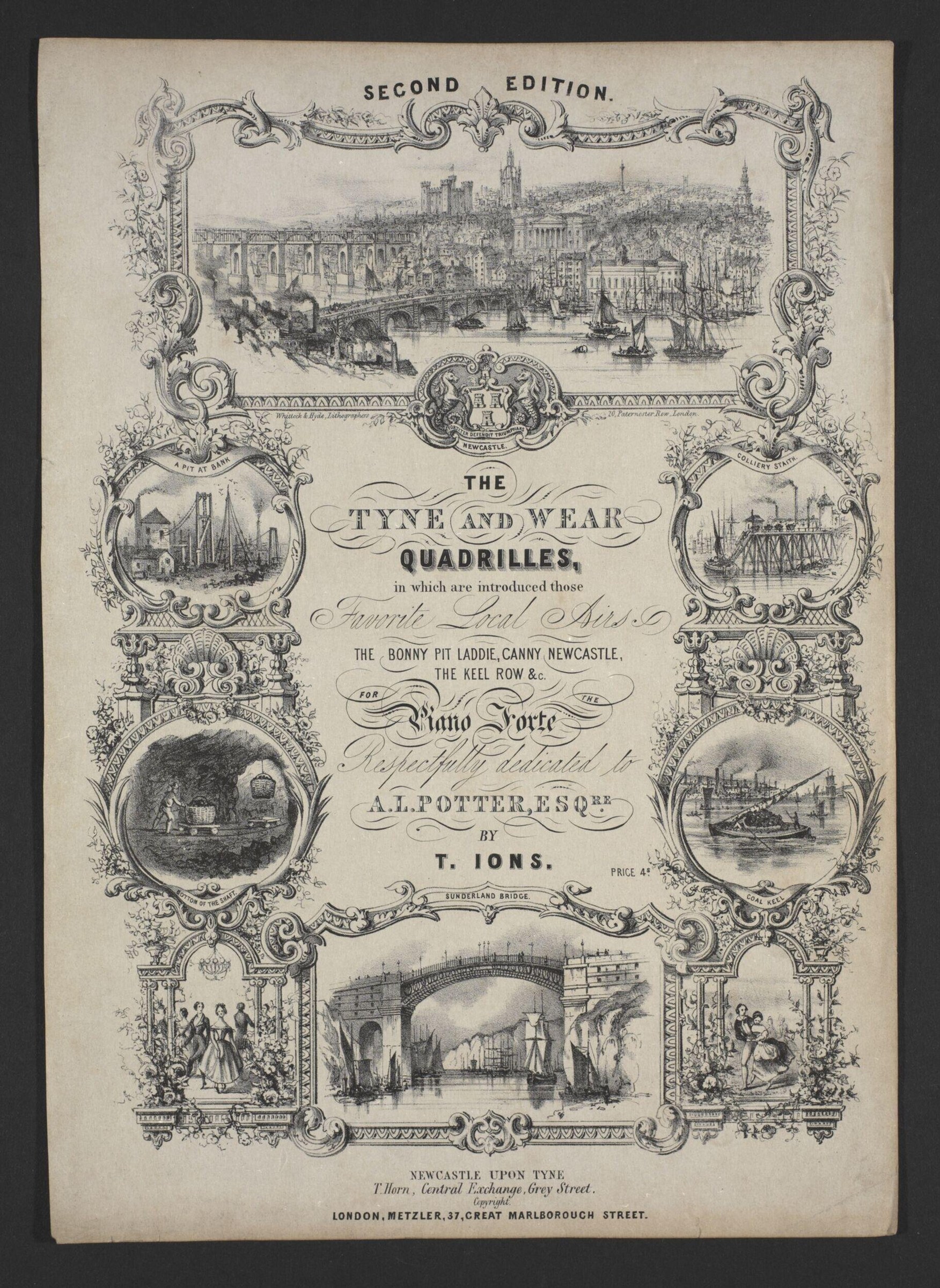
This object is crucial evidence for understanding how quadrilles circulated in the 19th century: not just as a dance performed at balls, but as printed commodities purchased by amateur musicians and sold regionally. It shows that quadrille composition was a living commercial practice tied to local identity and working-class culture ('Bonny Pit Laddie'), not merely an aristocratic drawing-room convention. For historians of ballroom dance, print culture, and regional music traditions, this is primary documentation of how a dance became a text.
What you are looking at
This is the decorative title page of a printed music collection, likely a mid-19th-century publication. The composition is framed by an ornate border of scrollwork, floral cartouches, and classical urns in the Victorian engraving style. At the top, a large landscape vignette shows Newcastle upon Tyne's skyline with the Tyne Bridge, the cathedral spires, and riverfront activity. Below this are four rectangular panels: the left side shows two regional river and architectural views (one featuring a Bonny Pit Laddie scene, the other a Canny Newcastle setting); the right side mirrors this with two different regional scenes. At the bottom center is a grand engraving of the Sunderland Bridge spanning the river with industrial and maritime activity. The entire composition surrounds the centered title text announcing a collection of quadrilles for piano forte, respectfully dedicated to a local pottery business. The work advertises regional dances and local pride in Northeast England industrial and commercial life.
The dancing
The only human figures visible are small, distant silhouettes in the vignettes—passengers in boats, workers at industrial sites, and crowds in urban scenes. No dance figures are depicted, no bodies in ballroom dress, no visible postures or holds that would indicate couples in the act of dancing. The work is entirely architectural and landscape in focus.
The dance depicted
Though titled 'The Tyne and Wear Quadrilles,' this is a title page and prospectus for a printed music collection, not a depiction of quadrille dancing itself. Quadrilles were a standard social ballroom dance of the mid-19th century, typically performed by four couples in a square formation with five distinct figures. This publication documents regional quadrille compositions associated with Northeast England locations and characters—'The Bonny Pit Laddie' and 'Canny Newcastle' reference working-class and local culture—suggesting these were country-house or assembly-room dances composed for regional subscribers. The image tells us nothing about how the dances were performed, only that they were a commercial music product tied to local identity and industry.
How it was made
This is a steel or wood engraving, a relief printing technique that allowed fine detail and widespread circulation through multiple impressions. The intricate linework, crosshatching for shadow, and delicate ornamentation of the border are characteristic of Victorian commercial music publishing. The 'Second Edition' note indicates this was a commercially successful product reprinted for sale. The technique allowed for the combination of ornamental typography, landscape vignettes, and promotional imagery in a single coherent design—common practice for mid-19th-century quadrille and dance music covers aimed at middle-class piano students and drawing-room musicians.
About this work
This is a title page and advertisement for a printed collection of quadrille compositions set to piano, published in London by Metzler and associated with Newcastle and the Tyne and Wear region of Northeast England. It documents an important strand of 19th-century dance culture: the commercialization of regional quadrilles as printed music for domestic and local performance. Though no dancers are depicted, the work is an artifact of quadrille practice and consumption—evidence of how a formal ballroom dance was domesticated, published, and marketed to regional audiences. The elaborate frame and regional imagery suggest these were not generic ballroom pieces but compositions with local character and commercial appeal to regional pride and identity.
How to look at it
Attend to the ornamental frame: the delicate scroll work and floral cartouches signal the prestige and commercial ambition of the product—this is music for respectable drawing rooms. The landscape vignettes are not decorative accident but marketing: the Tyne Bridge, industrial scenes, and local character names ('Bonny Pit Laddie') anchor the abstract social dance (the quadrille) to a specific region and working identity. The symmetrical layout and centered title page announce this as a professional publication, not manuscript. The scale of the engraving and the quality of detail suggest this was an object of some price and value—owning and playing these quadrilles was a mark of musical and social competence.
The artist
T. Ions is credited as composer; beyond this attribution in the record, little is known of them. The publisher is Metzler of Great Marlborough Street, London, a significant Victorian music publisher. The engraver is not identified but was likely a London commercial shop producing dance music and theatrical prints in the mid-19th century. The ornamental style and quality of the engraving are consistent with Metzler's prestige publications.
The period
The quadrille dominated English ballroom culture from approximately 1815 to 1880, spreading from France as a fashionable square dance for four couples. Mid-19th-century quadrilles became increasingly commercialized, published in vast numbers as piano reductions for domestic performance by young women and amateur musicians. Regional and character-themed quadrilles ('The Bonny Pit Laddie,' referencing coal mining) represent a democratization of the form—ballroom dances were no longer exclusive to aristocratic balls but were consumed as domestic music, often with local or narrative flavor. The Newcastle and industrial Tyne and Wear setting reflects the 19th-century rise of the prosperous industrial middle class as consumers of printed music and leisure culture. This object dates from approximately 1840s–1860s based on printing style and the 'Second Edition' note.
Where it lives
This object is held as sheet music in a collection; the record does not specify which archive holds it. The publisher information (Metzler, 57 Great Marlborough Street, London) and the 'Second Edition' note are printed on the page. The notation 'Source: va' in the record is unclear but may indicate an institutional holding in an archive with the initials 'VA.'
Questions about this work
What is a quadrille and why is this a title page rather than a dance image?
A quadrille is a formal square ballroom dance for four couples, hugely popular in the 19th century. This work is not a picture of dancers but a commercial music publication—the composer and publisher are advertising their product through the printed page. Quadrilles were consumed as printed piano music for home performance, so the title page and score were the primary documents of the dance, not images of people dancing.
Why are there regional place names and industrial scenes on a dance music cover?
This reflects the commercial strategy of Victorian dance music publishing: regional and character-themed quadrilles appealed to local pride and identity. By associating the piece with Newcastle and the Tyne (and local figures like the 'Bonny Pit Laddie'), the publisher made the abstract ballroom dance feel local and accessible to regional middle-class consumers. It also suggests that working-class and industrial culture had become subjects of commercial ballroom music.
How do we know this is a quadrille if no dancers are shown?
The title announces it plainly: 'The Tyne and Wear Quadrilles.' Historians identify quadrilles from the titles of printed music collections, the musical structure of the score, and the context of mid-19th-century ballroom culture. The visual absence of dancers is typical of music publishing from this period; the dance itself is represented by notation and text, not by depiction.
More dance artwork





