49 works in this view — arrow keys or swipe to move between them.
Dance in Art
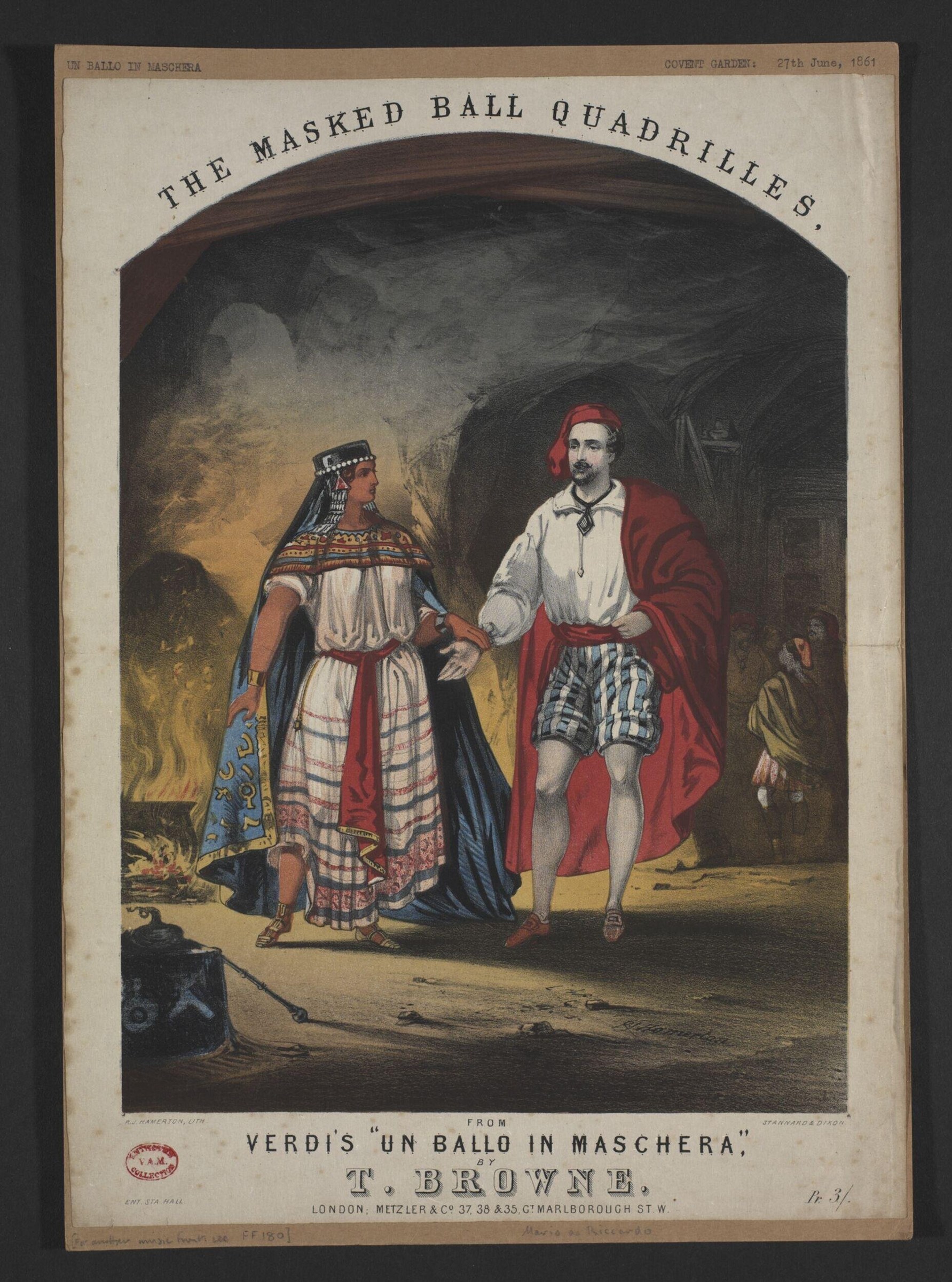
<i>The Masked Ball Quadrilles</i>
Metzler & Co.
- Collection:
- Sheet music
- Source:
- Victoria and Albert Museum
- Rights:
- Rights vary by item — check the source record before reusing this image. Source record ↗
- Recorded as:
- V&A — check rights per item
This is one of thousands of operatic quadrille arrangements published in the 19th century, yet it is almost never visible in dance history—neither in opera scholarship nor in ballroom dance history. The cover art shows us that quadrilles were not abstract social forms but narratively and theatrically inflected: dancers were expected to know the opera and to feel themselves enacting its dramatic moments. Understanding what Victorian ballroom dancers actually danced requires looking at objects like this.
What you are looking at
A theatrical scene set within a vaulted stone chamber lit by firelight. Two figures dominate the foreground: a woman in ornate dress with embroidered jacket, white pleated skirt with decorative borders, and an elaborate headdress with long trailing veil, stands facing a man in a red cloak over white shirt and checkered breeches, his head crowned with a red cap. The man extends his hand toward the woman in a gesture of invitation or courtship. Behind them, other figures in period costume are dimly visible in the shadow. The warm glow of flames on the left side of the composition casts dramatic light across the stone architecture, creating an atmosphere of masquerade and festive occasion. The image appears to be the cover or promotional material for a theatrical production based on Verdi's opera.
The dancing
The two principal figures stand in an upright, formal posture characteristic of 19th-century ballroom etiquette. The man's extended hand and slight forward inclination suggest the opening gesture of a quadrille invitation—a formal, codified moment in the dance. The woman's stance is poised and receptive, her body angled to face her partner. Both figures are depicted with the idealized proportions and dignified bearing typical of theatrical dance imagery of the 1860s. The secondary figures visible in the background are too indistinct to read their specific positions.
The dance depicted
This is sheet music for 'The Masked Ball Quadrilles,' based on Verdi's opera *Un ballo in maschera* (A Masked Ball), arranged by T. Browne and published by Metzler & Co. in London in 1861. The quadrille was the dominant ballroom dance of the mid-19th century—a suite of five figures danced by four couples in a square formation. The scene captures the opera's masked ball setting and translates it into the social dance that would have been performed at Victorian balls. The publication of operatic quadrilles was standard practice: successful operas were immediately adapted into dance music for public and private ballrooms, making the operatic narrative kinetic and participatory for amateur dancers.
How it was made
This is a hand-colored engraving or lithograph, a medium that allowed for theatrical imagery with expressive coloring to be reproduced and circulated to a broad audience. The techniques of color lithography, which came into use in the 1830s-1860s, allowed printers to render the dramatic lighting effects—the warm firelight, the deep shadows of the stone vault—with considerable subtlety. The process required multiple stone plates, one for each color. This method of production positioned the work as affordable sheet music cover art for middle-class drawing rooms, not fine art for galleries; the theatrical imagery helped sell the music to aspiring ballroom dancers.
About this work
This is a piece of popular music ephemera: the cover of a quadrille dance arrangement adapted from Verdi's 1859 opera *Un ballo in maschera*. It documents the rapid and systematic transfer of operatic material into ballroom dance repertoire in the 19th century. The theatrical staging, elaborate costume, and dramatic lighting evoke the opera's masked-ball scene while the title and musical content made the piece practical for amateur dancers in Victorian drawing rooms. Sheet music covers of this kind were among the most widely distributed images of dance in the era, seen and handled by thousands of music-playing households.
The work sits at the intersection of theatrical and social dance, operatic culture and domestic music-making, and commercial dance music publishing. It is both a document of how dance moved between genres and a window into how Victorian society consumed and participated in dance.
How to look at it
Notice the precise moment the artist chose: not a moment of vigorous dance movement, but the formal invitation before the dance begins—the extended hand, the upright postures, the expectant pause. This was a standard convention of ballroom dance imagery, emphasizing courtesy, form, and anticipation rather than kinetic energy. The theatrical setting (the vaulted chamber, the firelight, the costume) signals that this is not a realistic ballroom but an operatic scene; viewers of the sheet music were expected to recognize both the opera and the social dance convention being represented. The other figures in shadow suggest the collective, social nature of the quadrille, which was never a solo or duo form but always embedded in the geometry of four couples.
The artist
Metzler & Co. was a London music publisher and instrument maker active from the 1840s onward. The firm published and distributed thousands of ballroom and theatrical dance arrangements, making it one of the engines of Victorian dance culture. The cover engraving credits "T. Browne" as the arranger of the quadrilles, but the artist who created the engraved image is not identified on the cover and is not recorded in the catalogue. The engraver was likely a staff artist working in the Metzler house style.
The period
*Un ballo in maschera* premiered at the Teatro Apollo in Rome in 1859 to immediate success across Europe. By 1861, when this quadrille was published, the opera had become a fixture of concert halls and opera houses, and operatic dance arrangements were already a standard product. The quadrille itself was at the height of its popularity as a ballroom form in the 1850s-1870s, especially in England. Operatic quadrilles allowed middle-class dancers to access and perform operatic content in their own homes, converting the passive consumption of opera into active musical and kinesthetic participation. The masked-ball setting of the opera made it particularly apt for quadrille treatment: masked balls were actual social events in the period, and the operatic narrative could be imaginatively layered onto the ballroom experience.
Where it lives
The work is sheet music—specifically, a song or dance music cover—held in a collection focused on performing arts. The catalogue record identifies it only as held in a source labeled "va," likely indicating a Virginia collection, though no institution is named. Metzler & Co. was a major London publisher, and copies of their publications circulated widely in Britain and America.
Dance in this work
Questions about this work
What is a quadrille and how does it relate to this image?
A quadrille is a ballroom dance for four couples arranged in a square. It consists of five distinct figures (sections) danced in sequence, each with its own music and steps. The quadrille was the most fashionable and widely performed ballroom dance of the 19th century. Publishers issued thousands of quadrille arrangements based on popular operas, songs, and instrumental pieces, allowing amateur dancers to perform them in drawing rooms and at dances.
Who would have danced to this music?
The sheet music was intended for middle-class and upper-middle-class households where music-making was a standard part of domestic and social life. The quadrille was danced at public balls, private parties, and in homes by amateur dancers of mixed skill levels. The cover art suggests that performers and audience members would recognize the operatic reference and would understand themselves as enacting the opera's masked-ball scene while performing the familiar quadrille figures.
Why did opera get turned into ballroom dances?
Operatic quadrilles and other ballroom arrangements allowed theaters, publishers, and the music industry to capitalize on a successful opera, while giving amateur dancers and middle-class music enthusiasts a way to participate in and claim operatic culture. Publishing operatic quadrilles was a profitable business; each successful opera could generate dozens of dance arrangements. It also meant that the narrative and music of the opera permeated social life and domestic entertainment, extending the opera's cultural presence far beyond the theater.
What does the theatrical costume tell us about how this was danced?
The elaborate costumes shown here were operatic—the kind of dress seen on the opera stage. Amateur ballroom dancers would not have worn such costumes. Rather, the cover art evokes the dramatic and narrative dimension of the opera, inviting dancers to imagine themselves in the operatic scene while performing the actual ballroom steps. The costume emphasizes that this is a theatrical quadrille, not merely a mechanical dance form.
More dance artwork





