49 works in this view — arrow keys or swipe to move between them.
Dance in Art
The Perfect Cure Quadrilles
Brown, F. H.
- Collection:
- Sheet Music
- Source:
- Victoria and Albert Museum
- Rights:
- Rights vary by item — check the source record before reusing this image. Source record ↗
- Recorded as:
- V&A — check rights per item
This work documents the commercial publishing infrastructure that supported social dancing in the Victorian era, showing how music and image were combined to market dance to the middle-class home and public ballroom. The figure on the cover, though not a realistic dancer, reveals the theatrical and entertainment dimensions of 19th-century dance culture, where fashionable ballroom dancing overlapped with popular theatrical performance.
What you are looking at
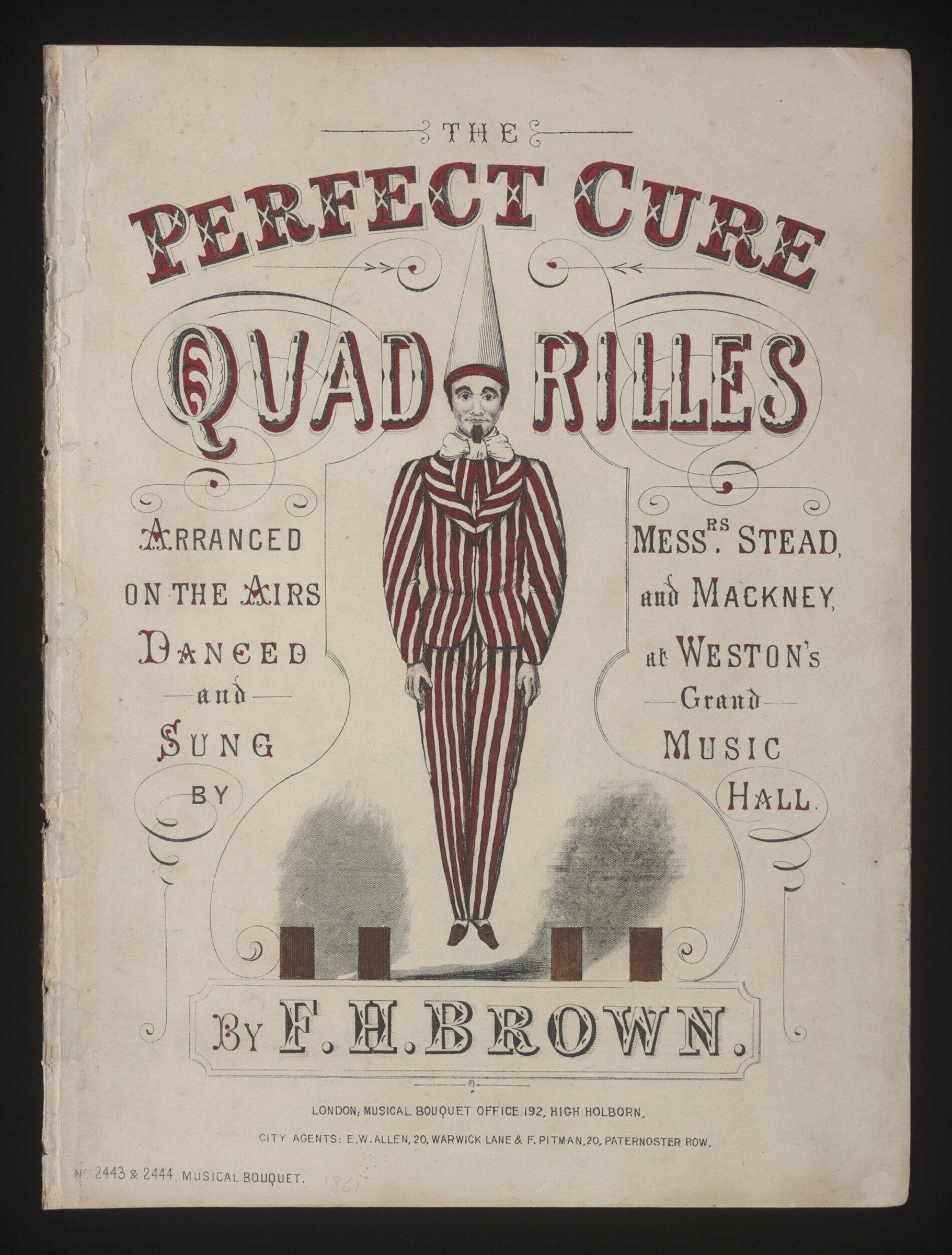
This is the cover of a piece of sheet music titled "The Perfect Cure Quadrilles," printed by the Musical Bouquet Office in London. The composition is dominated by a tall, narrow figure at center wearing a striking costume: a long, vertically-striped coat in burgundy and cream, with a tall pointed hat and a pale face marked with a thin mustache and goatee. The figure stands in an elongated, almost tapered silhouette against a plain cream ground. Decorative typographic flourishes frame the title on either side. At the base of the figure, two small shadowed forms suggest feet or a stage platform. The entire design is rendered in burgundy and black on cream paper, characteristic of mid-to-late 19th-century printed sheet music covers. The figure's exaggerated proportions and theatrical costume suggest this is a personified character or comic type—possibly a harlequin or pantomime figure—associated with the music rather than a naturalistic representation of an actual dancer.
The dancing
A single elongated human figure occupies the composition, standing in a frontal pose with no visible arm gesture or dynamic movement. The body is rendered as an extremely attenuated vertical form, almost columnar, with no indication of weight distribution, depth of field, or spatial positioning. There is no visible hold, frame, or footwork; the figure is essentially a costume display rather than a representation of a dancing body in motion. The proportions are cartoonish and deliberately distorted, flattening rather than articulating the anatomy of dance.
The dance depicted
Quadrilles were essential social dances of the 19th century—group dances typically performed by four couples in a square formation, often danced to sprightly music arranged in distinct figures or sections. This cover advertises "Perfect Cure Quadrilles," noting the music was "arranged on the airs danced and sung." The piece promises quadrille arrangements set to existing tunes, a common commercial format for Victorian dance music. However, the cover image does not depict actual quadrille dancers or formation. Instead, it presents a symbolic or comedic figure—possibly a character from pantomime or popular theatrical entertainment—suggesting the music may have been marketed with theatrical or entertainment associations rather than as a serious ballroom dance instruction work. The specific dance itself cannot be identified from the costume alone.
How it was made
This is printed sheet music, likely a lithograph or engraving on paper, from the Musical Bouquet Office imprint in London (address: 192 High Holborn). The standardized typography, decorative flourishes, and the use of burgundy and black inks on cream stock are characteristic of commercial music publishing in the mid-Victorian era. The technique of lithographic or engraved printing allowed rapid production and distribution of affordable sheet music to a broad domestic and commercial market. The cover design—using a memorable, eye-catching illustration—served as marketing for the individual piece, competing for attention on music sellers' shelves. Sheet music covers of this type were ubiquitous in Victorian parlors and dance halls.
About this work
This is the cover of a published quadrille set from the Victorian era, when quadrilles dominated fashionable ballroom dancing in Britain and Europe. Quadrilles were choreographed group dances—typically four couples arranged in a square—that filled evenings of social dancing and were a staple of entertainment. This particular piece, "The Perfect Cure Quadrilles," was commercial music: arrangements of familiar melodies composed for ballroom quadrille figures, printed by a London publisher and distributed to amateur musicians and dancers through retail and mail order. The striking cover illustration, featuring a tall theatrical figure in striped costume and a pointed hat, does not depict the quadrille itself but rather uses a memorable character image—possibly referencing pantomime or comic entertainment—to attract buyers. Such covers were a form of visual advertising in the competitive market for recreational dance music.
How to look at it
This cover should be read as an artifact of commercial design and publishing rather than a direct representation of the dance itself. Notice how the figure is rendered as a static, almost heraldic shape—not captured in motion, not demonstrating any step or hold. The designer has chosen a bold, eye-catching image that would stand out on a crowded shelf of sheet music. The costume is the sole information provided: the striped suit, the tall hat, the goatee—all signals of a specific character or theatrical type meant to intrigue the buyer. The design exemplifies Victorian commercial practice: memorable image rather than instructional clarity.
The artist
The artist is credited as F. H. Brown. The Musical Bouquet Office (192 High Holborn, London) was a commercial music publisher, and the cover artists for such publications were typically in-house designers or freelance illustrators producing eye-catching designs to compete in a crowded market. The name and practice of F. H. Brown are not otherwise documented in standard dance or art history sources.
The period
The quadrille dominated fashionable ballroom dancing from the 1830s through the end of the 19th century. It was the defining group dance of the Victorian era, taught in dancing schools, performed at public balls, and central to the social ritual of courtship and social display. Commercial publishers produced thousands of quadrille arrangements, typically setting familiar melodies (patriotic songs, operatic tunes, popular airs) to standard quadrille figures so that amateur musicians could accompany the dance in private homes and small public events. Sheet music covers used illustration and typography to create brand identity and appeal to consumers. The striped, theatrical costume on this cover may reference the visual language of mid-Victorian pantomime or music-hall entertainment, suggesting the lighter, more comedic side of entertainment dancing.
Where it lives
This sheet music was published by the Musical Bouquet Office, a London commercial music publisher located at 192 High Holborn, with city agents listed at E. W. Allen, Warwick Lane and F. Pitman, Paternoster Row. The Musical Bouquet was a major supplier of affordable sheet music to amateur musicians and dancers throughout the latter 19th century. The catalogue number visible at the base (2443 & 2444) is a standard publisher's mark for tracking inventory and editions.
Dance in this work
Questions about this work
What is a quadrille?
A quadrille is a social ballroom dance for four couples (eight dancers) arranged in a square formation. It was the dominant group dance of the 19th century, structured in distinct figures with specific steps and turns, typically lasting three to five minutes per set. Dancers moved through a planned sequence of formations while musicians played in sections that matched each figure. Quadrilles were taught in dancing schools, danced at public balls and private parties, and were essential to courtship and social display.
Who was F. H. Brown?
F. H. Brown is credited as the artist on this cover, but little is documented about their life or broader practice. They were likely a freelance illustrator or in-house designer working for the Musical Bouquet Office in the mid-to-late 19th century, producing commercial covers intended to attract buyers in a competitive sheet music market.
Does the figure on the cover represent a specific character?
The striped costume, tall pointed hat, and theatrical styling suggest a figure from pantomime or popular entertainment—possibly a harlequin or comic character. However, the image alone does not identify the specific reference. The cover uses this distinctive visual to appeal to buyers rather than to instruct dancers in the actual quadrille figures.
Why did Victorian sheet music have illustrated covers?
Illustrated covers served as advertisement and brand identity in a crowded market. A memorable image would catch the eye of a potential buyer browsing a music seller's shelves. The covers often referenced current fashions, entertainments, and theatrical trends, making the music appealing beyond its musical or dance value.
More dance artwork





