49 works in this view — arrow keys or swipe to move between them.
Dance in Art
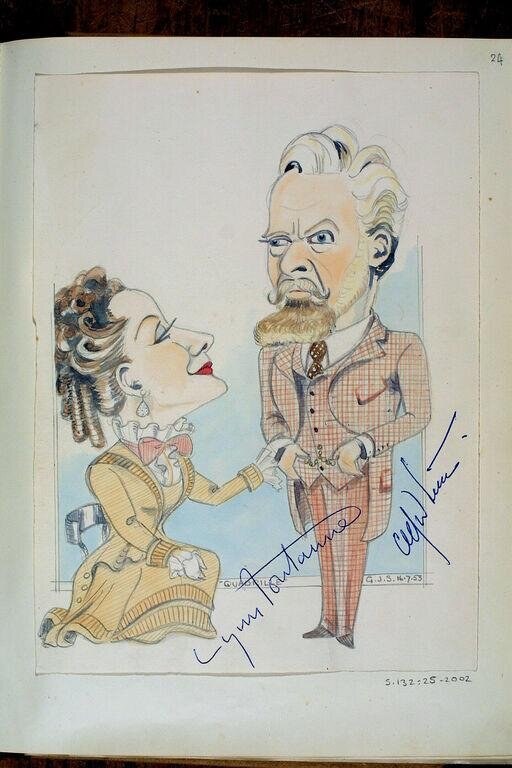
Lynn Fontanne and Alfred Lunt in <i>Quadrille</i>
Sommerlad, Gilbert
- Collection:
- Caricature
- Source:
- Victoria and Albert Museum
- Rights:
- Rights vary by item — check the source record before reusing this image. Source record ↗
- Recorded as:
- V&A — check rights per item
While the work does not depict active dance, it documents a major theatrical production featuring two celebrated performers of the mid-20th century and provides visual evidence of the costumes, character types, and aesthetic choices of that production. For theatre historians and those studying the performance history of *Quadrille*, this caricature is a primary visual source.
What you are looking at
A caricature in watercolour and ink depicting two theatrical performers in exaggerated profile. On the left, a woman in an elaborate golden costume kneels or sits with her body angled toward the male figure on the right. She wears an ornate dress with detailed patterning, has styled hair with curls pinned up, and her face is painted with dramatic makeup including red lips and defined eyes. She holds what appears to be a stringed instrument (a lute or similar) across her lap. On the right stands a man in a checked jacket over a patterned vest, rendered with angular, sharp features and a stern expression. His hair is swept back in waves. Both figures are highly stylized, with elongated proportions typical of theatrical caricature. The composition places them against a plain background with a subtle blue wash, drawing attention entirely to the exaggerated character portrayal. The artist has signed the work in the lower left, and the piece is rendered in a loose, gestural hand with watercolour washes applied over ink outlines.
The dancing
The female figure adopts a submissive, deferential posture—kneeling or seated with her body turned toward the standing male. Her arm extends toward him in a gesture suggesting either supplication or intimate address. The male figure stands upright and austere, his body angled away slightly, his expression cool or dismissive. Neither figure is captured in active dance movement; instead, they are frozen in a moment of dramatic interaction or emotional exchange. The poses suggest theatrical performance and character interaction rather than choreographed dance steps.
The dance depicted
This is not a depiction of dance movement per se, but rather a character portrait from a theatrical production. The image documents performers in costume for *Quadrille*, a theatrical work, capturing the dramatic relationship between two characters rather than the execution of a ballroom dance form. The woman's ornate costume and the man's formal attire suggest a period drama or comedy of manners. While *Quadrille* was historically a ballroom dance and a form that featured in theatre, this image captures theatrical costume and character rather than the actual choreography or dance technique of a quadrille.
How it was made
This is a watercolour and ink caricature, a medium well-suited to theatre promotion and character documentation. The artist has used pen or ink to establish sharp outlines and details—the checked pattern of the jacket, the woman's facial features and curled hair—and then applied watercolour washes to add tone and volume. The technique allows for both precision (in the rendering of costume detail and facial caricature) and spontaneity (in the loose gestural quality of the washes). This combination of media and the caricatural style suggest the work was created for theatrical promotion, publicity, or review, circulating among theatre-goers and critics rather than as a fine art object.
About this work
This is a character caricature from the 1953 theatrical production *Quadrille*, documenting the performers Lynn Fontanne and Alfred Lunt in costume. Rather than depicting a moment of dance, it captures the dramatic relationship and character types embodied by the two leads—the ornately dressed, submissive woman and the austere, commanding man. The work sits within the tradition of theatrical portraiture and caricature, a visual record of performance and casting. Its value lies not in documenting dance technique or choreography, but in capturing the theatrical world of mid-20th-century Broadway or London theatre, where such caricatures served as both publicity and artistic commentary on performance.
How to look at it
Attend to the contrast between the two figures—the woman's elaborate, decorative costume and yielding posture versus the man's severity and control. The artist has exaggerated facial features (her delicate, refined face; his angular, commanding one) to communicate character type and social role. The detail of the costume—the patterning, the lute, the jewellery—reinforces the theatrical and formal nature of the scene, while the loose, confident application of watercolour gives the work immediacy and personality. Notice how the caricaturist captures not movement but theatrical presence and relationship.
The artist
Gilbert Sommerlad was a caricaturist and theatrical artist active in the mid-20th century. He specialised in character caricatures of theatrical performers and productions, working in watercolour and ink. His style combined exaggeration and costume detail to capture both the physical peculiarities of performers and the dramatic essence of their roles. Such caricaturists played an important role in theatre publicity and criticism, their work appearing in programmes, periodicals, and collections dedicated to documenting the stage.
The period
The work dates to 1953, a period of flourishing theatrical production in London and New York. *Quadrille*, written by Noël Coward, premiered in 1952 and became a notable success. The production exemplified mid-century comedy of manners and sophisticated theatrical entertainment aimed at an urbane audience. Caricature as a theatrical documentation tool was well-established by this period, having evolved from 19th-century traditions of character portraiture in the theatre. The watercolour caricature form allowed for rapid, witty capture of performance and was widely reproduced and collected.
Where it lives
The work is held in a caricature collection (noted as "Caricature" in the holding description) and is catalogued with source "va," suggesting it may derive from a Virginia archive or collection. The catalogue record is sparse, providing title, artist, and date but no further provenance details.
Questions about this work
Is this a picture of people actually dancing?
No. This is a character portrait of two theatrical performers in costume, frozen in a moment of dramatic interaction rather than executing dance steps. It documents the theatrical production *Quadrille* through costume and character portrayal, not through choreography or dance movement.
What is *Quadrille* and why does it matter?
*Quadrille* is a 1952 comedy by Noël Coward, a significant theatrical work of its era. The play's title references the historical ballroom dance, but the work itself is a comedy of manners. This caricature documents the original production and its two celebrated leads, Lynn Fontanne and Alfred Lunt, and serves as a visual record of mid-20th-century theatre.
Why is this in a dance gallery?
The work relates to dance through its theatrical context and its title reference to the quadrille, a ballroom dance form. However, it primarily documents theatrical performance and character rather than dance technique or choreography. It is included as part of the broader history of dance in performance and theatrical culture.
Who were Lynn Fontanne and Alfred Lunt?
They were celebrated theatre performers of the 20th century, known for their roles in sophisticated comedies and dramas. Fontanne and Lunt were frequent collaborators and were celebrated for their on-stage chemistry and impeccable comic timing. They represent the tradition of urbane, refined theatrical performance in the mid-20th century.
More dance artwork





