49 works in this view — arrow keys or swipe to move between them.
Dance in Art
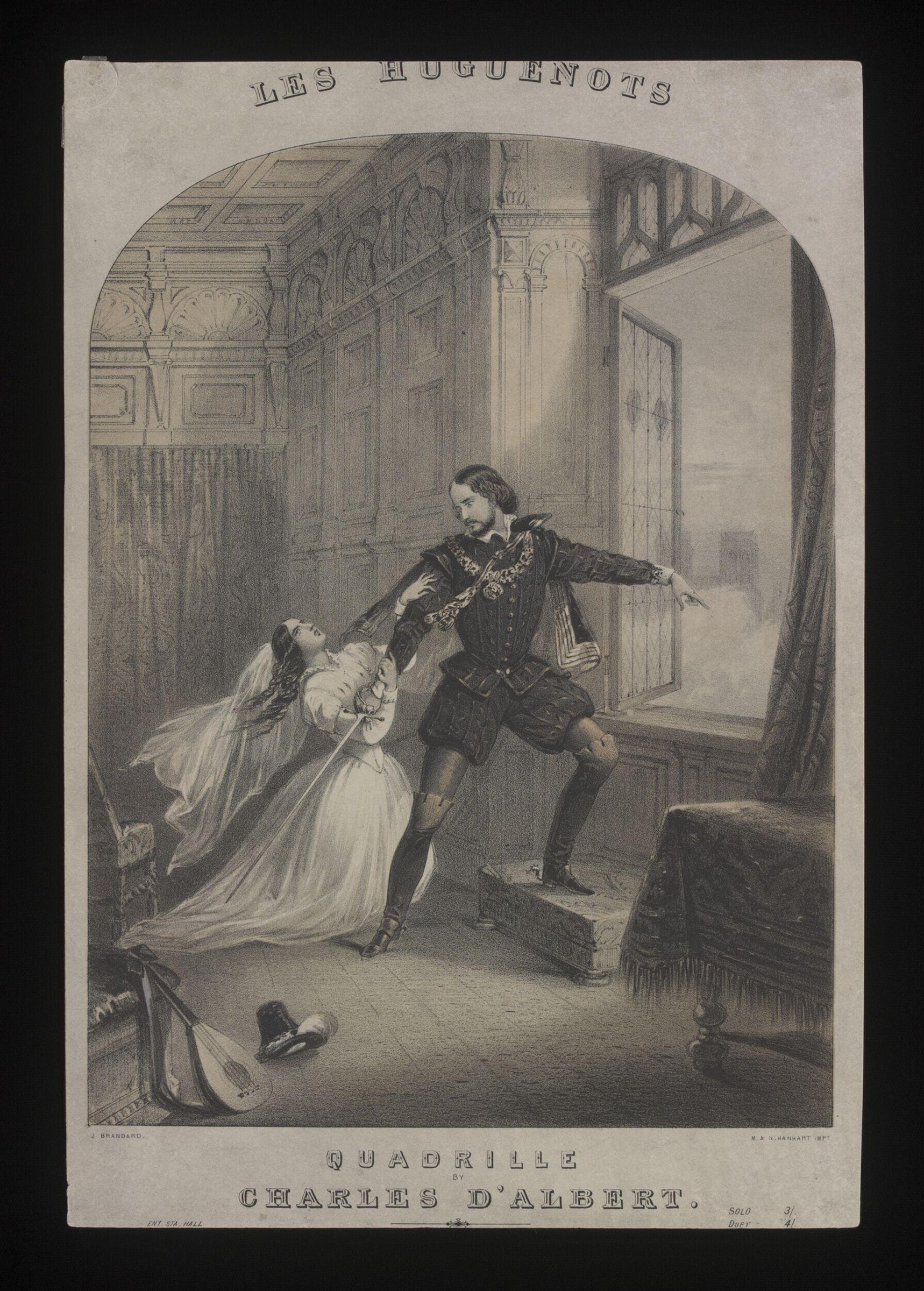
The Hugenots Quadrille
D'Albert
- Collection:
- Sheet Music
- Source:
- Victoria and Albert Museum
- Rights:
- Rights vary by item — check the source record before reusing this image. Source record ↗
- Recorded as:
- V&A — check rights per item
The work demonstrates how dance—specifically the quadrille, that quintessential ballroom form—was absorbed into operatic and theatrical narrative, and how prints of theatrical moments were marketed to both opera-goers and dancers. It shows the quadrille not as an abstract form but as an element of the visual and emotional culture of courtship, marriage, and social crisis in the nineteenth century. For historians of social dance, it is evidence of the quadrille's prominence and the way prints commodified both the dance and the drama surrounding it.
What you are looking at
A young woman in a white wedding dress with a long veil kneels or sinks to the ground in a gesture of supplication or despair, her body angled toward the viewer's left. A man in dark Renaissance or early modern military dress—with ornate armor, jeweled chains of office, and a plumed hat—stands above her in a commanding pose, his right arm extended outward in a gesture that is simultaneously protective and dismissive. The setting is an ornate interior with classical columns, decorative ceiling work, and tall windows admitting strong light from the right. The woman's veil and skirts sweep dramatically across the floor; a discarded shoe lies in the foreground. The composition suggests a moment of high theatrical emotion—possibly a declaration, a rejection, or a plea—rendered in the Academic style favored for historical or literary scenes of the mid-nineteenth century.
The dancing
The woman's body is in a kneeling or partially collapsed posture, her weight forward and downward, her arms and hands reaching or grasping toward the man. The man stands erect and dominant, one leg advanced, his torso twisted to face the woman while his arm gestures away or outward—a posture of authority and emotional distance. Their proximity and the direction of gaze create an intense relational moment rather than a partnered dance hold. The composition emphasizes emotional narrative over physical coordination.
The dance depicted
The title identifies this as a quadrille—a four-couple ballroom dance form that was enormously popular in the nineteenth century and central to courtship ritual. However, this image does not depict the structured figures of an actual quadrille in progress. Instead, it appears to illustrate a dramatic moment from *Les Huguenots*, Meyerbeer's 1836 opera by Eugène Scribe, possibly the wedding scene or another pivotal moment of emotional crisis. The figures are posed as if in a theatrical drama rather than executing dance steps, suggesting this is a *souvenir* or illustration associated with a staged version of the opera in which a quadrille or ball scene featured prominently, rather than a documentation of the dance form itself.
How it was made
This is a steel-engraved print, likely hand-colored or tinted in the original. The title, artist credit (Brissard), and publisher mark (C. Lassart Édit.) are printed below. Steel engraving allowed fine detail, wide circulation, and long print runs; prints like this were sold as sheet music covers, theatrical souvenirs, or affordable art for middle-class homes. The technique's precision and the subject matter—a moment from a celebrated opera—date this to the mid-nineteenth century. The engraving style itself is evidence of professional production for a commercial market.
About this work
This is a theatrical souvenir print illustrating a dramatic moment from *Les Huguenots*, Meyerbeer's hugely successful grand opera, published as a quadrille-themed engraving or sheet music cover. The title *Quadrille des Huguenots* suggests that a quadrille was performed in a staged version of the opera—either as an actual ballroom scene or as a quadrille arrangement of themes from the score. The image itself, however, abandons dance documentation in favor of emotional theatre: the kneeling bride and the commanding officer enact a moment of crisis, framed in the ornate Parisian interior style. This work sits at the intersection of theatrical culture, dance history, and the nineteenth-century appetite for accessible, narrative art.
How to look at it
Attend to the mismatch between the title and what is shown. A real quadrille is a structured, four-couple dance with specific figures; this image shows an emotional, two-figure scene from theatrical drama. The artist has frozen a moment of narrative intensity—supplication, rejection, or declaration—rather than a dance step. The ornate setting, the grand gestures, and the emotional register all signal opera and theatre rather than ballroom etiquette. The image tells us less about how the quadrille was danced than about how it was *framed* in theatrical culture and visual imagination.
The artist
Brissard is credited as the engraver. The print carries the imprint of C. Lassart, a Paris publisher. Both are consistent with mid-nineteenth-century commercial print production for the operatic and theatrical market, a thriving sector of Parisian industry. The quality and finish suggest a professional workshop rather than amateur work; such prints were sometimes issued as part of opera librettos or sold as theatrical souvenirs in editions of hundreds or thousands.
The period
This print dates to the height of the quadrille's fashionability in the 1840s–1860s. The quadrille had been the defining ballroom dance across Europe since the 1830s and was prominent in both public balls and private salons. *Les Huguenots* premiered in 1836 and was one of the most celebrated and frequently performed operas of the mid-nineteenth century. Operatic and theatrical scenes were routinely published as engravings for a middle-class market, and dance forms—particularly the quadrille—were frequently referenced in both theatrical and popular visual culture. The print reflects the era's fascination with historical narrative (the opera is set during the St. Bartholomew's Day massacre of 1572) combined with contemporary social dance.
Where it lives
The work is catalogued as sheet music, likely a cover or insert for a published arrangement of themes from *Les Huguenots* as a quadrille. It was produced in Paris, where such prints were a standard and affordable commodity.
Dance in this work
Questions about this work
Is this an actual depiction of a quadrille being danced?
No. While the title references the quadrille form, the image shows a dramatic theatrical scene, not a demonstration of the dance's figures or technique. It likely illustrates a ball or wedding scene from a staged version of the opera, where a quadrille may have been performed, but the print captures theatre and emotion rather than dance instruction or documentation.
What was *Les Huguenots* and why was it important?
*Les Huguenots* (1836) was Giacomo Meyerbeer's grand historical opera, one of the most celebrated works of the nineteenth century. It tells a tragic story set during the St. Bartholomew's Day massacre in 1572 and features lavish staging, dance scenes, and music that made it a fixture of European opera houses. This print is theatrical ephemera tied to its immense popularity.
What is a quadrille and why was it so fashionable?
A quadrille is a four-couple ballroom dance consisting of five figures, performed to lively music (often in 2/4 time). It originated in France and dominated European ballroom culture from the 1830s through the 1870s. It was easier to learn than earlier dances, allowed for social mingling, and was suitable for both formal balls and intimate private gatherings, making it the defining dance of the Victorian era.
Who were the Huguenots and why was their story told in opera?
The Huguenots were French Protestants persecuted during the Wars of Religion in the sixteenth century. The St. Bartholomew's Day massacre of 1572 was a pivotal moment of violence. The historical trauma and human drama of the story made it appealing to Romantic-era artists and audiences, who valued grand historical narratives combined with music, spectacle, and emotion.
More dance artwork





