49 works in this view — arrow keys or swipe to move between them.
Dance in Art
H Beard Print Collection
Unknown artist
- Collection:
- Source:
- Victoria and Albert Museum
- Rights:
- Rights vary by item — check the source record before reusing this image. Source record ↗
- Recorded as:
- V&A — check rights per item
For historians of theatrical art and dance history, this print documents how Romantic opera was visualized and circulated to the public—through dramatic lithographs that emphasized mood, costume, and narrative spectacle rather than formal choreography. It shows the boundary between dance and theatrical drama: the Faust story was danced in some adaptations and performed in others, and prints like this confirm that audiences valued the visual spectacle and symbolic gesture regardless of whether the medium was ballet or opera.
What you are looking at
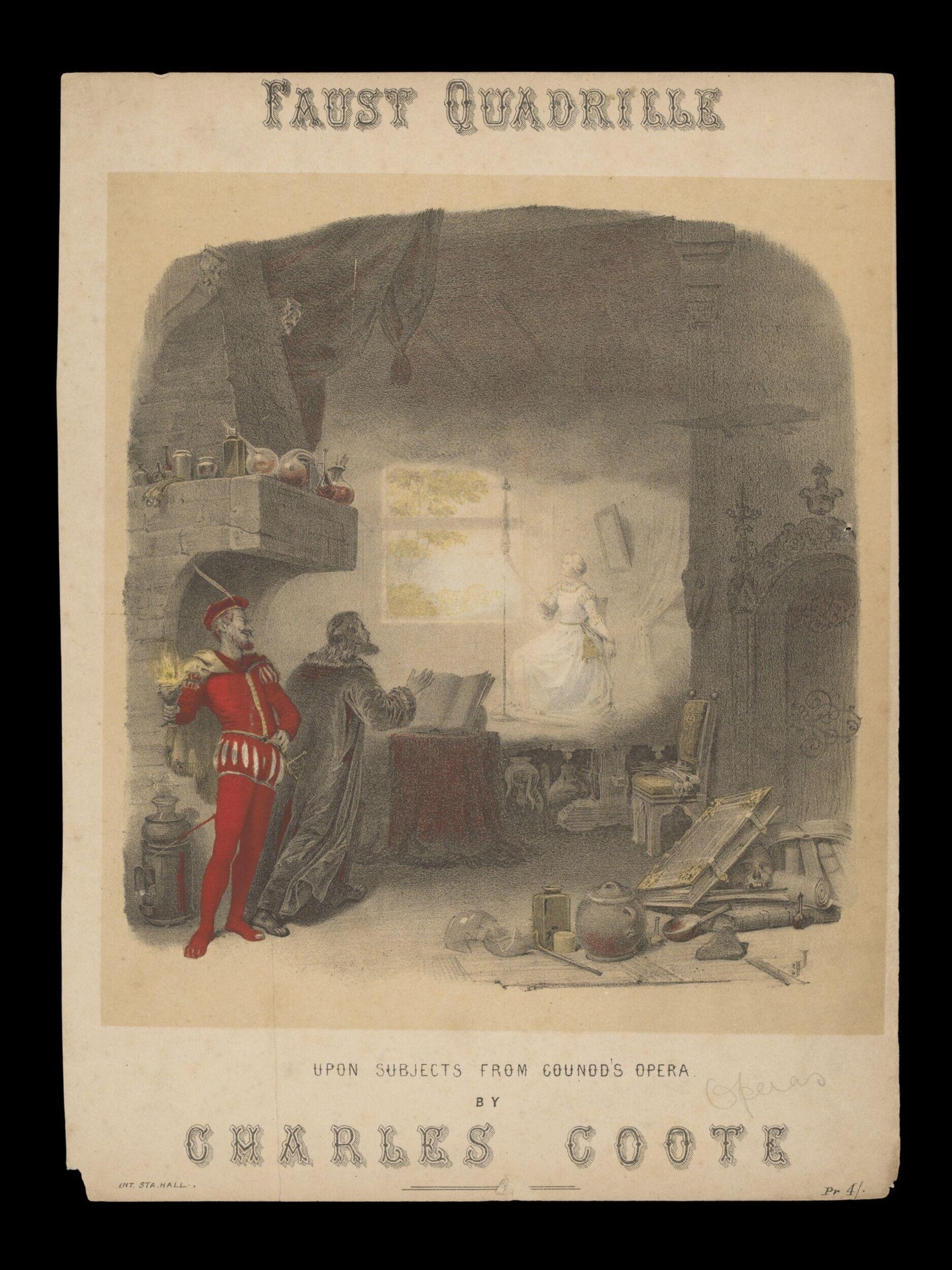
A theatrical scene set within a Gothic stone chamber, rendered in tinted lithograph. The composition frames a dramatic moment of performance or conjuring: a luminous female figure in classical white drapery stands center-right, glowing against the dark interior, while a man in brilliant red hose and tunic stands to the left in an attitude of command or amazement. A second figure in dark robes and a feathered hat occupies the middle ground, turned toward the apparition. The setting is densely architectural—stone walls, a vaulted ceiling, hanging ropes and theatrical apparatus visible above—and cluttered with props including books, vessels, scientific instruments, and a fire-bucket, all suggesting a magician's laboratory or scholar's cell. The light concentrates on the central female figure, creating an otherworldly effect typical of 19th-century theatrical visualization.
The dancing
Three figures occupy distinct spatial zones. The man in red stands in a confident contrapposto, weight shifted, arms gesturing expansively in a posture of presentation or invocation. The figure in dark robes leans forward with hands raised, expressing shock or concentration. The luminous woman in the center holds a graceful, upright stance with arms positioned in a classical pose suggesting either ecstasy or formal display. None of the three are engaged in balletic movement proper; their gestures belong to theatrical mime and dramatic pantomime rather than to codified dance steps.
The dance depicted
This is not a depiction of social or theatrical dance, but of theatrical spectacle and magic. The scene illustrates a moment from Gounod's opera *Faust*, specifically the famous scene in which Faust conjures the apparition of Marguerite. The female figure represents Marguerite's phantom, summoned by magical means; she is not dancing but appearing as a visionary or supernatural presence. The red-clad male is Faust, and the figure in robes is likely Méphistophélès. This is theatrical drama rendered in a moment of heightened visual effect rather than a moment of choreographed movement.
How it was made
The work is a hand-colored or tinted lithograph, a medium ideal for theatrical imagery in the 19th century. Lithography's capacity to render fine tonal gradations is fully exploited here: the dark architectural framework is built in dense grayscale, while the white-robed figure glows through selective wiping and careful grading of the stone. The technique allows for the atmospheric chiaroscuro central to Romantic theatrical visualization. Lithographs of this kind were produced in runs for popular circulation, reaching audiences who knew the opera through performance or reputation.
About this work
This is a scene illustration from Charles Gounod's opera *Faust*, one of the most popular and frequently depicted works of 19th-century musical theater. The image captures not a moment of dance but a moment of supernatural theater—the apparition of Marguerite summoned by Faust's magical invocation. It belongs to the long tradition of illustrating operatic moments through fine-art prints: a form of documentation and publicity that existed in parallel with ballet imagery. The theatrical gesture and staging are central to how 19th-century audiences understood and remembered operatic drama. Although dance imagery is not the primary subject, the work reflects how theatrical spectacle, movement, costume, and lighting were understood as a unified art form.
How to look at it
Attend to the distribution of light: the artist uses luminosity as a sign of the supernatural, isolating Marguerite's apparition through whiteness and glow against the darkened stone. Observe the three figures' gestures—none of them execute balletic vocabulary, but all three communicate emotional states through the language of Romantic pantomime: expansion, turning inward, raising the hands. The composition is deeply theatrical, organized around a central revelation rather than a moment of movement. This is how 19th-century audiences understood opera: as a fusion of music, drama, costume, and visual spectacle.
The artist
The title page credits the composition to Charles Coote, a 19th-century printmaker and illustrator who specialized in theatrical and literary imagery. Coote worked in a Romantic idiom typical of the 1840s–1860s, emphasizing dramatic lighting, psychological intensity, and historical or fantastical settings. The print is part of a series on Gounod's *Faust*, indicating Coote held a contract or regular commission to illustrate the opera's key scenes for a print publisher. His work reached middle-class audiences through theatrical publications and print collections.
The period
The print dates to the Romantic era of opera and theatrical arts, when Gounod's *Faust* (premiered 1859) became one of Europe's most celebrated and frequently performed operas. The 1860s and 1870s saw intensive publication of theatrical imagery, driven by the growth of opera's popularity and the expansion of middle-class print culture. Lithography had made theatrical illustration affordable and accessible. In dance history, this period saw the decline of Romantic ballet and the rise of naturalistic and spectacle-driven opera; the boundary between the two forms was increasingly porous, with performers and choreographers working across both.
Where it lives
The work is catalogued as part of the H. Beard Print Collection, held at the Virginia Museum of Art. It is a lithograph, likely from a published theatrical series, and would have been accessible to a broad audience through print sales, theatrical programs, or collected editions of opera illustrations.
Questions about this work
Is this a ballet?
No. This is a scene from Gounod's opera *Faust*, illustrated through theatrical drama and mime rather than choreographed dance. The figure of Marguerite is an apparition, not a dancer. However, the moment illustrates how closely opera and ballet were related in 19th-century theater, and how theatrical spectacle unified both forms.
Who is the red-clad figure?
This is Faust, the protagonist of Gounod's opera. He stands in a commanding pose, often understood in theatrical tradition as expressing the moment of magical power or invocation. The red costume identifies him as a dramatic character of significance in Romantic theater.
Why is Marguerite glowing?
The luminosity signals her supernatural status as a phantom or vision summoned by Faust's magical pact. 19th-century lithography used selective inking and tonal gradation to create this effect, making the white-robed figure appear otherworldly against the dark architectural surround.
What was the original source of this illustration?
This is part of a series of theatrical illustrations by Charles Coote based on scenes from Gounod's *Faust*. The series was likely published commercially for audiences who knew the opera through performance, word of mouth, or collected theatrical imagery.
More dance artwork





