49 works in this view — arrow keys or swipe to move between them.
Dance in Art
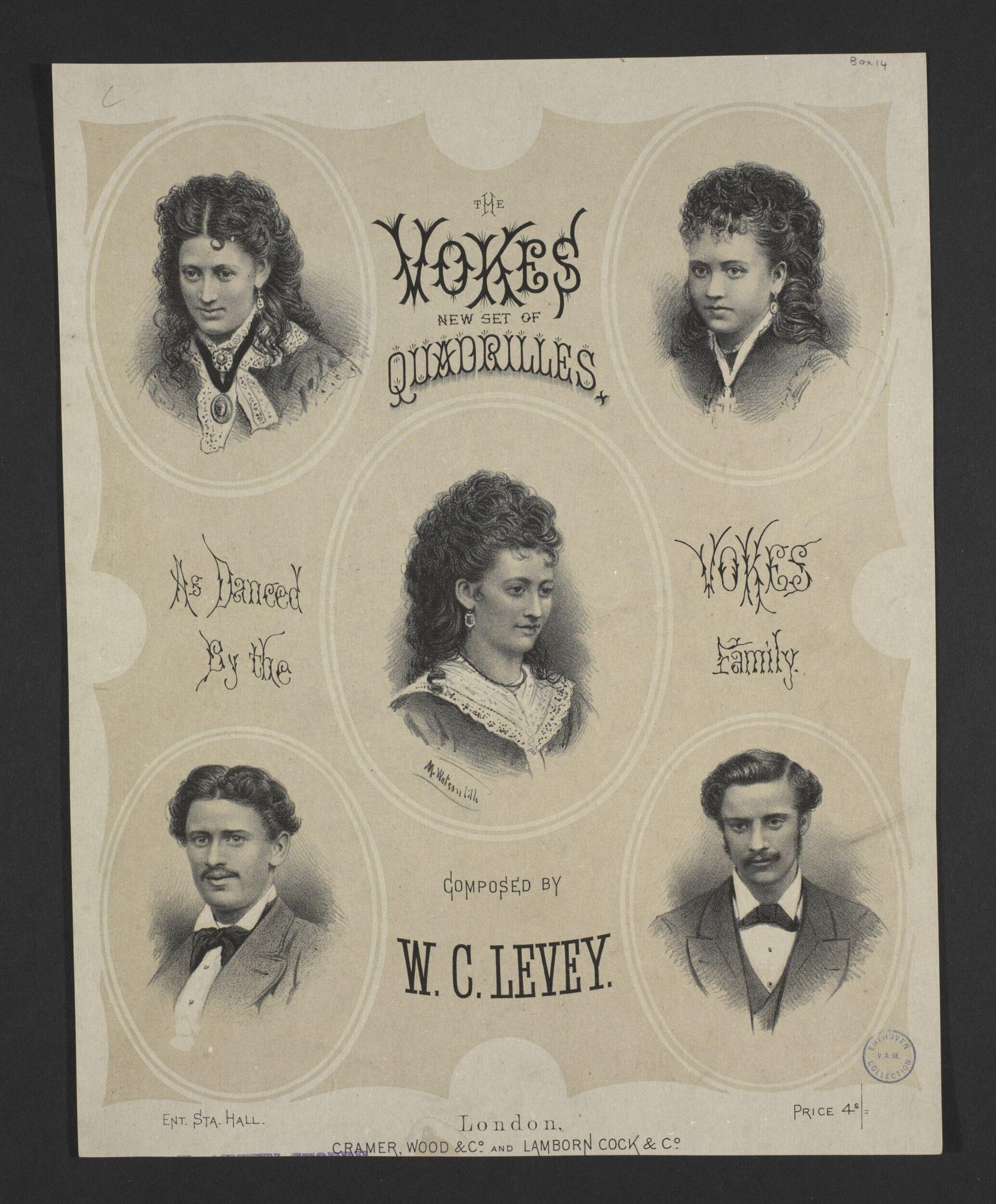
The Vokes New Set of Quadrilles
Levey, W.C.
- Collection:
- Sheet Music
- Source:
- Victoria and Albert Museum
- Rights:
- Rights vary by item — check the source record before reusing this image. Source record ↗
- Recorded as:
- V&A — check rights per item
The Vokes family were central figures in Victorian musical theater and burlesque, and their quadrille compositions were widely performed. This cover documents the intersection of theatrical dance, popular music publishing, and celebrity performance in the 1870s—showing how a formulaic social dance (the quadrille) was packaged as professional entertainment and sold to the public.
What you are looking at
This is a sheet music cover for 'The Vokes New Set of Quadrilles,' featuring five oval portrait engravings arranged on a cream background. The central portrait depicts a young woman with curled hair and delicate features, wearing a pale dress with lace collar detail. She is positioned in the middle. Surrounding her are four male portraits—two above (left and right) and two below (left and right)—each showing young men with period hairstyles typical of the 1870s. All five subjects have the refined, polished appearance of professional performers. The title appears in decorative gothic lettering at the top center, with 'Composed by W.C. LEVEY' printed prominently at the bottom. Publication details identify the printer as 'CRAMER, WOOD & C° and LAMBORN COCK & C°' in London, with a price of 4d marked in the lower right. The layout is symmetrical and formal, emphasizing the status of the Vokes family as celebrated performers.
The dancing
The portraits are head-and-shoulders engravings showing no active dance movement—this is a promotional cover rather than a dance scene. The subjects display composed, frontal or three-quarter poses typical of theatrical portraiture. The woman wears jewelry and styled hair suggesting theatrical costume. The men are dressed in formal evening wear—jackets and bow ties—indicating stage performers of the ballroom or musical theater world. No holds, frames, or footwork are visible; the focus is entirely on identifying the performers rather than depicting the dance itself.
The dance depicted
The title explicitly states this is a 'Quadrille'—a set-dance formation for four couples that was the dominant social and theatrical dance of the 19th century. The Vokes family were celebrated English performers known for pantomime, burlesque, and musical theater, and this appears to be music for a theatrical quadrille set rather than domestic social dancing. The image does not depict the dance in action but rather presents the performers who would have danced it. Quadrilles were typically performed in ballrooms and on stage, often in theatrical costume with orchestral accompaniment, making this a professional theatrical work rather than amateur social dancing.
How it was made
This is an engraved sheet music cover, a common format for theatrical music of the 1870s. The portraits are executed in steel or wood engraving with fine tonal work creating depth in the faces and clothing. The decorative lettering of the title suggests both engraving and possibly hand-lettering overlay. As sheet music, this object was mass-produced for sale to performers, music teachers, and amateur musicians—circulation would have been broad within musical and theatrical circles. The price of 4d (four pence) and the publishers' names confirm this as a commercial product for retail sale in London.
About this work
This is a promotional sheet music cover for a theatrical quadrille set composed by W.C. Levey and performed by the Vokes family, a celebrated English theatrical dynasty of the 1870s. Rather than depicting the dance itself, the cover uses five formal portrait engravings to present the performers, making it a visual advertisement as well as musical score. The work belongs in a dance archive as evidence of how the quadrille functioned as both a social dance and a staged theatrical entertainment, and how performers were marketed through visual portraiture as well as musical composition.
How to look at it
Focus on the way this object functions as both musical score and theatrical advertisement. The symmetrical arrangement of portraits—with a woman at center surrounded by four men—reflects typical quadrille formation (four couples) even though no dance is depicted. The formal dress and refined engraving technique signal this as professional theatrical work rather than domestic entertainment. The decorative gothic lettering of the title and the careful composition of the cover demonstrate how 19th-century sheet music covers were designed as objects of display and desire, not merely functional packaging.
The artist
W.C. Levey (dates not established in the record) was a composer and musician working in London during the 1870s. The breadth of the Vokes family's theatrical work—from pantomime to burlesque to musical theater—suggests Levey composed light theatrical music for popular performance. The collaboration with a family of established performers would have given the publication both musical and commercial credibility.
The period
The quadrille dominated European and American ballrooms from the 1830s through the 1880s, though it remained popular well into the 20th century. By the 1870s when this was published, the quadrille had evolved from pure social dancing into a theatrical entertainment form, often performed by professional companies on stage with elaborate costume and orchestration. The Vokes family were part of the broader Victorian boom in musical theater, burlesque, and pantomime. Sheet music covers featuring theatrical performers' portraits were a standard marketing tool, making visual celebrity inseparable from musical consumption.
Where it lives
Held as sheet music in a collection (source: va). The work is a commercially printed London publication from the 1870s, produced for retail sale at 4 pence.
Dance in this work
Questions about this work
What is a quadrille?
A quadrille is a set-dance for four couples arranged in a square formation, with each couple executing figures in sequence. Originating in France around 1760, it became the dominant ballroom dance of the 19th century. By the Victorian era, quadrilles were both performed by amateurs in social settings and by professional dancers on stage, often with elaborate choreography and theatrical costume.
Who were the Vokes family?
The Vokes were a celebrated English theatrical family active in Victorian musical theater, pantomime, and burlesque. Multiple family members performed together in popular productions, making them recognizable celebrities of the 1870s-1880s. Their name on a sheet music cover would have guaranteed sales to fans and theaters.
Why are there five people on a quadrille cover?
A quadrille requires four couples (eight dancers minimum), but theatrical quadrilles were often arranged for smaller performing groups or solo performers taking multiple roles. The presence of one woman and four men may represent a specific theatrical arrangement or the lead performers of a larger ensemble.
What does the price '4d' mean?
The notation '4d' means four pence in pre-decimal British currency. For 1870s London, this was an affordable price for middle-class amateur musicians and music teachers, placing sheet music firmly within popular commercial entertainment.
More dance artwork





