49 works in this view — arrow keys or swipe to move between them.
Dance in Art
Plaque
Unknown
- Collection:
- Plaque
- Source:
- Victoria and Albert Museum
- Rights:
- Rights vary by item — check the source record before reusing this image. Source record ↗
- Recorded as:
- V&A — check rights per item
The plaque documents how dance and courtly entertainment were imagined and represented in elite domestic interiors of the 18th century. The composition reveals the aesthetic conventions by which aristocratic bodies were posed and displayed, and the role of spectatorship and admiration in structuring social ritual. For historians of dance and visual culture, such plaques offer evidence of how movement, dress, and the gaze were choreographed in pre-revolutionary aristocratic society.
What you are looking at
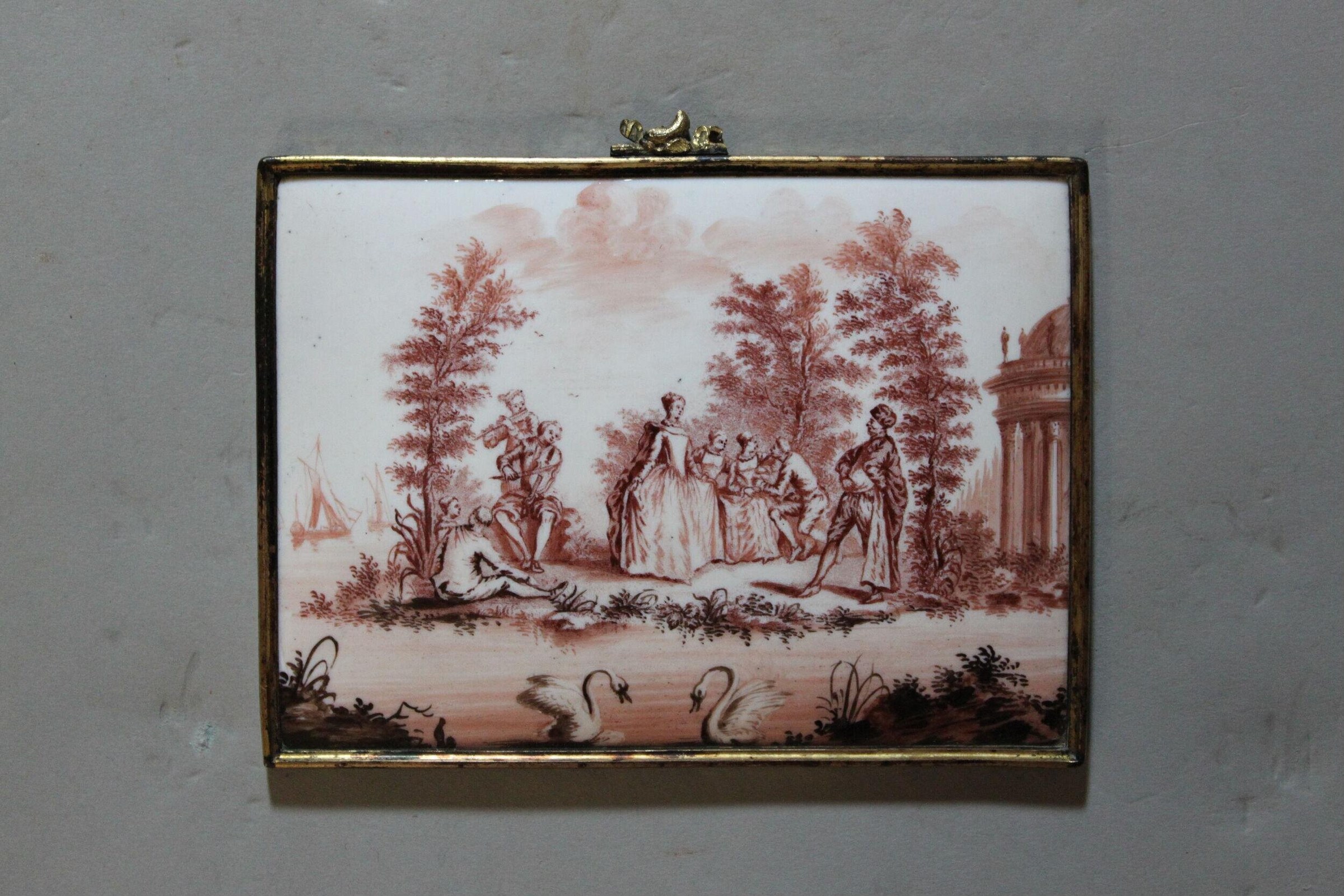
A sepia-toned porcelain plaque set in a brass frame depicts an aristocratic garden scene of the 18th century. A central female figure in a flowing white gown stands elevated on a stone terrace, surrounded by attendants and courtiers in formal dress. To her left, a figure reclines on the ground in an attitude of supplication or admiration; to her right, several standing figures gesture toward her in gestures of homage or entertainment. Tall trees frame both sides of the composition, their feathery foliage rendered in reddish-brown tones. A classical colonnade or temple structure with columns rises on the right. In the foreground, swans glide across a body of water, their reflections suggested in the darker tones below. A small sailing vessel appears in the distant left, anchoring the scene in a leisured, aristocratic world of refined pleasure.
The dancing
The composition centers on a standing woman in formal court dress, her posture upright and commanding. A prone male figure in the lower left extends his body toward her in an attitude of devotion or entertainment—a posture common in 18th-century courtship imagery. Several standing attendants flank the central woman, their bodies angled toward her, with arms raised in gestures of attention or applause. The overall grouping suggests a moment of social hierarchy and aesthetic admiration rather than partnered dancing; the figures do not display the balanced reciprocity or close holds characteristic of ballroom or court dance forms.
The dance depicted
The scene does not depict an identifiable dance form. The reclining figure and the gestures of the attendants suggest a tableau of courtship, entertainment, or allegorical homage rather than structured choreography. The composition echoes the aesthetic conventions of 18th-century aristocratic leisure imagery, in which the body's display and the gaze of observers create a theatrical moment. If dance is present, it is dance as courtly spectacle or ritual rather than as a recognizable social or theatrical form with defined steps or holds.
How it was made
This is a hand-painted porcelain plaque mounted in a brass frame with an ornamental loop for hanging. The design is executed in sepia tones—a monochromatic, single-color palette typical of Baroque and early Rococo decorative porcelain from German and Continental European workshops. The technique allows for fine linear detail in the architecture and foliage, while the monochromatic restraint gives the scene an engraved or print-like quality. Such plaques were luxury objects, mass-produced in workshops but individually hand-painted; they circulated among wealthy collectors and were displayed in domestic interiors as markers of taste and access to Continental luxury goods.
About this work
This is a porcelain decorative plaque from the 18th century, painted in sepia tones and mounted in a brass frame. It depicts an aristocratic garden scene in which a central female figure in court dress is attended by courtiers and admirers in an attitude of homage or entertainment. The work belongs to the tradition of Rococo domestic decoration and courtly allegorical imagery, in which the female body and the admiring gaze of onlookers create a moment of aesthetic and social ritual. While the scene may reference dance or courtship spectacle, no identifiable dance form is present; instead, the work documents the visual culture of 18th-century aristocratic leisure and the conventions by which bodies, dress, and gesture were deployed to express rank, beauty, and refined pleasure.
How to look at it
Attend to the formal positioning of the figures and the absence of reciprocal contact or partnering between them. The reclining admirer and the elevated central figure suggest a moment of aesthetic contemplation rather than interactive dance. The composition's debt to allegorical and pastoral prints is evident in the naturalistic setting (water, trees, temple) and the arrangement of figures in a shallow stage-like space. The sepia monochrome invites comparison with contemporary engravings; this effect of print-like reproduction was intentional, allowing a wealthy owner to display an image of refined taste and connoisseurship in miniature form within the home.
The period
This plaque dates to the height of Rococo decoration and taste in 18th-century Europe. Porcelain workshops in Germany (Meissen, Vienna) and elsewhere produced such decorative plaques for wealthy collectors, often decorated with scenes of courtship, leisure, music-making, and dance. The sepia monochromatic style mimics the appearance of prints and engravings, making the plaques affordable reproductions of more expensive artwork. In the same period, court dance was undergoing codification and professionalization; minuet, allemande, and contredanse dominated aristocratic ballrooms. The imagery of spectators gathered around a central female figure reflects both the actual structure of court entertainment—in which women of rank were displayed and admired—and the allegorical or pastoral traditions of French and Italian art that dominated Continental taste.
Where it lives
The plaque is catalogued as part of a decorative arts collection (recorded as 'va' source). It is a functional decorative object designed for domestic display, typical of the luxury goods trade in 18th-century Europe.
Questions about this work
Is this a painting or a print?
It is neither. This is a hand-painted porcelain plaque—a decorative luxury object produced in a workshop. The sepia monochromatic style mimics the appearance of engravings, but the object itself is ceramic, glazed and fired. The brass frame and loop indicate it was designed to hang in a domestic interior.
What dance is shown here?
No specific dance form is depicted. The scene shows an aristocratic leisure moment in which a central female figure is admired by attendants and courtiers. The reclining figure and static poses suggest a tableau or spectacle of courtship rather than structured choreography.
Why would this be in a dance collection?
The plaque documents how dance, courtship, and the display of the body were imagined and valued in 18th-century elite culture. Even if no dance form is named or choreographed, the image reveals the aesthetic conventions and social rituals of aristocratic life in which movement and the gaze were carefully composed.
More dance artwork





