49 works in this view — arrow keys or swipe to move between them.
Dance in Art
Theatre costume
Wilhelm
- Collection:
- Theatre costume
- Source:
- Victoria and Albert Museum
- Rights:
- Rights vary by item — check the source record before reusing this image. Source record ↗
- Recorded as:
- V&A — check rights per item
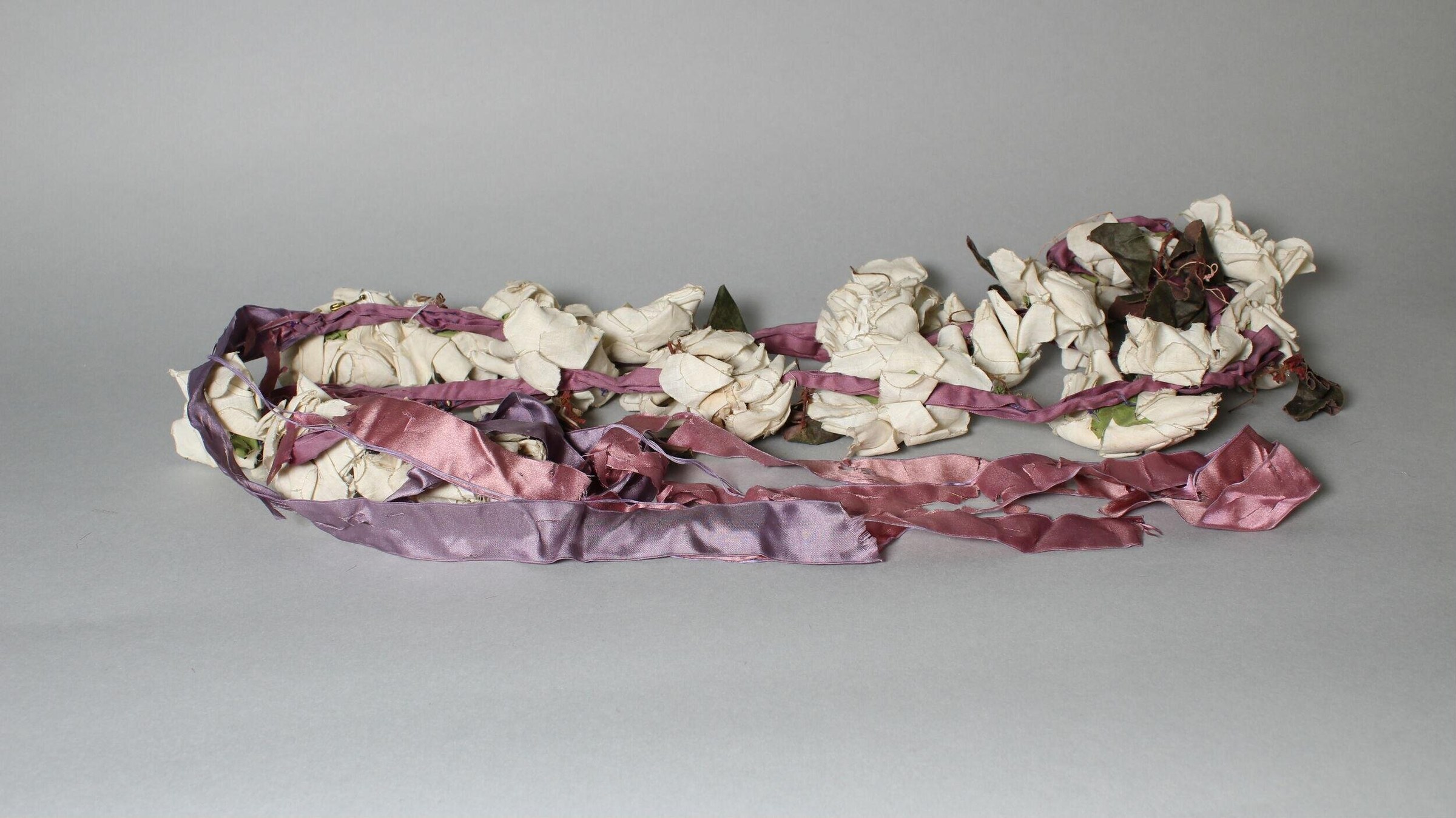
This documentation captures the unseen craftsmanship essential to theatrical dance. For historians and choreographers, it provides concrete evidence of what danced in 1912—the weight, volume, and color of the materials that shaped how bodies moved and appeared on stage. The photograph is a record of ephemeral labor, preserving materials that would otherwise have been discarded or altered.
What you are looking at
A long horizontal composition displaying the deconstructed elements of a theatrical costume laid flat against a neutral ground. The arrangement stretches across the full width of the image, with cream-colored silk petals or fabric fragments clustered at both ends and in the center, interspersed with deep mauve and burgundy silk ribbons that wind through the composition like strands connecting the floral elements. The petals appear to be individual fabric pieces, densely gathered and creating three-dimensional texture, while the ribbons are flattened and semi-translucent, showing variation in saturation from pale mauve to deep wine tones. At the center-right, darker green and maroon fabric emerges among the petals, suggesting the remains of leaves or deeper structural elements of the costume. The overall effect is of a costume in its component parts—perhaps the remnants of a floral headdress, garland, or bodice decoration—as if captured in the process of construction or documentation.
The dancing
This is not a representation of a dancing body but rather the materials that would adorn one. The composition lacks human figures entirely; instead, it presents the technical and decorative elements of costume construction. The arrangement suggests how these materials would be assembled—the ribbons appear designed to bind or support the clustered petals, and the spatial distribution implies a garment that would drape or sit on the body. The work is fundamentally about the object rather than the gesture.
The dance depicted
Without figures, this work does not directly depict dance, but it documents the material culture of theatrical dance costume. The components suggest a costume for a Romantic or early twentieth-century theatrical work—the abundant silk flowers and ribbons are consistent with ballet costumes from that era, particularly those designed for roles involving floral or naturalistic themes. The quality and assembly suggest this may be a documentation or study piece, possibly for a production record or a designer's working material.
How it was made
This appears to be a photograph of the assembled costume materials, laid flat and arranged for documentation purposes. The photographic medium allows the exact colors, textures, and condition of the original materials to be preserved with precision. This is likely a museum or archive photograph used for conservation records, provenance documentation, or production documentation rather than an artwork intended for public display. The flat-lay arrangement and neutral background are characteristic of archival or curatorial documentation practice.
About this work
This is a documentary photograph of costume components—specifically the floral and ribbon elements of a theatrical costume dated to 1912. The work belongs in a gallery of dance history not as a representation of dance itself but as material evidence of how dancers were dressed and what skilled labor went into creating theatrical spectacle. It demonstrates the elaborate handwork required of costume makers and preserves the specific aesthetic of early twentieth-century theatrical fashion. The photograph serves as a window into the technical and material practices that shaped the visual language of dance in the Edwardian era.
How to look at it
Study how the ribbons are arranged to support and bind the clustered petals—this reveals the structural engineering of the costume. Note the subtle color gradations in the silk ribbons from light to deep tone, suggesting how light would have played across the dancer's body in stage lighting. Observe the density and weight implied by the massed petals; this costume would have created significant volume and movement, likely restricting or channeling the dancer's motion in specific ways. The photograph invites reconstruction: imagine how these materials would be attached to a bodice, how they would catch air in movement, and what the wearer's range of motion would have been.
The artist
The photographer credited as 'Wilhelm' is not identified further in the available record. The photograph is part of a costume documentation archive, suggesting it was made in a curatorial, archival, or production context rather than as fine art. Such photographs were common practice in major European theaters and opera houses of the early twentieth century, where production records were kept for institutional memory and future production reference.
The period
In 1912, theatrical dance was dominated by the Russian Imperial Ballet's influence on European stages, following the success of Diaghilev's Ballets Russes (founded 1909). Costume design had become increasingly elaborate and historically researched; designers like Léon Bakst created lavish, colorful garments that departed from classical ballet's white tutus. This costume—with its abundant floral materials and complex ribbon construction—reflects the aesthetics of that moment, when dance spectacle relied on sumptuous visual effect. The photograph itself is a product of the era's systematic documentation practices, part of a broader culture of theatrical archives.
Where it lives
This work is held in the Theatre costume collection and sourced from the VA (Victoria & Albert Museum). It is a documentary photograph of costume components, likely made as part of the Museum's curatorial and conservation practice.
Questions about this work
Is this a costume from a specific ballet or production?
The catalogue record does not identify a specific production or title. The date of 1912 and the style of materials suggest it may be from a European theatrical production of that era, but the original context has not been preserved in the available record. The photograph is a fragment of a larger archive that may contain more detailed information.
Why is the costume laid flat and photographed this way?
This is a standard archival and curatorial documentation practice. Museums photograph costume components in this way to preserve detailed visual records of materials, colors, and construction for conservation, research, and future reference. The flat-lay format allows complete visibility of all elements and is easier to catalog and compare across the collection.
Would a dancer have worn this entire arrangement?
Possibly. This could be a complete headdress or bodice decoration, or it could be one element of a larger costume. The photograph captures only the preserved remnants; the full costume in performance may have included additional materials no longer surviving or not present in this archive. The arrangement suggests components that would be assembled onto the body or into a structured garment.
What does this tell us about how dancers moved?
The weight, volume, and structure of the materials constrained and directed movement. The dense massing of petals would create drag and resistance, likely restricting leg extension and emphasizing upper-body and arm movement. The long ribbons could wrap around the body or trail behind, suggesting a choreography designed to showcase the costume in motion rather than technical facility.
More dance artwork





