49 works in this view — arrow keys or swipe to move between them.
Dance in Art
Theatre costume
Wilhelm
- Collection:
- Theatre costume
- Source:
- Victoria and Albert Museum
- Rights:
- Rights vary by item — check the source record before reusing this image. Source record ↗
- Recorded as:
- V&A — check rights per item
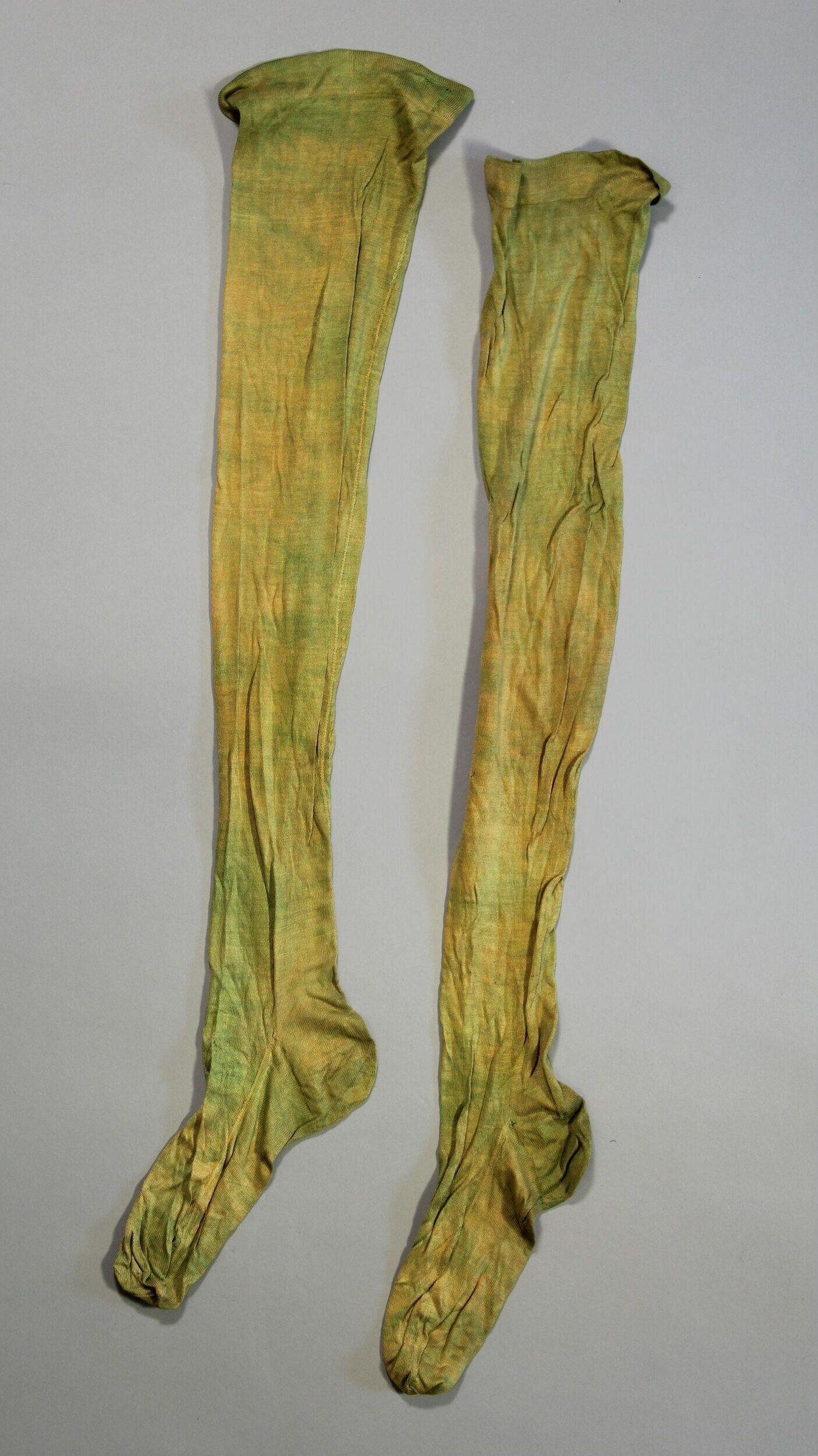
Surviving costume pieces from early theatrical performances are rare and fragile. These stockings document the material reality of stage dress—the fibers, seams, and fit—that no painting or photograph of a performer can fully convey, making them essential evidence for understanding how theatrical bodies were dressed and presented.
What you are looking at
Two long stockings or leg coverings in pale yellow-green linen lie against a light background. The fabric is wrinkled and creased from storage or use, with visible seams running the length of each leg. The stockings taper at the foot, suggesting they were shaped to fit the lower leg and foot closely. The weave and color are consistent throughout, indicating a single material, and the construction appears hand-finished. One stocking is noticeably longer or extended differently than the other, suggesting they may have been made as a pair but photographed in slightly different states of repose.
The dancing
There are no human figures or dancers depicted. The image shows only costume objects laid flat for documentation purposes.
The dance depicted
These appear to be costume stockings, likely worn as part of theatrical dress in the early 20th century. The pale, muted color and simple construction suggest they may have been part of classical or romantic theatrical costume rather than street wear. Without additional context or visible decoration, it is impossible to identify a specific dance form or theatrical tradition. The cataloguing as a "theatre costume" suggests they were preserved because of their association with performance, but the image alone does not reveal what dance or dramatic work they served.
How it was made
This is a photograph of a three-dimensional textile object, shot in raking or angled light that emphasizes the wrinkles and seams. The photograph documents the physical object for archival or curatorial purposes. The technique allows the full length and construction of the stockings to be visible, and the lighting reveals texture and wear that would identify them as historic garments. Photographs like this are standard for textile conservation and collection documentation.
About this work
These are a pair of stockings from a theatre costume dated 1912. The artist or maker is recorded only as Wilhelm. They are preserved as part of a theatre collection and serve as evidence of what performers wore under or as part of their lower-leg and foot costume during the early Edwardian theatrical period. The pale yellow-green linen and simple, close-fitted construction suggest a formal or classical theatrical context. As an archival object, the stockings reveal details of early 20th-century stage costume construction and materials that are not visible in illustrations or written descriptions alone.
How to look at it
Examine the seams and the way the fabric is shaped at the foot, which shows how the stocking was constructed to fit the performer's leg. Notice the slight yellowing and color variation, which indicates age and storage conditions. The wrinkles are not accidental; they record how the object was folded and stored over a century. The length of each stocking and the taper toward the foot are clues to the performer's likely size and the role for which they were made.
The artist
The catalogue records the creator only as Wilhelm, with no further identifying information. Without additional documentation, it is not possible to determine whether this was the artist, maker, designer, or collector who preserved or prepared these stockings for archival storage.
The period
In 1912, theatrical costume in Europe was undergoing significant change. Classical ballet and dramatic performance still dominated serious theatrical work, and stockings like these would have been standard wear for many roles. The pale, neutral color suggests they were worn by a supporting character or in roles where the leg was visible but not meant to draw attention. Early 20th-century theatre relied heavily on textile and construction details like these to create the silhouette and line performers needed; hosiery was as essential to the overall effect as the outer garment.
Where it lives
The stockings are held in a theatre costume collection. They are documented as part of the holdings, with source information recorded as 'va' (likely indicating a museum or archive abbreviation). No accession number, donor information, or detailed provenance is recorded in the catalogue.
Questions about this work
How do we know these are from 1912?
The catalogue record dates them to 1912. Without additional documentation visible in the photograph or in accompanying records, the basis for this dating is not clear from the image alone. It may derive from historical records, donor information, or stylistic analysis in the curatorial files.
What does 'Wilhelm' mean—is that the artist or the performer?
The record lists only 'Wilhelm' as the creator. This could refer to a costume maker, designer, performer, collector, or the person who preserved the object. Without further documentation, it is impossible to determine the specific role or identity of this person.
Why are these stockings pale yellow-green instead of black or white?
The color may have shifted over time due to age, light exposure, or storage conditions. The original dye may have been intended to match a performer's skin tone or to work with a specific costume design. The muted, neutral color suggests they were worn in a classical or formal theatrical context rather than as a character costume requiring bold color.
What kind of theatre or dance would have used stockings like these?
The simple, close-fitted construction and pale color suggest classical ballet, dramatic theatre, or formal theatrical traditions of the early 20th century. The stockings would have been worn to create a clean line from hip to foot or to add finish to the leg beneath a skirt or breeches. Without more information about the specific performance or role, the exact context cannot be determined from the image.
More dance artwork





