49 works in this view — arrow keys or swipe to move between them.
Dance in Art
Theatre costume
Wilhelm
- Collection:
- Theatre costume
- Source:
- Victoria and Albert Museum
- Rights:
- Rights vary by item — check the source record before reusing this image. Source record ↗
- Recorded as:
- V&A — check rights per item
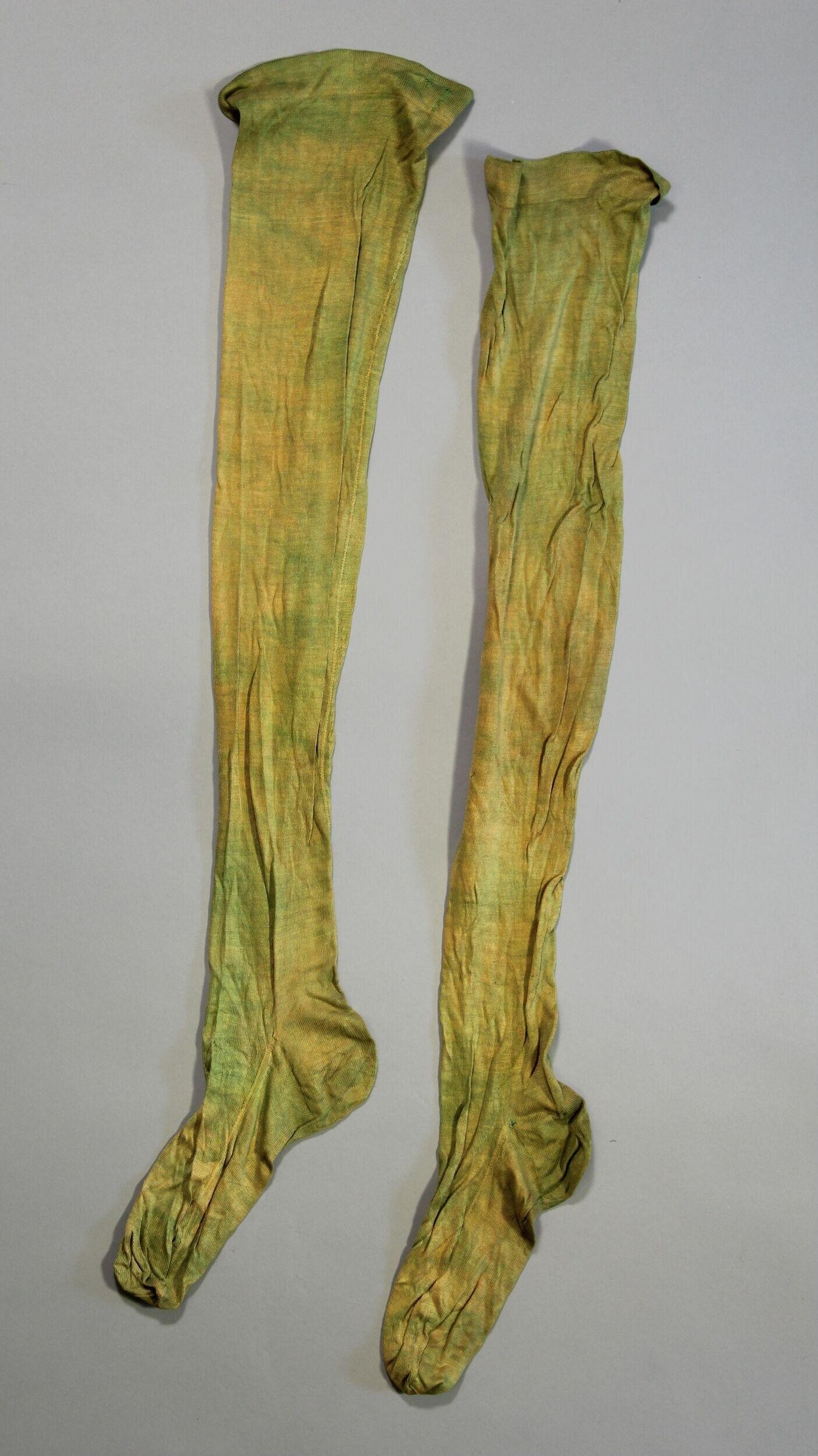
These are authentic costume pieces from the early modern theatre, not an artistic representation of dance. They are material evidence of how performers dressed and what materials and techniques were available to costume makers in 1912. For theatre historians and conservators, they document the construction methods and fibre content of the period.
What you are looking at
Two long stockings or leg coverings in a yellowish-green linen or cotton fabric, displayed flat against a neutral background. Each stocking is a tubular form, tapered at the foot and open at the top, with visible lengthwise seams running down the legs. The fabric shows creasing and folds natural to the material when laid out. The left stocking is slightly wider and longer; the right is narrower. Both exhibit the same pale greenish-yellow hue with subtle variations in tone, suggesting age or uneven dyeing. The stockings appear handmade, with simple construction typical of early 20th-century costume pieces.
The dancing
These are costume pieces rather than depictions of figures in motion. The stockings would have covered the leg and foot of a performer, fitting snugly from knee or mid-thigh to the toes. The open tops suggest they were pulled on over the foot and secured at the leg. The substantial length and tubular construction indicate they were designed for a tall performer or for a role requiring full leg coverage.
The dance depicted
Without additional documentation, the specific dance form cannot be firmly identified. The 1912 date and designation as theatre costume suggest these were worn in a staged performance, possibly ballet, pantomime, or dramatic theatre. The yellowish-green color is consistent with period dyes or natural aging. The simple construction and lack of embellishment suggest a subsidiary or character role rather than a principal dancer's costume. The style and material are consistent with early 20th-century European theatrical practice.
How it was made
These are surviving textile objects: handmade stockings constructed from woven linen or cotton, dyed in a greenish-yellow tone. The seams are hand-stitched, visible as linear creases running the length of each leg. The fabric shows the wear and discoloration characteristic of objects over a century old. As surviving garments rather than representations, they are primary sources for understanding the material culture of early theatre costume.
About this work
These are two stockings from a 1912 theatre costume, preserved as historical objects rather than depicted in artwork. They represent the material reality of early 20th-century stage dress—the unglamorous but essential pieces that completed a performer's costume. The yellowish-green dye, simple seaming, and robust construction indicate a practical working garment, one among dozens of such pieces that made up a theatre wardrobe. They survive now as a fragment of performance history, offering direct evidence of how stage costumes were actually made and worn.
How to look at it
Examine the seaming and the way the fabric folds naturally when laid flat; this shows how the stocking would have hung on the leg in performance. Note the color variation and the surface wear; these are signs of genuine age and use. The simplicity of construction—no decoration, no reinforcement at stress points—suggests a working costume for a character or supernumerary role rather than a principal dancer or star performer.
The artist
The artist 'Wilhelm' is not identified beyond this attribution in the record. Without further documentation, it is unclear whether this name refers to a costume maker, a theatre company, a designer, or the collector or donor who catalogued the piece.
The period
In 1912, European theatre was in a period of radical experimentation. Diaghilev's Ballets Russes had premiered just three years earlier in Paris (1909), revolutionizing theatrical costume and design. At the same time, naturalistic theatre and stagecraft were being challenged by symbolism and modernism. Costume construction remained largely handmade, with stockings and hose as essential components of both classical ballet and dramatic costume. The materials available—natural fibres, vegetable and synthetic dyes—determined the appearance and durability of stage dress.
Where it lives
These stockings are held in a theatre costume collection, catalogued simply as 'Theatre costume' with the artist name 'Wilhelm' and the date 1912. The source is listed as 'va,' which may indicate the Victoria and Albert Museum or another major UK archive. No additional provenance or context is recorded.
Questions about this work
Why are these just stockings and not a complete costume?
Theatre costumes survive piecemeal. Fragile garments were often separated, lost, or discarded. Individual pieces like stockings or sleeves may survive when the whole costume does not. Museums preserve what remains.
How do I know these are from 1912 and not earlier or later?
The record attributes them to 1912, but without other documentation—labels, receipts, photographs—it is difficult to verify the date from the object alone. The dye, seaming style, and material are consistent with the period, but not uniquely so.
What colour were they originally?
The current yellowish-green may be the original dye colour or the result of aging, light exposure, and storage. Early 20th-century dyes often shifted or faded over time. Without analysis or comparison, the original shade cannot be determined.
Who was 'Wilhelm' and what theatre did these come from?
The record does not say. 'Wilhelm' may be a costume maker, a performer, a designer, or a collector. Further research in theatre archives or the holding institution may reveal more.
More dance artwork





