49 works in this view — arrow keys or swipe to move between them.
Dance in Art
Theatre costume
Wilhelm
- Collection:
- Theatre costume
- Source:
- Victoria and Albert Museum
- Rights:
- Rights vary by item — check the source record before reusing this image. Source record ↗
- Recorded as:
- V&A — check rights per item
For a dancer or costume historian, these shoes demonstrate how early 20th-century theatrical productions created distinctive, colourful footwear that balanced aesthetics with function. The construction details—the gathered silk, the curved heel, the placement of the buckle—reveal what standards of comfort and movement were considered acceptable for stage performers. The shoes also document a specific moment in performance fashion when bright colours and decorative detail were acceptable or even required in theatrical dress.
What you are looking at
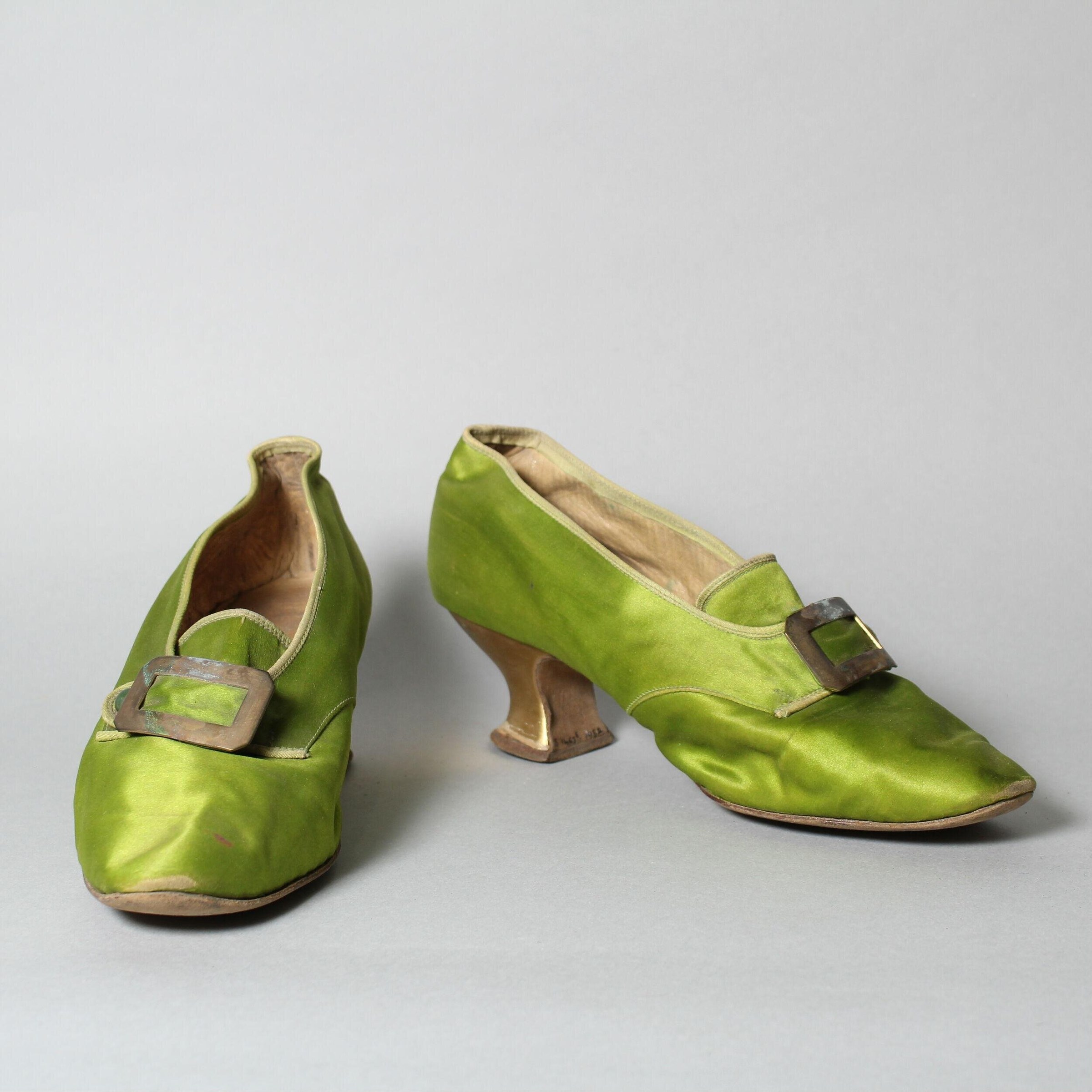
A pair of bright lime-green silk or satin slippers, photographed against a neutral ground. Each shoe is a heeled pump with a low, curved wooden heel and a squared toe. The uppers are gathered and ruched across the vamp in the style of early 20th-century evening wear. Both shoes feature small rectangular metal buckles positioned above the gathered fabric. The interior lining is a warm tan or beige. The shoes are shown from different angles—one from the three-quarter front view, the other in profile—to display their construction and silhouette. The fabric has the sheen and drape characteristic of silk, and the gathering creates soft folds across the shoe's face. These are clearly dance or theatre costume shoes: light, elegant, built for movement rather than everyday wear.
The dancing
There are no dancers depicted. These are artefacts—two shoes forming a pair—presented as museum specimens. The shoes themselves convey a delicate, refined aesthetic: the gathered silk suggests lightness and flexibility, the heels (perhaps 1.5 to 2 inches) indicate a dancer's heel rather than a street shoe's support. The buckles suggest fastening was decorative as much as functional. The shoes' proportions and construction imply a wearer of modest stature, likely female.
The dance depicted
These are early 20th-century stage shoes, most likely from a theatrical or ballroom dance production. The date (1912) and the bright green silk place them in the Edwardian to early Art Deco era. The style—gathered silk uppers, low curved heels, metal ornament—is consistent with both classical ballet pointe-work practice shoes and with the softer heel shoes used in revue, musical theatre, and ballroom dance of the period. Without additional documentation, the specific dance form cannot be determined with certainty. The vivid green suggests these were not meant to be neutral: they were show pieces, intended to be seen and admired, which rules out classical ballet's typically flesh-toned or black shoes and points toward music theatre, revue, or exhibition ballroom.
How it was made
These are preserved three-dimensional objects: actual shoes, not an artwork depicting shoes. The photograph documents them as museum pieces. The shoes were constructed by hand using techniques standard to the period: silk fabric gathered and sewn to a wooden last, a wooden heel attached to the sole, the metal buckle hand-sewn or riveted. The bright saturation of the green in the photograph may reflect the original finish, though silk can fade and photograph differently depending on lighting and age. The shoes are presented in a conservatorial manner—clean, lit to show construction details, photographed against a white ground—typical of early 20th-century museum documentation.
About this work
These are archival theatre shoes from 1912, attributed to a maker named Wilhelm. The vivid green silk and refined construction mark them as stage wear rather than street shoes, and their design suggests they were worn for a theatrical dance or musical production of the Edwardian era. The shoes are preserved in a theatre or performing arts collection and are documented here as both historical artefacts and evidence of how dancers dressed for performance in the early 20th century. They represent the practical craft of theatre shoemaking and the deliberate aesthetic choices that went into stage costume, even in areas not always visible to the audience.
How to look at it
Attend first to the gathered silk itself: it is not random bunching but a controlled ruching that distributes fabric evenly across the vamp. This gathering would have allowed the shoe to move with the dancer's foot, accommodating the flex of the sole during walking or dancing. Look next at the heel: it is low and curved, not straight, which means it was designed to work with the dancer's natural weight distribution. The buckle is positioned to be visible, not hidden, suggesting it was part of the shoe's visual vocabulary on stage. Finally, note the colour: in the early 20th century, such a vivid, almost acidic green would have read as modern, luxurious, and intentionally theatrical.
The artist
Wilhelm is credited as the maker. Without further documentation, it is not possible to establish whether this is a surname, a workshop name, or a stage-costume specialist's sole identifier. The shoes suggest either a trained shoemaker working for a theatre wardrobe department or a specialist costumier who produced performance footwear. Early 20th-century theatre shoes of this quality required both skill in textile handling and understanding of how dancers' feet needed to be supported and articulated.
The period
In 1912, theatrical dance in Europe was undergoing rapid change. The Ballets Russes, founded in 1909, was revolutionising stage design, costume, and music; Leon Bakst's vivid colour palettes were becoming the visual standard for avant-garde dance. At the same time, musical theatre and revue were enormous popular forms, particularly in Paris, London, and Berlin, and they demanded costume innovation. The bright green of these shoes sits squarely within the colour aesthetic of the period—bold, unapologetic, and meant to catch light and draw attention. The shoes' construction also reflects a moment before mass industrial shoe production fully displaced handmade theatrical footwear.
Where it lives
The shoes are held by a theatre collection identified in the record only as 'va'. They are documented as a costume piece, part of the material heritage of theatrical production rather than as fine art. The attribution to Wilhelm and the date of 1912 are part of the collection's own catalogue record.
Questions about this work
Why are these shoes so brightly coloured?
The vivid green was almost certainly a deliberate choice for visibility under stage lighting. In the early 20th century, theatrical costume was increasingly designed to be seen from a distance and to catch light. Neutral or flesh-toned shoes, standard in classical ballet, would have been inappropriate for revue or musical theatre. The colour also dates the shoes firmly to the 1910s, when bold jewel tones were fashionable in theatre design.
Are these ballet shoes?
Probably not classical ballet shoes. Ballet dancers of this period wore pink or flesh-coloured pointe shoes, not heeled pumps in vivid silk. These heeled shoes are more consistent with ballroom dance, revue, or musical theatre. The buckle and gathered silk also suggest a shoe designed for visibility and elegance rather than the minimal aesthetic of ballet.
Who wore these shoes?
Most likely a chorus dancer, soloist, or performer in a musical theatre production, revue, or ballroom exhibition in continental Europe around 1912. The size and refinement suggest a professional performer, probably female, working in a well-funded or ambitious production.
Could Wilhelm be a famous shoemaker?
Without additional documentation, it is not possible to confirm. Wilhelm may be a surname, a workshop name, or a known specialist in theatre footwear of the period. Theatre costume collections often preserve this level of maker attribution, but most early 20th-century shoemakers working in this sphere are now obscure.
More dance artwork





