49 works in this view — arrow keys or swipe to move between them.
Dance in Art
Theatre costume
Wilhelm
- Collection:
- Theatre costume
- Source:
- Victoria and Albert Museum
- Rights:
- Rights vary by item — check the source record before reusing this image. Source record ↗
- Recorded as:
- V&A — check rights per item
For dance historians, this costume is significant as evidence of the movement vocabulary available to stage performers in the early twentieth century. The tight lacing, structured sleeves, and full skirt imposed real physical constraints and created visual effects with every gesture—a reminder that dance and theatrical movement were inseparable from costume. It also documents a moment when theatrical dress was reaching toward maximum ornamentation before modernist reform.
What you are looking at
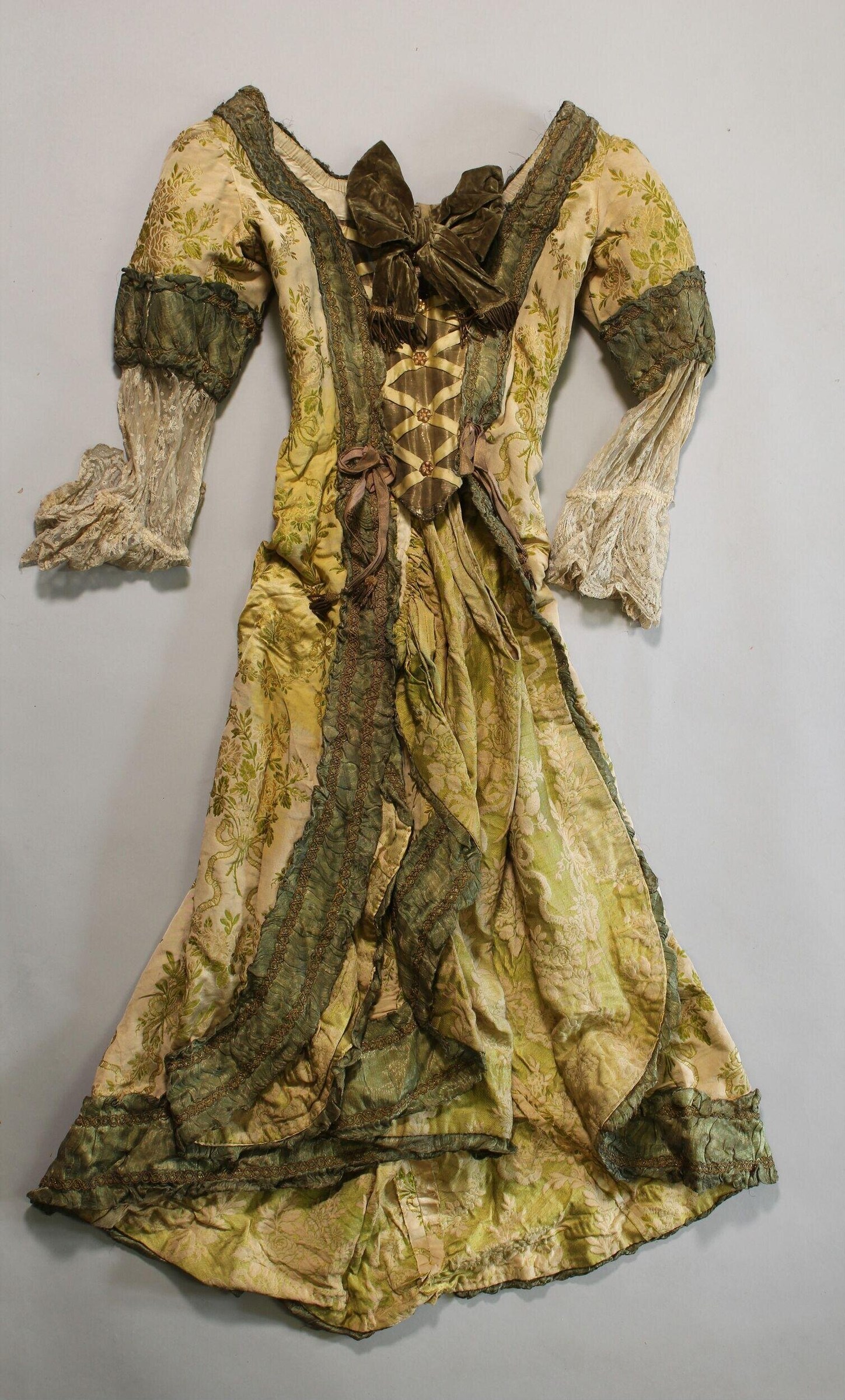
A theatre costume displayed flat against a neutral background, shown in its full length and spread width. The garment is a woman's dress of the early 1910s in pale cream or ivory silk, abundantly trimmed with deep olive-green velvet or silk ribbon forming decorative bands, swags, and borders. The upper bodice features a dramatic V-neckline filled with lacing or corset detail in contrasting thread or narrow ribbon, centering on a knot or bow of deep olive fabric. The sleeves are voluminous and theatrical—wide at the shoulder with a pronounced drape, narrowing to fitted cuffs finished with cream lace edging that falls to the wrist. The lower arm has a second layer of translucent fabric (possibly chiffon or gauze) extending below the cuff in ivory or cream, adding a diaphanous quality characteristic of Edwardian stage wear. The skirt is long and full, with the green trim applied in a rhythmic pattern of swags and festoons across the front, creating visual movement. The hem, visible in the display, is weighted and finished. The overall silhouette is S-bend and corseted, with the emphasis on the shoulders, a cinched waist, and a graceful skirt profile.
The dancing
This is not a depiction of dancers in motion but rather a costume object displayed for documentation. There are no figures or gestures to assess. However, the garment's construction—its boned bodice, elaborate sleeve architecture, and full skirt—indicates that the wearer would have moved within the formal, upright posture and constrained movement typical of early 1910s stage wear. The voluminous sleeves and trailing fabric would have created visual effects with even modest arm movement or turns.
The dance depicted
This appears to be a woman's theatrical costume, likely worn in a musical play, operetta, or dramatic theatre production of the 1912 era rather than in classical ballet or a specific dance form. The extreme decoration, the corsetry, and the emphasis on silhouette suggest a comic or romantic operetta role. The costume does not bear the specific markers of ballroom, folk, or concert dance wear—it is stage costume for a spoken or sung theatrical work that included dance or movement as an element.
How it was made
This is a textile object—a constructed three-dimensional garment of silk, velvet, lace, and other period fabrics, now preserved and displayed flat. The photograph shows the costume as a museum specimen, flattened against a wall or board, lit to reveal the construction, seaming, and decoration. As a museum photograph of a historical garment, the image serves both documentation and research purposes, allowing study of cut, ornamentation, and wear without handling the fragile original.
About this work
This is a woman's theatre costume from 1912, designed by the tailor or costumier Wilhelm. The dress exemplifies Edwardian stage fashion at the moment when the S-bend silhouette was still dominant and when theatrical costume was increasingly elaborate in its use of trimmings, ribbons, and mixed textiles. The voluminous sleeves and abundant decoration suggest a role in musical theatre, operetta, or revue rather than concert dance. The costume is a primary document of how women moved and were seen on stage in the early 1910s—constrained by corsetry, framed by fabric, and designed to catch the eye and register character through decoration and silhouette rather than through cut alone.
How to look at it
Notice the sleeve: its width at the shoulder and the way it narrows and finishes. This was the apotheosis of Edwardian sleeve design, and it would have created a striking silhouette in profile and from above. Observe the placement of the green trim—how it guides the eye downward through swags, creating a sense of movement on a stationary garment. The lace cuffs and the transparent sleeves beneath suggest layers of visual information, a richness that would read well from the audience distance. The corset lacing at the center front was both functional (the dress was worn over a corset) and decorative—it drew the eye and held the shape.
The artist
Wilhelm is recorded as the costume maker, but little additional information about this artisan is available from the record. The name suggests a German or Central European origin, which fits the period when continental European costume makers and tailors were highly sought after for major theatrical productions. Wilhelm's work appears in the theatre collections of major museums, indicating a professional of some standing in early twentieth-century stage costume.
The period
In 1912, theatre costume was at a point of transition. The rigid S-bend silhouette was still in force, but designers like Léon Bakst and the Ballets Russes had begun to introduce more fluid lines and bolder colour. Operetta and musical comedy were at their peak, and stage costumes for these genres were maximally decorative. At the same moment, modernist reformers in dance (Isadora Duncan and her heirs) were beginning to reject corsetry and ornamentation altogether, though they had not yet achieved dominance. This costume belongs to the dying world of ornamental theatre dress.
Where it lives
The costume is held in a theatre costume collection (the catalogue source indicates 'va', likely Virginia). It is catalogued as a theatre costume by Wilhelm, 1912, but the specific production and role are not recorded.
Questions about this work
Could someone dance in this costume?
With difficulty. The tight corsetry, heavy skirt, and elaborate sleeves would severely restrict movement—no large extensions, no fluid torso rotation. A performer could move within the formal theatrical conventions of the period: walking, turning, gesture from the shoulder and arm, possibly some stepping in place or modest travelling. This is costume for theatrical movement, not for athletic or expressive dance.
What was Wilhelm's role in theatre?
Wilhelm was a costumier or tailor, responsible for the construction and finish of stage costumes. The quality of this piece—the precision of the seaming, the careful application of trim, the attention to sleeve construction—indicates a skilled professional, probably employed by a major theatre or working for a costume rental house that supplied Broadway or touring productions.
When was the S-bend corset abandoned in stage wear?
Gradually between 1912 and 1920. The Ballets Russes and modernist dancers pushed toward unbound or lightly corseted silhouettes, but commercial musical theatre held onto some degree of corsetry and structured silhouette well into the 1920s. By 1930, the extreme S-bend had almost vanished from stage costume.
More dance artwork





