49 works in this view — arrow keys or swipe to move between them.
Dance in Art
Bacchanalian Dance
Meigh, Charles
- Collection:
- Mug
- Source:
- Victoria and Albert Museum
- Rights:
- Rights vary by item — check the source record before reusing this image. Source record ↗
- Recorded as:
- V&A — check rights per item
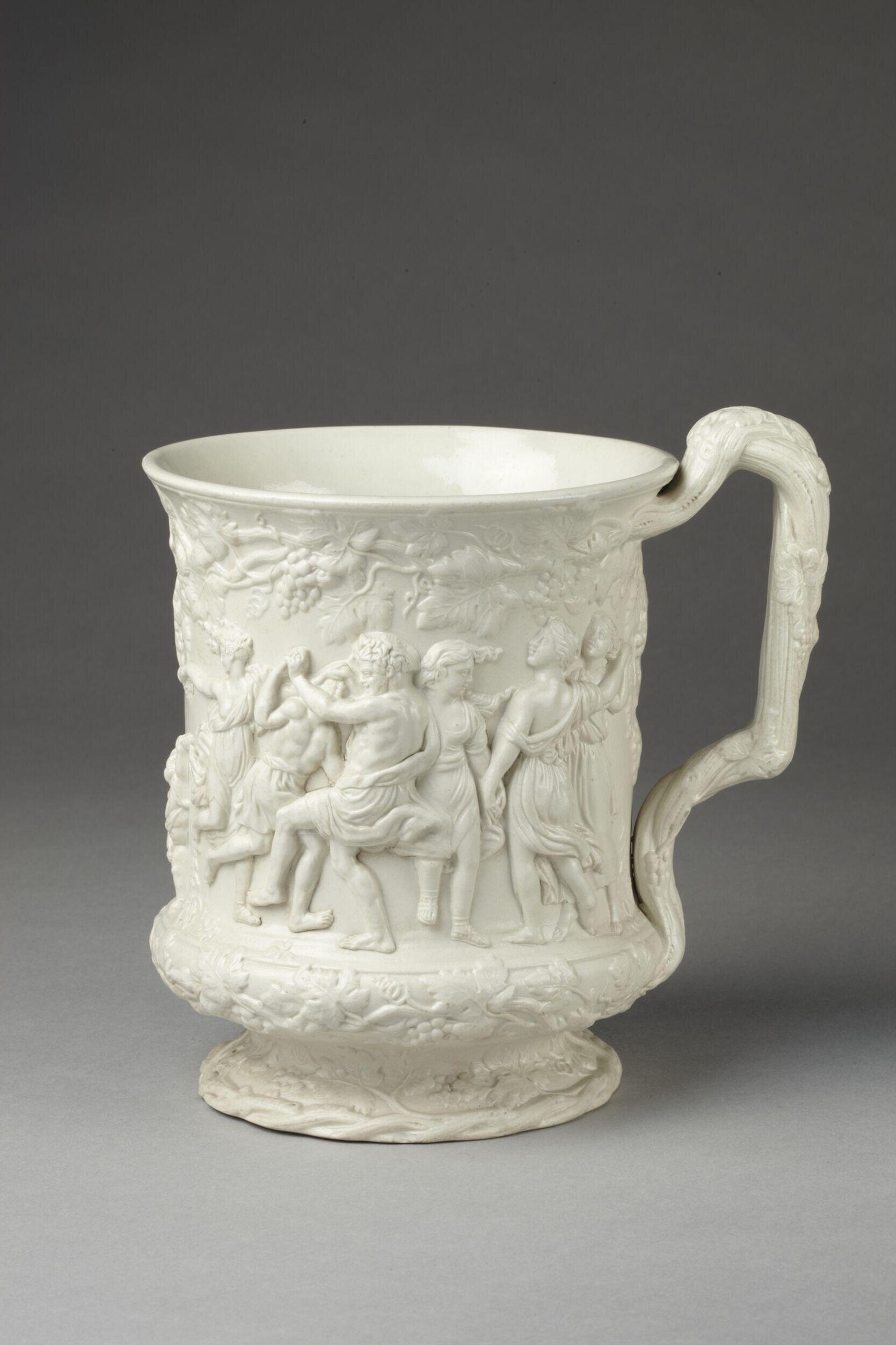
This object shows how dance—or at least ecstatic bodily movement—was represented in the everyday decorative arts of the industrial age, revealing what nineteenth-century taste valued in the depiction of the body in motion. The Bacchanalian subject was not merely antiquarian; it encoded contemporary anxieties about gender, intoxication, and the power of movement, and this mug brought those ideas into the domestic interior.
What you are looking at
This is a monumental ceramic mug, relief-decorated in white, depicting a crowded bacchanalian scene. The composition wraps around the cylindrical body with multiple figures engaged in revelry: satyrs, maenads, and putti are intertwined in energetic movement, some dancing, others playing instruments or bearing torches and vessels of wine. The relief work shows considerable depth and modeling, with figures overlapping and gesturing dramatically. At the top, the vessel opens to a plain white interior; the wide loop handle curves upward with its own relief ornament. A spreading foot anchors the form. The surface is brilliantly white, suggesting Parian porcelain or similar fine earthenware. The scene is dense and layered, in the manner of Bacchic processions familiar from Greco-Roman decorative arts.
The dancing
The bodies are rendered in classical contrapposto, with weight shifted asymmetrically. Figures display twisted torsos, raised arms, and expansive gestures—hands reaching upward or outward in exultation. The maenads wear flowing drapery that clings and swirls around their limbs, enhancing the sense of motion. Satyrs display musculature and animal vigor; putti are cherubic and plump. The grouping is tightly composed, with bodies overlapping and interlacing to create compositional unity. The musculature and anatomical articulation suggest training in neoclassical figure work.
The dance depicted
This depicts a Bacchanalian revel—a mythological scene of ecstatic, orgiastic celebration in honor of Bacchus/Dionysus. The figures are not executing a formal, codified dance but rather an uninhibited, chaotic abandonment associated with the god's wine-fueled festival processions. This is a Romantic and neoclassical interpretation of antique revelry, filtered through eighteenth- and nineteenth-century aesthetic ideals. The scene conflates dance with intoxication, music, and sacred frenzy. While not a ballroom or theatrical dance in the modern sense, it belongs to the visual tradition of depicting the body in ecstatic movement and is often cited in discussions of dance representation in decorative arts.
How it was made
This is a relief-molded ceramic mug, almost certainly Parian porcelain or similar fine white earthenware, as indicated by the brilliant white surface and the crisp definition of the relief work. Relief decoration was achieved either through mold-casting or the application of separately molded and applied relief elements to the body. The technique allowed the artist to achieve considerable narrative complexity and sculptural detail. Parian ware, which came to prominence in the mid-nineteenth century, was prized for its ability to render fine detail and its resemblance to marble sculpture, making it ideal for neoclassical and romantic subjects. The mug was a functional domestic object, yet its subject and finish elevate it to an art object, suggesting it was created for display or a collector's cabinet.
About this work
This mug, made by the Staffordshire potter Charles Meigh in 1847, brings together two nineteenth-century passions: the taste for neoclassical form and subject and the technological achievement of Parian porcelain. The Bacchanalian theme—ecstatic, body-centered, transgressive—was a Romantic-era obsession, reflecting anxieties and fantasies about the female body, intoxication, and the power of the body in motion to escape social constraint. The work sits at the intersection of applied arts and fine art history, a functional object decorated as a sculpture. For historians of dance, it documents how nineteenth-century makers and consumers understood ancient revelry and body movement, and how dancing bodies were imagined in the domestic sphere.
How to look at it
Attend first to the overall composition: the way bodies are arranged in a frieze-like spiral around the cylinder, creating a sense of continuous, swirling movement. Notice how the artist has used overlapping and foreshortening to suggest depth and crowd. Look at individual figures: the twisted poses, the raised arms, the dynamic drapery. The relief technique allows light and shadow to model the forms, enhancing the sense of three-dimensionality and physical presence. The handle is not merely functional but part of the sculptural whole, echoing the gesture and energy of the scene. The mug invites both tactile and visual engagement—the viewer can hold it and look, or simply contemplate it as a sculptural object.
The artist
Charles Meigh (1807–80) was a prominent English potter based in Hanley, Staffordshire, working during the height of the Industrial Revolution in ceramics. He was known for figural wares, relief-decorated earthenware, and experiments with Parian porcelain. His workshop produced both utilitarian and ornamental pieces, often featuring classical, mythological, or romantic subjects. Meigh was part of a cohort of potters who elevated the status of ceramics through ambitious sculptural and narrative decoration.
The period
Mid-nineteenth-century decorative arts were dominated by historicism and eclecticism. The taste for Parian ware (c. 1840s onward) coincided with a revival of interest in neoclassical form and subject matter. At the same time, the Romantic movement had elevated the Bacchanalian theme as a subject of fascination—both as a metaphor for the liberation of the body and as a fantasy about ancient sensuality. In dance history, the era saw the peak of Romantic ballet (the ethereal, otherworldly female dancer) alongside growing public interest in pantomime and spectacle. The Bacchanalian mug sits outside high theatrical dance but documents how the moving, dancing body was imagined in the wider culture.
Where it lives
This mug is held by the Victoria and Albert Museum. It is a domestic ceramic object, part of the vast holdings of nineteenth-century decorative arts that form the core of the V&A's collection.
Dance in this work
Questions about this work
Is this depicting an actual dance, or a mythological fantasy?
It is depicting a mythological fantasy—a Bacchanalian revel in honor of Dionysus. The revelers are not performing a choreographed dance but rather an ecstatic, orgiastic abandon associated with the god's cult. However, the image documents how nineteenth-century makers understood ancient movement and intoxication, and how ecstatic bodily expression was imagined.
Why would a drinking mug be decorated with such an elaborate scene?
Parian ware mugs were often created as display pieces or collector's items, not primarily for daily use. The Bacchanalian theme is appropriate to a vessel: Bacchus is the god of wine, so decorating a mug with his revels creates a playful thematic link. The object elevates domestic ceramics to the status of fine art.
What does 'Parian porcelain' mean?
Parian ware is a type of fine white earthenware or soft-paste porcelain developed in England in the 1840s. It was named after the marble from the Greek island of Paros because it resembles marble in color and finish. It was ideal for relief decoration and small sculptures, and was widely used for ornamental and commemorative pieces.
More dance artwork





