49 works in this view — arrow keys or swipe to move between them.
Dance in Art
Handbill
S. G. Fairbrother and Son
- Collection:
- Handbill
- Source:
- Victoria and Albert Museum
- Rights:
- Rights vary by item — check the source record before reusing this image. Source record ↗
- Recorded as:
- V&A — check rights per item
For dancers and historians, this handbill documents a crucial moment when non-Western dance was first entering European theatrical consciousness—not as authentic cultural practice, but as commodified spectacle. It shows the Orientalist lens through which Indian dance was first experienced by London audiences, and raises questions about authenticity, cultural appropriation, and the history of how 'exotic' dance has been packaged for Western consumption. The disparity between the advertised 'Indian' performance and the European-coded presentation seen here illustrates the colonial-era distortion of non-Western dance forms.
What you are looking at
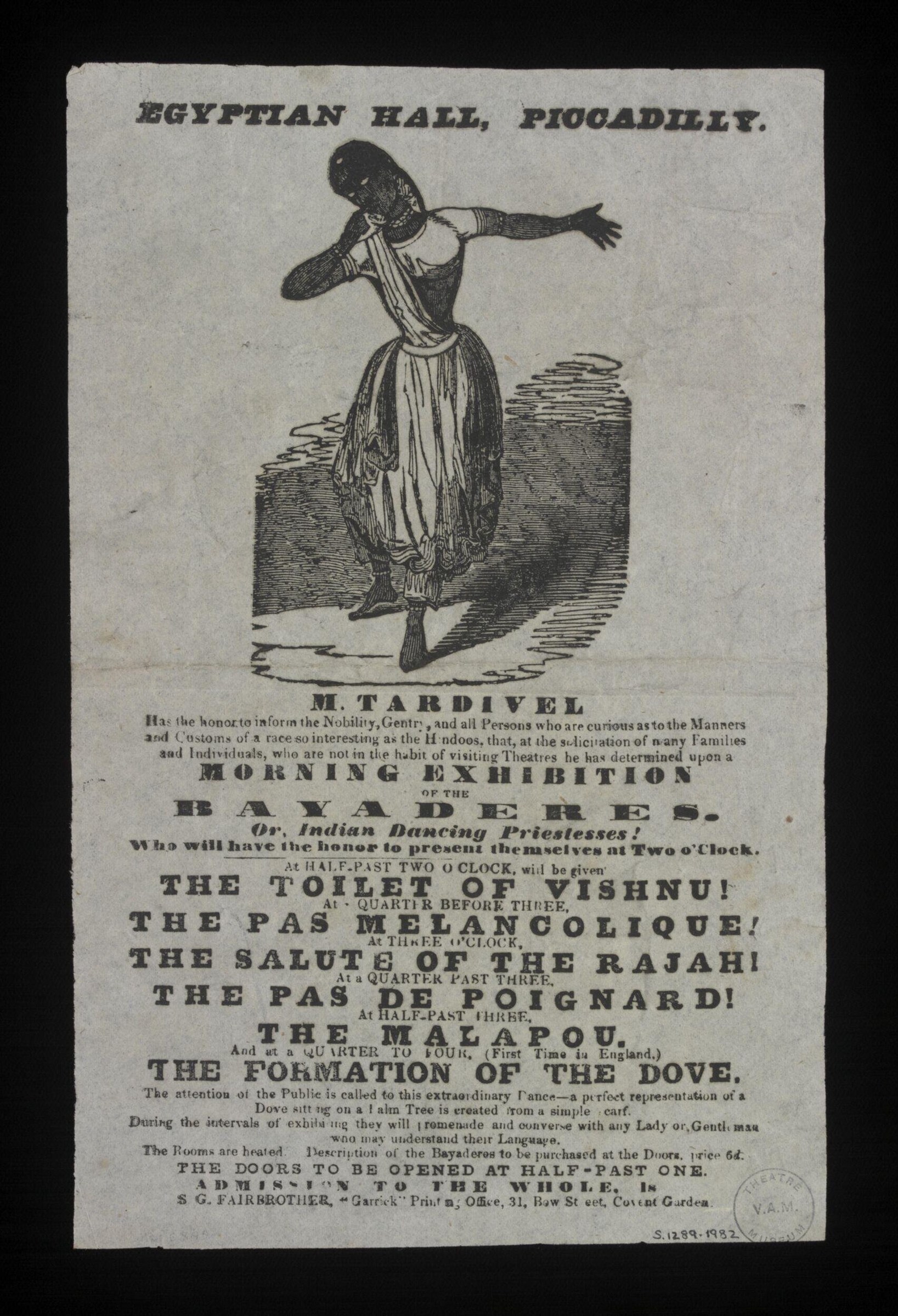
This is a theatrical handbill announcing an exhibition of Indian dancing at the Egyptian Hall in Piccadilly, London. The composition is dominated by a single figure of a woman in classical pose against a plain background. She wears a fitted bodice with short sleeves and a long, gathered skirt that reaches to her ankles, with what appears to be a draped sash or shawl across her torso. Her head is covered or adorned with a large rounded headdress or turban. Her right arm is extended outward in a graceful gesture while her left arm appears to rest at her side or on her body. Her posture is upright and her gaze directed away, suggesting an attitude of composed dignity. The figure is depicted in black and white engraving style against the pale background of the printed page. Below the figure, dense black text in various typefaces announces the exhibition and its contents, including performances with titles such as "The Toilet of Vishnu," "The Pas Mélancolique," and "The Salute of the Rajah."
The dancing
The single figure stands in contrapposto, with weight evenly distributed and no suggestion of active movement. The extended right arm is held at approximately shoulder height with the hand open and fingers relaxed, a gesture of presentation or offering rather than active dance articulation. The pose is static and tableau-like rather than captured mid-movement. The figure's frame is upright and frontal, with shoulders squared to the viewer. There is no partnering, no dynamic weight transfer, and no footwork visible that would suggest active choreography—the posture reads as a formal presentation stance.
The dance depicted
The handbill advertises an exhibition of Indian dancing, though the single figure shown does not clearly exhibit the characteristic features of classical Indian dance forms such as Bharatanatyam or Kathak—no visible mudras (hand gestures), no bent-knee posture, and no suggestion of the sophisticated arm and eye movements those traditions require. The costume is ambiguous: while the long skirt and bodice could suggest a Europeanized interpretation or adaptation, the turban or headdress might allude to South Asian dress. This appears to be a 19th-century European theatrical spectacle marketed as 'Indian' dance, likely aimed at curious London audiences seeking exotic entertainment. The image shows a performer in costume rather than a documentation of actual Indian dance technique, and reflects the conventions of Orientalist performance popular in Victorian Britain.
How it was made
This is a wood or steel engraving printed on paper, typical of theatre handbills and public notices of the 1830s–1840s. The technique allowed for mass reproduction at low cost, making handbills affordable to print widely and post in public spaces. The figure is rendered with clear outlines and careful parallel hatching to suggest volume and shadow, particularly in the skirts and the headdress. The dense typography below uses multiple point sizes and weights to create visual hierarchy and draw attention to the key attractions. This medium and format—the handbill as a disposable but informative advertisement—was the primary means of promoting theatrical events to London's urban audience before newspaper advertising became standard.
About this work
This is a wood-engraved theatrical handbill from 1838 advertising an exhibition of Indian dancing at the Egyptian Hall, a fashionable venue for exotic attractions in Piccadilly. It represents a moment when 'Indian dance' was being marketed to British audiences as a novelty spectacle, packaged within a framework of Orientalist curiosity. The single figure shown is a theatrical performer in costume rather than a practitioner of classical Indian dance, and the image reveals more about 19th-century European expectations of 'the Orient' than about actual South Asian dance practice. The handbill itself is a historical artifact of how dance was promoted, consumed, and imagined in the early Victorian era.
How to look at it
The viewer should note the complete stillness of the figure—this is not a moment of dance, but a posed presentation. The extended arm reads as a gesture of display or welcome, borrowed from academic painting and ballet rather than from the gestural language of Indian classical dance. The formal frontality and the carefully controlled composition suggest this image was designed to intrigue and reassure the London viewer, presenting 'Indian dance' as something comprehensible through familiar European theatrical conventions. Look at what is absent: the bent knees and dynamic weight shifts of actual Indian classical dance, the sophisticated hand and eye work, the floor contact—instead, what we see is a static, costumed figure that promises exoticism while remaining entirely legible to a European audience.
The artist
S. G. Fairbrother and Son were London printers and publishers of theatrical handbills and notices during the 1830s–1840s. The firm specialized in wood-engraved advertisements for theatrical performances, exhibitions, and public entertainments. Their output reflects the commercial production of theatre publicity in a period when handbills were the primary method of announcing performances to the public. Nothing in the surviving record distinguishes their artistic practice beyond technical competence in the engraver's craft; they were jobbing printers serving the theatrical industry.
The period
The 1830s–1840s in Britain saw a craze for exotic entertainments—Egyptian mummies, Indian rope tricks, and various 'Oriental' spectacles drew paying crowds to West End venues. The Egyptian Hall itself (opened 1812) became famous for such attractions, hosting everything from natural curiosities to theatrical performances marketed as windows onto distant lands. This period coincided with Britain's expanding imperial reach into India; 'Indian dance' as a London attraction reflected both genuine curiosity about colonial territories and the projection of Western fantasies onto those lands. Classical Indian dance traditions were not well understood in Europe at this time, and theatrical 'Indian dance' was largely a European invention, influenced by ballet vocabulary and costuming conventions rather than by authentic South Asian practice.
Where it lives
This handbill is held in the Victoria & Albert Museum (V&A) collection, catalogued from the reference source marked 'va'. As a printed theatrical advertisement, it is part of the V&A's broad holdings of 19th-century theatre ephemera and represents the documentary material of Victorian theatrical culture—materials often overlooked in favour of scripts, photographs, and playbills, but essential to understanding how performances were marketed and what audiences were promised.
Questions about this work
Was this real Indian dancing?
Probably not as we would understand Indian classical dance today. The costume, pose, and presentation are filtered through European theatrical conventions and Orientalist fantasy. In the 1830s, authentic South Asian dance forms were barely known in Britain; what was marketed as 'Indian dance' was largely a European creation, using Indian costume trappings and vague exoticism to attract paying audiences. This handbill is a window into colonial-era misrepresentation.
What was the Egyptian Hall?
A fashionable West End venue in Piccadilly that opened in 1812 and specialized in exotic exhibitions and entertainment—mummies, natural curiosities, and theatrical spectacles marketed as 'authentic' glimpses of distant lands. It was a commercial venue designed to attract curious Londoners willing to pay for access to the supposedly exotic and extraordinary. The Egyptian Hall was demolished in 1905.
Why is the figure so still?
The pose is a formal presentation stance, not a moment of active dance. In engraved handbills, movement is difficult to suggest and stillness is easier to render clearly. More importantly, the static, dignified pose may have been chosen to reassure potential audiences that 'Indian dance' was respectable entertainment, not something wild or threatening—it presents exoticism in a form that was culturally legible and socially acceptable to Victorian viewers.
More dance artwork





