49 works in this view — arrow keys or swipe to move between them.
Dance in Art
David Garrick
John Hall
- Collection:
- Source:
- Victoria and Albert Museum
- Rights:
- Rights vary by item — check the source record before reusing this image. Source record ↗
- Recorded as:
- V&A — check rights per item
Garrick was a transformative figure in English theatre whose approach to performance emphasized naturalistic movement and emotional authenticity, breaking from the more declamatory style of his predecessors. For historians of dance and embodied performance, Garrick's career marks a shift toward valuing the actor's body as a vehicle for psychological realism rather than formal artifice. This portrait documents how that fame was memorialized and circulated through the reproductive arts.
What you are looking at
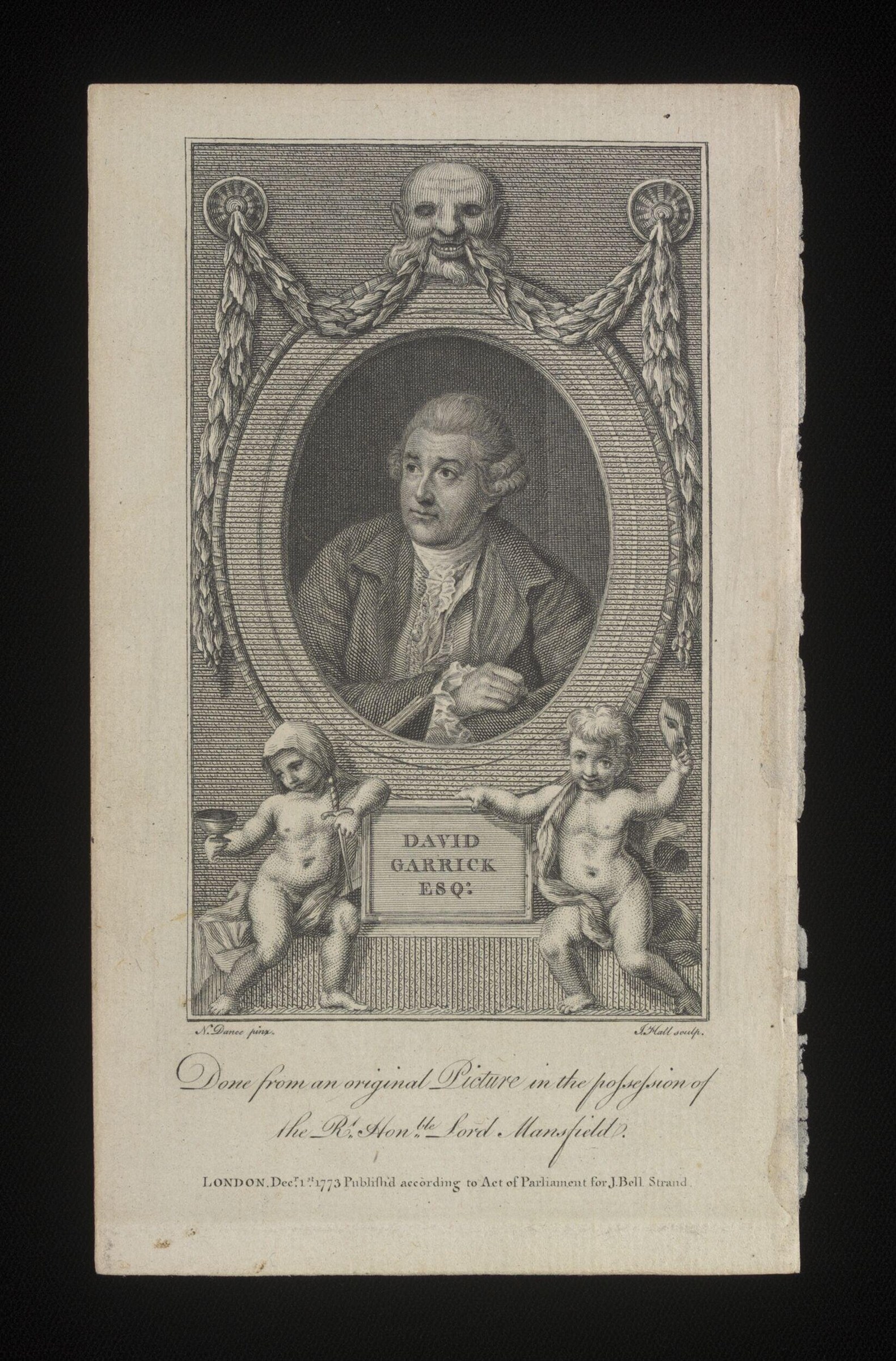
This is an engraved portrait of David Garrick, the celebrated 18th-century actor and theatre manager, set within an ornamental neoclassical frame. The sitter occupies a circular medallion at the center, shown from the waist up in three-quarter view, wearing a formal coat with decorative buttons and a lace cravat. He gazes slightly to his left with a composed, dignified expression. The frame itself is elaborate: above the portrait sits a bearded male head (possibly a classical reference), from which two swags of laurel or oak leaf garland descend on either side, anchored to rosette medallions at each corner. Below the portrait, two cherubs or putti flank a cartouche bearing the inscription "DAVID GARRICK ESQ:" The background is rendered in fine parallel lines (hatching) typical of engraving technique, creating tonal depth and formality. The entire composition speaks to Garrick's status as a celebrated figure worthy of classical honor.
The dancing
Garrick is posed in a static, formal manner characteristic of portraiture rather than in active movement. His upper body turns slightly; one arm is positioned across his torso in a gesture of composed reflection or presentation. There is no visible dance movement, frame, or partnering. The figure is singular and dignified, positioned as an object of veneration rather than as a performer in motion.
The dance depicted
This is not a depiction of dance, but rather a formal portrait of an actor and theatre impresario. While Garrick was celebrated for his transformative performances and his work modernized English theatre throughout the 18th century—and while some of his most celebrated roles involved staged movement and physical expression—this particular image shows him as a statesman of the stage rather than as a dancer or performer captured mid-gesture. The portrait format and neoclassical framing situate him in the tradition of honorific representation.
How it was made
This is an engraving (as indicated by the signature marks visible at lower left and right, reading "Ad. Linn. pinx." and "Sh. del. sculp." or similar), a reproductive medium that allowed multiple impressions to be pulled from a copperplate. Engraving was the principal medium for circulating portraits of notable figures in the 18th century, making such images accessible to a broad educated audience. The technique's capacity for fine detail and tonal modulation through hatching made it ideal for the rendering of portraiture and formal documentation. The date 1773 and the London publisher attribution ("Published according to Act of Parliament") indicate this was a commercial print made for public sale and collection.
About this work
This work is an engraved portrait of David Garrick, the preeminent English actor-manager of the 18th century, created in 1773 during his lifetime and widespread fame. It belongs to a major tradition of celebrity portraiture that emerged in the 18th century as printing and engraving made it possible to distribute idealized images of famous performers to a national audience. Garrick's theatrical innovations—his naturalistic acting style and his physical command of the stage—did much to elevate the profession of acting in England, and portraiture became one of the means by which his public image was constructed and circulated. While the image does not itself depict dance or choreography, it testifies to the visual culture surrounding performance and fame in the period when modern theatre was being established.
How to look at it
Attend to the framing devices: the classical ornaments, the laurel wreaths, the putti with their cartouche are all assertions of Garrick's status and permanence. Note how the portrait itself is restrained and dignified, showing Garrick not in theatrical dress or mid-performance, but as a gentleman of letters and a public institution. The engraving technique—the fine hatching in the background, the precision of the line work—conveys the formality and reproducibility of print culture, which was the primary means by which Garrick's image reached the public. This is not a narrative scene or an action shot; it is a claim of immortality through portraiture.
The artist
The engraver is identified as John Hall ("Sh. del. sculp." likely refers to the draftsman or other contributors). Hall was an active reproductive engraver working in London in the mid-to-late 18th century, producing prints after paintings and drawings by other artists. The division of labor between painter (pinx.), draftsman (del.), and engraver (sculp.) was standard practice in commercial print production of this era, allowing efficient production and distribution of high-quality images.
The period
The 1770s were the height of Garrick's fame and influence. He had been the dominant figure on the English stage since the 1740s, and his naturalistic approach to acting had reshaped what audiences expected from theatre. This was also the era in which Garrick was engaged in his ambitious rebuilding and modernization of Drury Lane Theatre (1775–1776), cementing his status as a theatrical visionary. In the visual arts, the neoclassical revival was underway, and the formal, antique-inspired framing of Garrick's portrait—with its laurel wreaths and classical male heads—placed him within a tradition of enduring fame and civic honor. The 1770s also saw the proliferation of celebrity portraiture as a commercial enterprise.
Where it lives
The work is held as a print (engraving) and was published in London in December 1773 by J. Bell, Strand, "according to Act of Parliament." It derives from an original painting by another artist (identified by the signature marks), and was disseminated as a commercial print—an affordable way for people to own an image of the celebrated actor.
Questions about this work
Why is this portrait surrounded by classical symbols?
The laurel wreaths, male heads, and cherubs all reference classical antiquity and honor, asserting that Garrick's achievements place him in the tradition of great figures from ancient Rome and Greece. This was a standard visual language for honoring celebrated public figures in the 18th century. It also elevates theatre—traditionally viewed as a lower art—by associating Garrick with timeless values of wisdom and civic virtue.
What is the engraver's signature and what does it tell us?
The lower corners carry small abbreviations (pinx., del., sculp.) indicating the original painter, draftsman, and engraver respectively. This division of labor was standard in commercial print production: different artisans specialized in each step. The engraver was responsible for transferring the design to copper plate and producing multiple impressions, making the image widely available and affordable.
Did Garrick dance, or is this work just about acting?
Garrick was an actor and theatre manager, not primarily a dancer, though his performances were celebrated for their physical expressiveness and naturalistic movement. This portrait documents him as a public figure and impresario rather than capturing him in any particular movement or dance. However, his influence on theatre included a shift toward valuing the actor's embodied presence and gesture.
What makes this a significant document of 18th-century performance culture?
This print is evidence of how celebrity and fame were constructed and circulated in the 18th century through reproductive media. Garrick's widespread celebrity generated demand for his image, and engravers like Hall capitalized on that demand. The formality and neoclassical framing show how theatre—and the actor's body—was being elevated to a status previously reserved for statesmen and royalty.
More dance artwork





