49 works in this view — arrow keys or swipe to move between them.
Dance in Art
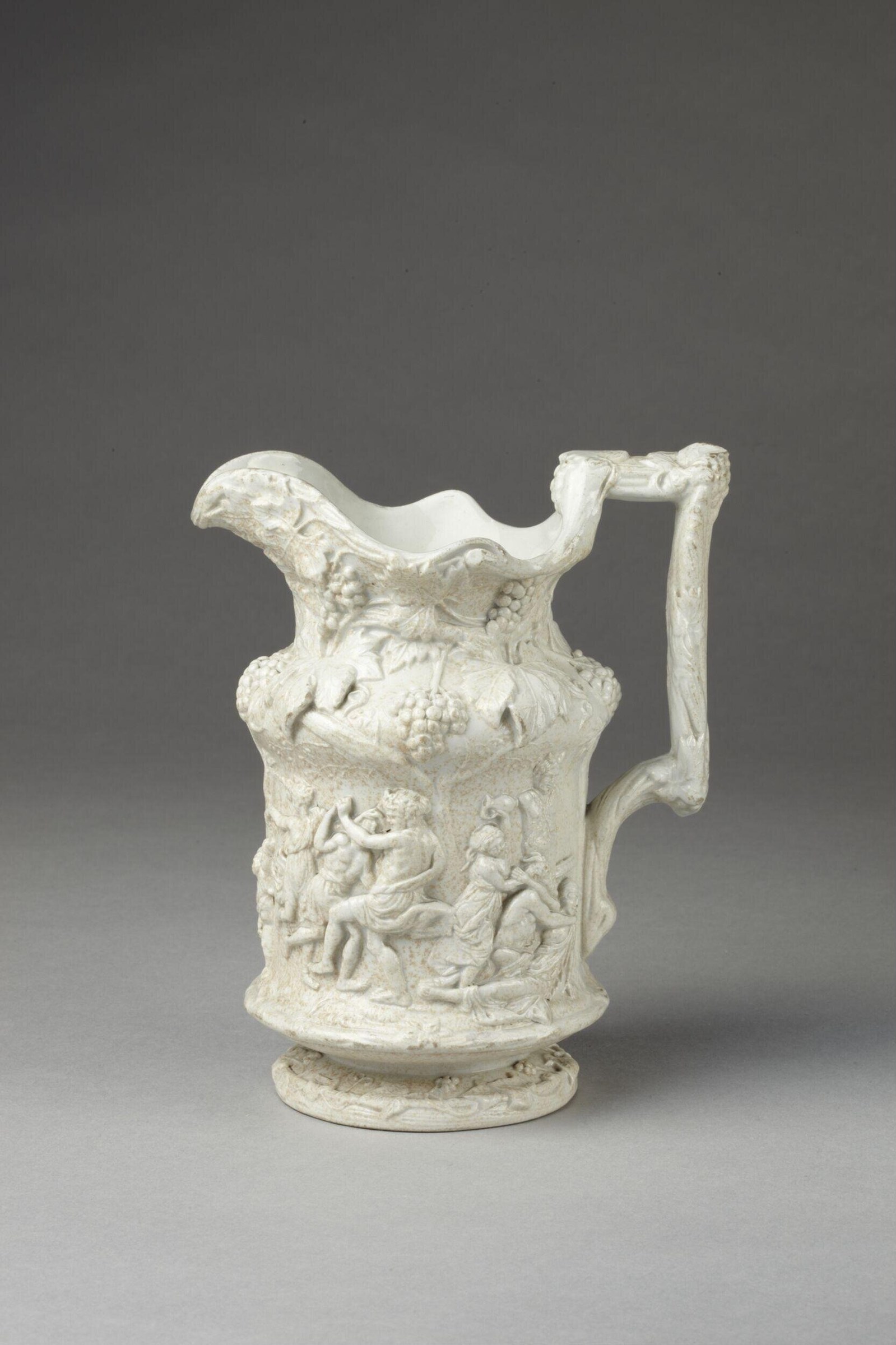
Bacchanalian Dance
Meigh, Charles
- Collection:
- Jug
- Source:
- Victoria and Albert Museum
- Rights:
- Rights vary by item — check the source record before reusing this image. Source record ↗
- Recorded as:
- V&A — check rights per item
For dance historians, this object demonstrates how 19th-century artists and manufacturers used mythological dance imagery—the bacchanal—as a fantasy of bodily freedom and ecstatic transport, distinct from the increasingly codified, rational forms of theatrical dance (ballet, ballroom) emerging in the same period. The relief technique, which flattens and compresses bodies into overlapping silhouettes, creates a visual effect of uncontrolled movement and emotional excess that contrasts sharply with the geometric precision valued in contemporary dance instruction.
What you are looking at
This is a relief-decorated ceramic pitcher or jug, likely Parian ware or similar white earthenware, depicting a densely populated bacchanal scene in the neoclassical taste. The cylindrical body is covered entirely with relief figures of satyrs, maenads, putti, and revelers in various states of intoxicated abandon. At the upper body, grapevines with bunches of grapes and vine leaves provide the frieze's ornamental frame. The composition is crowded and theatrical, with figures overlapping and gesturing wildly—some appear to be dancing or leaping, others reclining or stumbling, all in the midst of ritual revelry. The form itself is classical: a wide pouring lip with rolled edge, a muscular body that swells slightly at the shoulder, and a curved handle with decorative terminals. The pale, uniform surface suggests the work is unglazed or minimally glazed ceramic, common to British decorative pottery of the mid-19th century.
The dancing
The relief figures are small and densely packed, carved rather than modeled, making individual anatomical detail difficult to discern from this distance. What is clear is the variety of poses: several figures appear in mid-leap or stride, arms raised or extended, suggesting violent ecstatic movement. Others crouch, recline, or support themselves on companions. The satyrs are distinguished by pointed ears and animal legs. There is no sense of coordinated group formation—this is chaos and individual transport, not ordered dance. The artist understood the body's capacity for expressive gesture and distortion in states of abandon rather than the technical requirements of any specific dance form.
The dance depicted
The title *Bacchanalian Dance* invokes the mythological revels of Dionysus and the frenzied state induced by wine and ritual ecstasy. The imagery draws on classical sources—Ovid's Metamorphoses, wall paintings from Pompeii and Herculaneum—rather than any contemporary dance practice. A bacchanal is theatrical and transgressive: it celebrates intoxication, dissolution of social order, and the triumph of instinct over reason. The 'dance' here is not a codified style but a visual metaphor for abandonment and ecstatic movement. In the context of a 19th-century decorative object, it offered viewers a sanctioned fantasy of ancient license rendered in tasteful neoclassical form.
How it was made
The piece is a ceramic jug, likely Parian ware or stone china, a white semi-vitreous earthenware that was fashionable for decorative household ceramics in Britain from the 1840s onward. The relief decoration was produced by pressing clay into a mold or by hand-carving and applied to the leather-hard body before firing, a labor-intensive technique that required skilled modelers. The uniformity of the surface and the delicacy of the carving suggest factory production with artisanal finishing, characteristic of industrial ceramics masquerading as fine art. The technique allowed for mass production of 'classical' objects at prices affordable to middle-class households, democratizing access to mythological imagery.
About this work
This is a mid-19th-century English decorative ceramic jug decorated in relief with a scene of Bacchanalian revels—intoxicated satyrs, maenads, and putti in a state of frenzied movement and abandon. Made in Parian ware by the potter Charles Meigh, it represents the Victorian appetite for neoclassical imagery translated into functional domestic objects. The work sits at the intersection of two practices: the long tradition of depicting bacchanals in Western art (stretching back to the Renaissance and the classical sources it mined), and the industrial ceramics industry's production of ornamental ware for the drawing room. The image itself is not concerned with documenting any real dance but with evoking a state of ecstatic, transgressive movement through the vocabulary of classical mythology.
How to look at it
Examine the surface from multiple angles: the relief technique means the figures cast strong shadows that enhance the impression of writhing movement. Note how the artist uses density and overlap—piling bodies and limbs together—to suggest chaos and loss of individual control. The grapevines framing the scene establish the Dionysian context: wine, fertility, and ritual transgression. The contrast between the formal, elegant shape of the jug itself and the wild abandon of the figures carved upon it captures a central Victorian paradox: the desire to contain and display 'civilized' versions of uncivilized ecstasy.
The artist
Charles Meigh (1807–1861) was a prominent English potter and ceramic manufacturer based in Hanley, Staffordshire, in the heart of the Potteries. He established his factory in the 1830s and became known for high-quality decorative wares in Parian ware and stone china, often featuring neoclassical or Gothic revival ornament. Meigh and his workshop were part of the mid-Victorian movement to elevate industrial ceramics to the status of fine art through classical and historical subject matter. His pieces were exhibited at the Great Exhibition of 1851 and sold to a prosperous middle-class market seeking tasteful decoration.
The period
The 1840s–1850s saw a Victorian revival of neoclassicism in decorative arts, driven by enthusiasm for Greek and Roman archaeology and by the growth of industrial production capable of reproducing complex ornament. At the same time, theatrical dance was becoming increasingly rationalized and professionalized: Romantic ballet was at its height, and ballroom dancing was being codified into standardized steps and holds. The bacchanal—as a theme in the decorative arts—thus carried a nostalgic, even transgressive charge: it represented a pre-rational, ecstatic state of the body at odds with Victorian propriety and the emerging scientific management of movement. The imagery appealed to educated consumers as a link to classical antiquity, lending cultural prestige to household objects.
Where it lives
This jug is held as part of a decorative arts collection; the specific institutional provenance is not recorded in the available documentation. It is catalogued as a ceramic vessel (jug), likely part of a larger holding of 19th-century English pottery.
Dance in this work
Questions about this work
Is this depicting a real dance that people performed in the 1840s?
No. The bacchanal is a mythological fantasy drawn from classical literature and ancient art, not a contemporary dance form. Victorians used bacchanal imagery in decorative arts as a way to evoke ancient sensuality and ecstatic movement in a 'tasteful' form—by rendering it in classical style on a respectable household object, they could enjoy transgressive imagery while maintaining respectability.
What is Parian ware?
Parian ware is a white, unglazed ceramic developed in Britain in the 1840s to imitate marble. It was used for both sculptural ornaments and decorative functional wares. The material was less expensive than marble or fine porcelain but conveyed classical elegance, making it popular for middle-class domestic decoration.
Why are satyrs and maenads dancing together?
In classical mythology, satyrs (creatures part human, part goat, attendants of Dionysus) and maenads (women in the ecstatic retinue of Dionysus) are the stock characters of bacchanals. They represent the crossing of boundaries—between human and animal, male and female, civilization and wildness—all celebrated in Dionysian ritual.
More dance artwork





