49 works in this view — arrow keys or swipe to move between them.
Dance in Art
Costume
Hall, Peter
- Collection:
- Costume
- Source:
- Victoria and Albert Museum
- Rights:
- Rights vary by item — check the source record before reusing this image. Source record ↗
- Recorded as:
- V&A — check rights per item
Costume is choreography made visible. This garment, with its loose sleeves and draped torso, reveals specific assumptions about what bodies needed to do—assumptions that changed radically in the early 20th century as dancers rejected the rigid, supported silhouettes of classical ballet in favor of forms that centered movement quality and visibility. The stains and wear patterns on the fabric are documentation of use, telling us this was worn, not merely admired.
What you are looking at
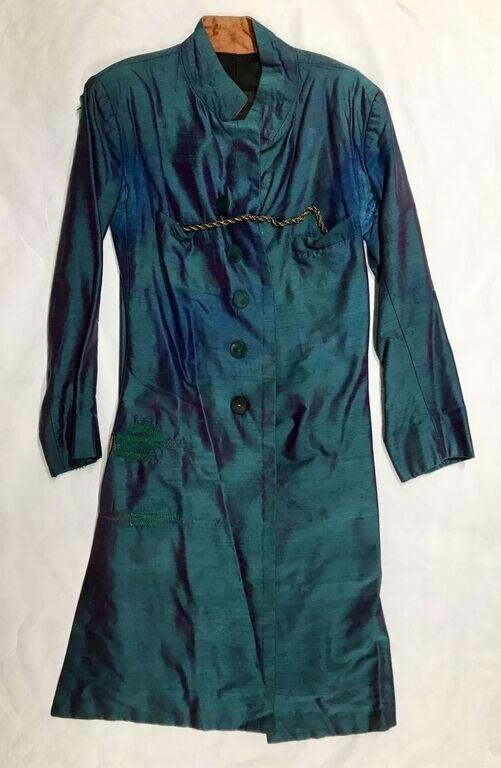
A single garment is displayed against a neutral background on a wooden hanger. The costume is a long-sleeved dress or tunic in deep teal or peacock blue-green silk or linen, falling to below the knee. The fabric shows significant creasing and age-related discoloration, with darker staining visible on the left side and lower portions, suggesting handling and storage over decades. The garment features a loose, draped silhouette with a cowl neckline that hangs generously at the front. Three dark buttons run down the center front. A decorative cord or rope trim in metallic gold or bronze tones crosses diagonally across the torso, possibly securing the garment or serving as ornament. The sleeves are straight and full length, with a relaxed fit. The overall construction is simple and substantial, suggesting a costume piece designed for movement and visibility on stage rather than everyday wear.
The dancing
This is not a depiction of dancers in motion but rather a historical costume object. No human figure is present—only the garment itself, displayed flat on a hanger. The cut and drape suggest it was designed to move with a wearer: the loose sleeves and cowl neckline allow arm mobility, while the straight, A-line silhouette would permit stride and turning. The substantial weight of the fabric and the placement of the fastening cord suggest this piece was intended for theatrical performance rather than social dance.
The dance depicted
This is a costume piece rather than a representation of dance in performance. The garment's style, fabric weight, and construction are consistent with early 20th-century theatrical costume design—the loose silhouette and draped neckline suggest modernist or experimental theatrical practice rather than classical ballet or ballroom dress. The 1983 date likely reflects when the object was catalogued or accessioned, not when it was made; the fabric, construction, and style point to an earlier era, possibly early-to-mid 20th century. Without additional documentation, the specific dance context cannot be determined from the costume alone.
How it was made
This is a three-dimensional costume object, not a two-dimensional artwork. It is a hand-constructed garment made from silk or linen, hand-sewn with running stitches visible at seams and button attachment. The fabric shows natural aging—fading, creasing, and staining—consistent with use and long-term storage. The decorative cord trim appears to be hand-applied. The garment is photographed in situ as a museum object, a conservation documentation practice common for textile and costume collections since the mid-20th century.
About this work
This is a historical dance or theatrical costume: a teal-blue silk or linen dress with simple, loose construction designed for stage performance rather than social wear. The garment's design—with its cowl neckline, full sleeves, and straight silhouette—belongs to early-to-mid 20th-century modernist theater practice, a period when choreographers and costume designers were intentionally moving away from the restrictive, highly decorated garments of classical ballet toward simpler, more functional forms that prioritized movement and visual clarity. The object is significant not as a depiction of dance but as material evidence of how dancers were dressed and how costume functioned as part of the choreographic vision. It belongs in a dance archive because it preserves the physical conditions of performance—the weight, drape, and construction that shaped how a performer moved on stage.
How to look at it
Examine the drape and weight of the fabric; see how it would move with a wearer's arm or torso. Notice the placement of the cord trim and buttons—how they divide and frame the body. Observe the stains and creasing as a record of wear. Consider the neckline: the cowl allows the head and neck visibility and does not restrict the movement of the shoulders. The garment's simplicity is not poverty but a deliberate aesthetic choice—a commitment to letting the body and its movement speak rather than competing with ornament.
The artist
Peter Hall (1930–2005) was a British theater and film director, best known for his work at the Royal Shakespeare Company and for directing several films. If this costume is from Hall's practice, it likely dates to his work in theater rather than his film career. However, without additional documentation, it cannot be confirmed that Hall designed or owned this costume, or that it was used in a dance work specifically; it may be a costume from a theatrical production that included choreographed movement.
The period
The early-to-mid 20th century saw a fundamental shift in how dance costumes were conceived. The heavy, structured silhouettes of Edwardian theater and classical ballet gave way to looser, more minimal forms influenced by modernist visual art and the somatic experimentation of pioneers like Isadora Duncan, Martha Graham, and Merce Cunningham. By the 1930s–1950s, costume designers were working to make the body more visible and the movement more legible, often choosing natural fabrics in plain colors and avoiding ornament that might distract from the choreography. This dress—with its simple construction, unadorned color, and unstructured fit—belongs to that tradition.
Where it lives
The object is held by a costume collection, catalogued in 1983 under the artist's name. The source code 'va' suggests a UK institutional holding, possibly the Victoria & Albert Museum or a similar archive, though this cannot be confirmed from the record alone. As a costume object in a collecting institution, it has been preserved for historical research and exhibition rather than use.
Questions about this work
When was this costume actually made?
The catalogue record lists 1983, but that is almost certainly the accession or documentation date, not the date of manufacture. The fabric type, construction method, and style suggest the costume was made in the early-to-mid 20th century, likely 1920s–1950s. Only technical analysis of the fabric and dye, or additional archival documentation, could pinpoint the date precisely.
What dance or performance did this costume appear in?
The record does not say. The simple construction and style are consistent with modernist theatrical dance of the early-to-mid 20th century, but without more documentation—production photographs, reviews, or label information—it cannot be matched to a specific work or even confirmed that it was used for dance rather than spoken theater.
Why does it have stains?
The stains and creasing are evidence of use and aging. They show that this was a working costume that was worn, moved in, and stored—possibly multiple times—over decades. In conservation terms, they are part of the object's history and are typically not removed, as cleaning can damage fragile historical textiles.
What is the cord across the chest?
It appears to be a decorative trim or functional fastening, applied by hand. It may have served to gather or adjust the loose fabric, or it may be purely ornamental. Without closer examination or archival documentation, its specific function cannot be determined.
More dance artwork





