49 works in this view — arrow keys or swipe to move between them.
Dance in Art
Costume
Hall, Peter
- Collection:
- Costume
- Source:
- Victoria and Albert Museum
- Rights:
- Rights vary by item — check the source record before reusing this image. Source record ↗
- Recorded as:
- V&A — check rights per item
Costume collections preserve the tangible record of how movement was clothed in performance; examining the actual tailoring, fabric choice, and fit reveals the designer's intention and the performer's embodied experience in ways that photographs or sketches cannot. This particular jacket's formal striping and institutional badge may hold significance for a specific production history, making it valuable research material for theatre and performance historians.
What you are looking at
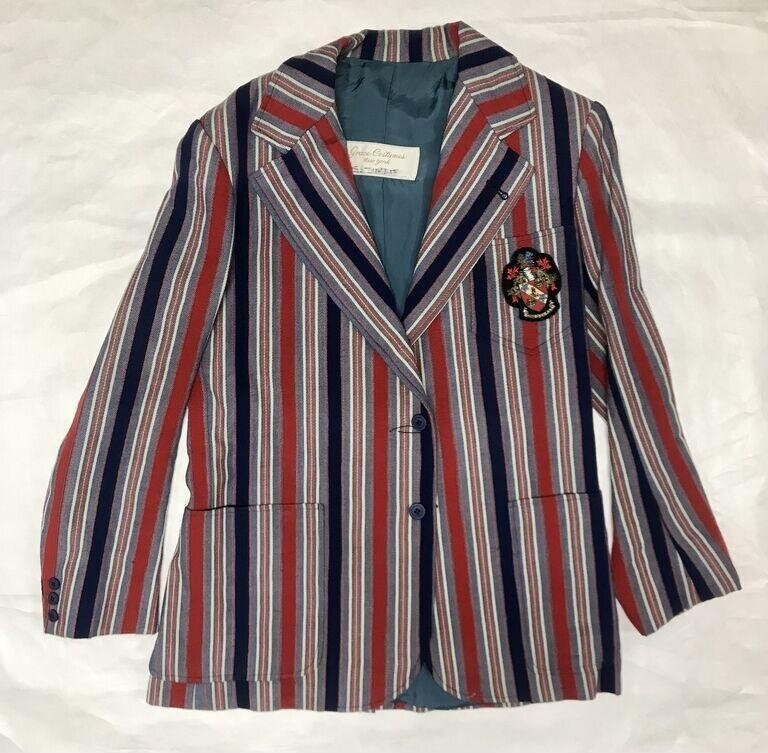
A blazer or jacket lies flat against a pale background, displayed as if on an invisible form. The garment is constructed from a striped fabric in navy, burgundy red, and pale grey or cream, with vertical stripes of varying widths running the full length. The jacket features a classic double-breasted front with at least three visible buttons on the right side, notched lapels, and a structured tailoring typical of 1980s menswear or androgynous formal wear. The sleeves are long and set at a natural shoulder line. A decorative badge or emblem—dark with bright jewel tones—is pinned to the left chest. The interior lining, visible where the jacket lies open, is a deep teal or petrol blue. The jacket appears unworn and is presented as a specimen or costume piece rather than a garment in use.
The dancing
There are no figures or bodies in this image. The jacket is displayed flat and frontal, showing its full cut and construction but no sense of movement, wear, or inhabitation. This is a costume object presented as a textile document rather than as worn dress during performance.
The dance depicted
Without any visible wearer or context of use, the dance genre cannot be determined from the image alone. The formal tailoring and bold striped pattern suggest theatrical costume—possibly for musical theatre, period comedy, or gender-fluid character work—but the specific dance style or performance context is not apparent. The badge suggests a school or institutional affiliation, but whether this was worn by a dancer, actor, or character in another performance mode remains unclear.
How it was made
This is a tailored garment—a jacket constructed from woven striped fabric with hand-stitched or machine-sewn seams, interfaced lapels, and set sleeves. The technique is professional tailoring rather than costume construction; the quality of the work suggests a skilled garment maker or small tailoring house. The preservation of the piece as a flat costume object in a collection means it has been stored and displayed rather than worn to deterioration, allowing the original colours and construction to remain visible.
About this work
This is a theatrical costume jacket from 1983, attributed to designer Peter Hall. The bold vertical striping in navy, burgundy, and cream, combined with formal double-breasted tailoring and a institutional badge, suggests a character costume for a stage production—possibly a comedy, musical, or gender-conscious dramatic work. The garment is preserved as a three-dimensional object in a costume collection, allowing examination of cut, seam construction, and the original colour and fabric rather than relying on production photographs or designer sketches. It is a primary source for how theatrical costume was realized in the early 1980s.
How to look at it
Study the construction of the jacket itself: the lapel roll, the button placement, the sleeve cap, and the seam finishing all reveal the skill and intention of the maker. The striped fabric is cheerful and formal at once—note how the vertical lines emphasise height and formal dress codes, while the burgundy and cream colours against navy make the garment visually assertive rather than neutral. The badge on the chest draws the eye and suggests character identity or affiliation. Without seeing the jacket worn, consider how its weight, structure, and visual impact would register on a moving body and stage.
The artist
Peter Hall was a prominent theatre director and designer whose career spanned the mid-to-late twentieth century. His work encompassed both classical and contemporary drama, often with attention to visual clarity and the formal elements of stagecraft. Costume design was one element of his total theatrical vision.
The period
The early 1980s saw continued evolution in theatrical costume design away from purely historical reproduction toward more conceptual, coded, or symbolic dress. Striped and patterned suiting—particularly bold geometric stripes—appeared frequently in 1980s theatre, film, and fashion as a marker of eccentricity, artificiality, or character distinctiveness. The formal tailoring of this jacket places it within a tradition of dandyish or provocative costume, where formal menswear is rendered strange through colour and pattern.
Where it lives
The jacket is held in a costume collection. The attribution to Peter Hall and the 1983 date come from the catalogue record; the collection source is marked as 'va', which may indicate the Victoria and Albert Museum or another institutional archive, but this is not confirmed by the information provided.
Questions about this work
Is this jacket from a specific production?
The catalogue record attributes it to designer Peter Hall and dates it to 1983, but does not name the production or character for which it was worn. Further research in the holding collection would be needed to establish the full performance context.
Why is a costume preserved flat rather than on a mannequin?
Flat storage and display prevents stress on seams and fabric, reducing deterioration and handling damage. Garments are often photographed and catalogued in this state for conservation and curatorial efficiency, then displayed on forms only for exhibition.
What does the badge on the chest signify?
The badge appears to be a school or institutional emblem, suggesting the character wore or claimed membership in an organization. Its bright enamel or pin-back construction suggests it was affixed to the costume specifically for performance rather than being part of the tailored garment itself.
More dance artwork





