49 works in this view — arrow keys or swipe to move between them.
Dance in Art
Costume
Hall, Peter
- Collection:
- Costume
- Source:
- Victoria and Albert Museum
- Rights:
- Rights vary by item — check the source record before reusing this image. Source record ↗
- Recorded as:
- V&A — check rights per item
For dance historians and performers, this piece documents how costume designers used color, geometry, and stripe direction to amplify and visually extend the body's movement. The diagonal stripes are not incidental pattern but active choreography on fabric—they teach the eye where to look and predispose the viewer to perceive motion.
What you are looking at
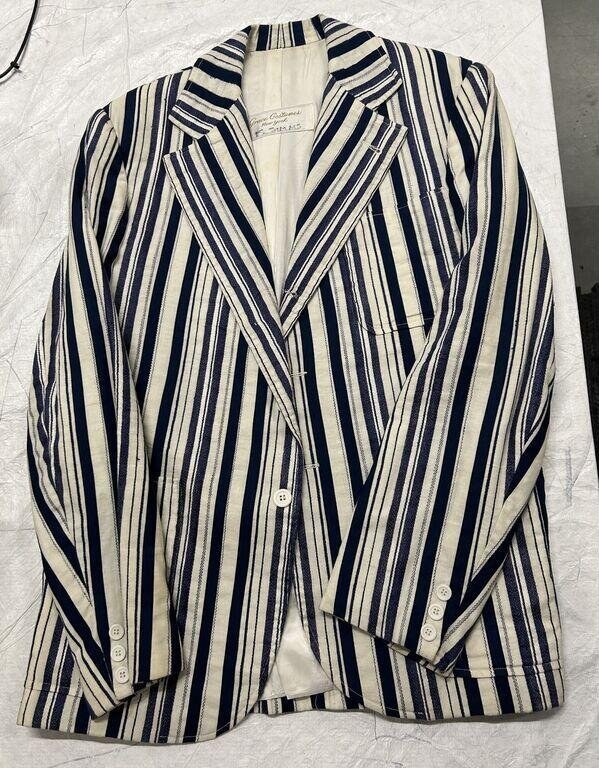
A navy and cream striped blazer lies flat on white fabric, photographed from above. The jacket displays a bold, multi-directional stripe pattern in navy blue and off-white, with vertical stripes dominating the body but diagonal stripes across the front panels creating dynamic visual movement. The collar is open and notched in classic tailored style, revealing the cream lining inside. Two white buttons are visible on the front closure. The garment appears unworn or newly displayed, and the angle of the stripes—especially the diagonal cut across the fronts—creates an optical effect of forward motion, as though the jacket itself is mid-stride.
The dancing
No figures are present. The jacket is arranged to display its full frontal geometry, with lapels splayed open and the body laid flat. The stripe pattern creates an illusion of three-dimensional form and implied motion through the eye's following of the diagonal lines across the front panels.
The dance depicted
This is not a depiction of dance, but rather a costume object—a piece of performance wear. The garment's construction and visual language suggest stage costuming from the early 1980s. The bold geometric stripe pattern and the deliberate interplay of vertical and diagonal lines create a kinetic quality typical of theatrical costume design intended to enhance a dancer's visual impact and apparent motion under stage lighting. The blazer could have been worn by a performer in contemporary dance, musical theatre, or avant-garde performance art of that era.
How it was made
This is a tailored garment—wool, wool blend, or synthetic suiting based on the crisp drape and structured appearance. It was likely photographed as a museum or archival documentation using color film or digital capture, creating a flat, frontal view typical of costume cataloguing practice. The photograph captures the garment's construction detail: the precision of the seams, the placement of the stripe pattern relative to the garment's geometry, and the quality of the tailoring.
About this work
This is a single costume piece from the collection of British designer Peter Hall, dated 1983. It is a performance blazer whose geometric stripe pattern was deliberately engineered to interact with movement and stage lighting. The diagonal stripes across the front panels create a visual vector of motion even when the jacket is still, a sophisticated costume design choice that suggests the wearer's actions and energy. It represents a specific moment in 1980s theatrical design when fashion and avant-garde performance converged around bold geometry and optical dynamism.
How to look at it
Observe how the stripes change direction across the garment's seams: the vertical stripes of the body panels give way to diagonal stripes on the front, creating an implicit vector of forward motion. Notice the precision of the tailoring—how the seams align with the stripe pattern, suggesting this was not a random choice but a calculated design decision. The effect is that the jacket appears to be moving even while still.
The artist
Peter Hall was a British designer active in theatrical and performance costuming in the 1970s and 1980s. His work is characterized by bold geometric patterning and a sophisticated understanding of how fabric interacts with the body in motion and under stage light. The precision of the tailoring and the deliberateness of the stripe geometry suggest training in both haute couture and avant-garde theatre.
The period
In the early 1980s, theatrical and performance costume design in Britain and Europe embraced geometric abstraction, synthetic fabrics, and visual patterning that departed from naturalistic decoration. Designers were engaged with postmodern movement vocabularies that emphasized the body as a surface and geometry as a language. Stripe patterns in particular became a language of dynamism and visual rhythm, influenced by op art and contemporary fashion.
Where it lives
This piece is held in the Costume collection, sourced from holdings designated as 'va' (likely a British museum or archive code). It is catalogued as a single object within a collection of performance dress, preserved as evidence of 1980s theatrical design practice.
Questions about this work
Who wore this jacket?
The catalogue does not identify the performer. It is preserved as a costume object designed by Peter Hall in 1983, but the dancer or actor who performed in it is not recorded.
Was this jacket designed for a specific dance piece or performance?
The record does not specify a production title or collaborating choreographer. The jacket's design language—bold stripes, diagonal emphasis, precise tailoring—suggests it was intended for a contemporary or avant-garde performance, but the exact context is not documented.
Why are the stripes diagonal on the front?
Diagonal stripes interact dynamically with the body's movement, especially the rotation and reach of the torso and arms. Under stage lighting, they create an optical illusion of forward motion and energy that extends the visual impact of the dancer's movement.
More dance artwork





