49 works in this view — arrow keys or swipe to move between them.
Dance in Art
The Tender Husband
Hall
- Collection:
- Source:
- Victoria and Albert Museum
- Rights:
- Rights vary by item — check the source record before reusing this image. Source record ↗
- Recorded as:
- V&A — check rights per item
For historians of dance and gesture, this print is valuable evidence of how non-dance bodily behavior was represented in the period—the upright carriage, the angled stance, the formal distance maintained between social unequals—conventions that governed ballroom and stage alike. It also shows how theatrical illustration itself became a medium for circulating images of fashionable social interaction, making the play and its actors' deportment visible to readers who might never attend a performance.
What you are looking at
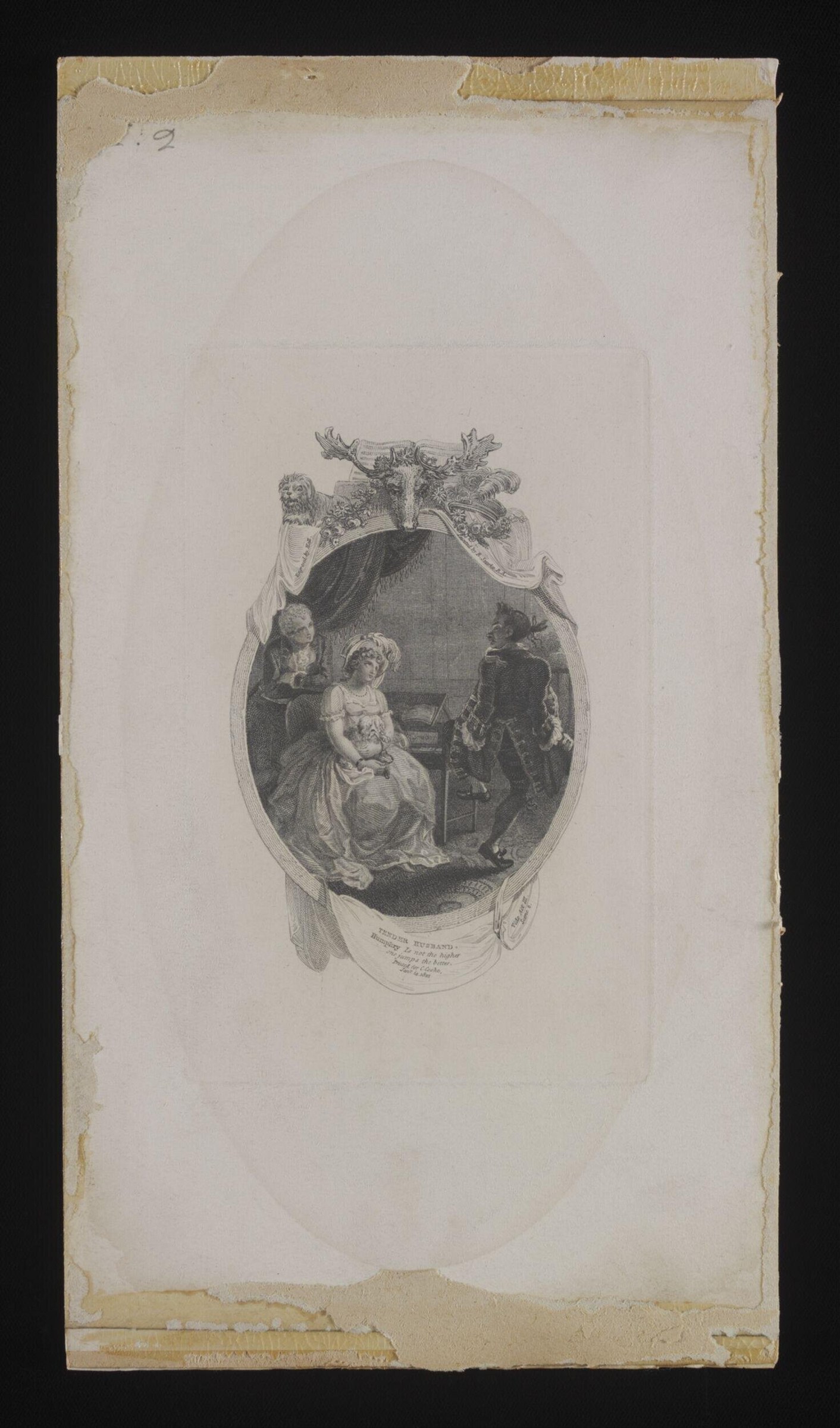
An oval-framed engraving depicting an interior scene from what appears to be an 18th-century comedy of manners. A woman in an elaborate white gown sits centrally, attended by a young page or servant boy to her left. A man in dark formal dress and hat stands to her right, engaged in conversation or courtship. The setting is a modest interior with draped fabric overhead—possibly a tent or pavilion—creating an intimate domestic space. The composition is tightly focused on the three figures, with decorative ornamental elements framing the scene in an elaborate cartouche at top (including drapery, cherub-like figures, and foliage) and a cartouche below containing the title and attribution. The light is even and theatrical, typical of reproductive prints intended for circulation as theatrical illustrations.
The dancing
The woman sits upright in a posture of restrained dignity, her voluminous skirts spreading across the seat. Her gaze is directed toward or past the standing man, her posture neither welcoming nor rejecting. The man stands at a conversational distance, his weight distributed evenly, his body angled toward her in a posture of address or entreaty typical of courtship scenes. The boy stands passively beside the woman, serving as a visual and compositional counterweight. There is no suggestion of partnered movement or dance hold; the figures are arranged in a tableau of social interaction rather than kinetic engagement.
The dance depicted
This print does not depict dance in the strict sense. It illustrates a dramatic scene—likely from Richard Steele's comedy *The Tender Husband* (1705), judging from the title—in which social etiquette and courtship convention are the subject, not bodily movement. The composition draws instead on the visual language of theatre and social comedy, where stance and gesture convey character and intention. Any 'dance' here is metaphorical: the social choreography of courtship, negotiation, and domestic hierarchy.
How it was made
This is a line engraving, recognizable by the fine parallel hatching used to model form and create tonal gradation, and by the crisp, sharp lines and clear detail throughout. The technique suggests professional reproductive work intended for circulation as a theatrical illustration, likely accompanying a printed edition of the play or sold separately to theater audiences. The oval frame within the rectangular plate, the ornamental cartouche, and the inscription below are typical of 18th-century engraved illustrations of theatrical scenes. The scale and format indicate this was designed for bound collections or framed display in homes of readers interested in theater and current drama.
About this work
This is an engraved illustration of a scene from Richard Steele's comedy *The Tender Husband*, showing a moment of courtship or social negotiation between a gentleman and a seated lady attended by a page. It belongs in a gallery of dance in art not because it depicts dancing, but because it records the visual conventions and bodily deportment of a specific historical moment—one in which the social 'performance' of courtship and genteel manners was itself a kind of choreography, governed by strict rules of dress, posture, and spatial relationship. The print documents how 18th-century audiences understood the body in social situations and how artists of the period rendered human interaction through theatrical composition and engraved line.
How to look at it
The viewer should attend to the precise postures and spatial relationships of the three figures—the woman's seated composure, the man's stance of address, the boy's deferential positioning—as these encode social meaning in the period's visual language. The moment chosen is not one of action or movement, but of social encounter: the artist has frozen a conversational moment to emphasize the attitudes, distances, and hierarchies that governed polite society. The ornamental framing, with its theatrical drapery and cherubs, signals that this is a scene of fashionable drama, not domestic realism; the artificial composition invites viewers to read the figures as performers.
The artist
The artist 'Hall' is not identified in the catalogue record. Reproductive engravers of the early 18th century often worked in relative anonymity, producing theatrical illustrations for publishers on commission. The high quality of line work and the competent handling of drapery and form suggest a trained hand, but without further documentation, the artist's individual practice and career remain unestablished.
The period
The early 18th century saw the rise of illustrated printed editions of popular plays and the circulation of theatrical engravings as independent commercial objects. *The Tender Husband*, first performed in 1705, was a successful and frequently reprinted comedy of manners, and its scenes became standard subjects for engravers. The period was one of intense interest in codifying and representing genteel social behavior—the very subject of Steele's play—as an expanding middle class sought visual guidance on proper deportment. Engraved theatrical scenes served both as mementos of performances and as models of fashionable conduct.
Where it lives
This engraving is held in the collections of the Virginia Museum of History & Culture (catalogue reference 'va'). It is part of the museum's print collection and is catalogued as a historical theatrical illustration.
Questions about this work
Is this actually a dance image?
No, this print depicts a dramatic scene of courtship or social negotiation, not dancing in the theatrical or ballroom sense. However, it is valuable for understanding the bodily conventions and postures that governed 18th-century social life—a kind of 'social choreography' that was inseparable from the movement practices of the period. It documents how bodies were supposed to move and stand in formal interaction.
What is 'The Tender Husband'?
It is a comedy by Richard Steele, first performed in 1705, satirizing the follies of courtship and married life among the English gentry. The play was popular and frequently reprinted, and scenes from it were a common subject for theatrical illustrators throughout the 18th century.
Who was the artist?
The catalogue record attributes this engraving to an artist named 'Hall,' but does not provide dates, biographical information, or confirmation of this attribution. The quality of the work suggests a professional reproductive engraver working for a London publisher, but the artist's individual identity and career remain undocumented here.
How was this engraving made?
This is a line engraving, a printmaking technique in which an image is incised into a metal plate with a pointed tool called a burin. The plate is then inked and printed on paper under pressure. The fine parallel lines visible throughout the image (called hatching) are the characteristic hallmark of hand-engraved work and create the tonal gradations that model form.
More dance artwork





