49 works in this view — arrow keys or swipe to move between them.
Dance in Art
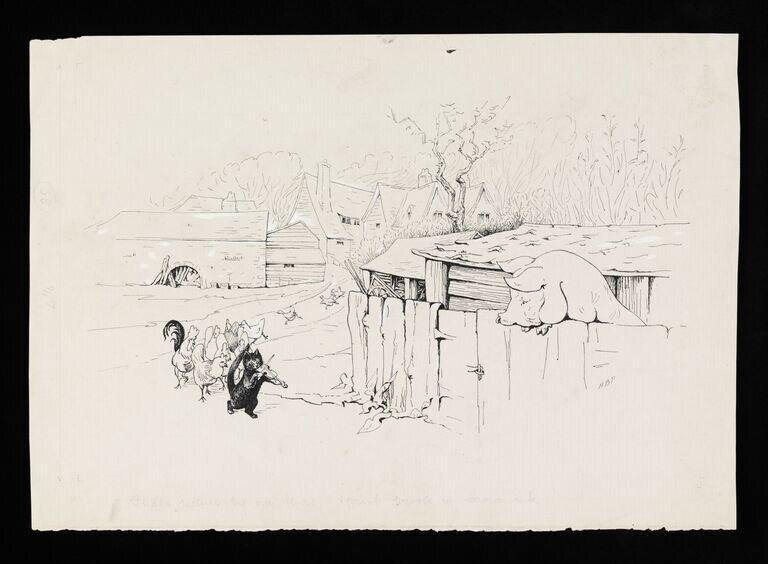
Come dance a jig, to my Granny's pig
Potter, Beatrix
- Collection:
- drawing
- Source:
- Victoria and Albert Museum
- Rights:
- Rights vary by item — check the source record before reusing this image. Source record ↗
- Recorded as:
- V&A — check rights per item
This work documents English folk dance as a lived, everyday practice rather than a staged performance or historical curiosity. It shows how a major artist of the period understood and rendered the physicality of vernacular dance, offering a valuable counterpoint to the theatrical ballet and formal social dances that dominate period art historical records.
What you are looking at
A pen-and-ink sketch of a farmyard scene set in rural England, dominated by a substantial wooden barn or shed with a sloped roof in the middle distance. The structure is drawn with careful attention to its timber construction and weathered detail. To the left, a water wheel and additional farm buildings suggest a working mill or farm. The landscape is framed by tall reeds and willows, characteristic of English wetland or riverside country, rendered with loose, gestural linework. In the foreground, at the left, three figures are engaged in active movement: a woman in a long skirt, a man in darker clothing, and a goat or pig—the titular "granny's pig." Their postures suggest vigorous, playful motion. The drawing style is characteristic of book illustration, with economical line work and areas of white paper left unworked, giving the scene a light, sketch-like immediacy.
The dancing
Three human figures animate the foreground, their bodies caught in a moment of energetic movement. The central woman wears a long skirt that swings outward, her posture open and unguarded, suggesting rapid motion or a turning step. The man beside her is darker in tone, his body angled toward her in engagement. Both figures lean into their action with an unselfconscious exuberance characteristic of folk movement rather than formal dance. The pig or goat between them is drawn with equivalent dynamism, its body in motion, making it an active participant in the scene rather than mere scenery.
The dance depicted
The title announces a jig, and the image supports this identification through several markers: the rural English setting, the farmyard context, the presence of a pig (a fixture of folk tradition and children's rhymes), and most importantly the style of movement visible in the figures' bodies. A jig is a spirited folk dance in quick duple or compound time, danced by couples or groups in informal social settings. This sketch appears to document or celebrate precisely such a moment—the spontaneous, playful performance of a traditional jig, likely tied to an English nursery rhyme or folk tradition. The energy and informal posture suggest this is observation of actual vernacular dance practice rather than theatrical reconstruction.
How it was made
This is a pen-and-ink drawing, probably executed on paper, rendered in a technique that favors rapid, assured line work over tonal modelling. Beatrix Potter was a practiced illustrator working at the turn of the twentieth century, and this sketch shows the characteristic economy of her pen: detail concentrated where needed (the barn, the figure faces), and looser, more suggestive line work in the landscape. The technique allowed for rapid circulation as book or periodical illustration and suggests an audience of readers familiar with both English rural life and the nursery-rhyme tradition the title invokes.
About this work
This is a pen-and-ink sketch of three figures dancing a jig in a farmyard setting, animated by a recognizable English folk dance tradition and title. The work sits at the intersection of children's book illustration, rural vernacular practice, and dance documentation—a record of how ordinary people moved in ordinary places. Potter's observation of the figures' bodies and her attention to the specific landscape and architecture suggest she witnessed or deeply understood the social and physical context of folk dancing in Edwardian England.
For a gallery focused on dance in art, this work is valuable precisely because it does not romanticize or formalize its subject. It shows a jig as it was actually danced: playful, informal, integrated into farmyard life, and involving animals as well as people. The sketch records a moment of genuine folk culture at the moment when such practices were becoming subjects of antiquarian interest and nostalgic documentation.
How to look at it
Attend to the posture and weight of the dancing figures—how Potter has caught them in the moment of a turn or leap, with the woman's skirt and the man's body both angled to suggest momentum and abandon. The pig's inclusion is not incidental: notice how it is drawn with the same dynamic energy as the human dancers, making the scene one of collective play rather than formal instruction. The looseness of the linework contrasts with the more careful rendering of architecture and landscape, suggesting that the artist prioritized capturing the energy of the moment over documentary precision. The rural setting—the barn, the reeds, the water wheel—is not mere backdrop but context: this is how folk dances lived, in working landscapes, not in drawing rooms.
The artist
Beatrix Potter (1866–1943) was a writer, illustrator, and naturalist best known for her children's books, particularly The Tale of Peter Rabbit (1902). She was trained as an illustrator and naturalist, with a careful eye for observation and an ability to render both human figures and animals with psychological presence. Potter's illustrations spanned children's literature, scientific study, and personal artistic practice. Her work in all media shows an interest in ordinary life—gardens, farms, animals, and people—rendered with humor and affection rather than sentimentality.
The period
In the early 1900s, when this drawing was made, English folk dance was undergoing a revival among educated middle-class people concerned with cultural preservation. Cecil Sharp's English Folk Dance Society, founded in 1911, would soon begin systematic collection and documentation of folk traditions. At the same time, commercial ballet and music-hall dance dominated theatrical entertainment. Potter's sketch belongs to neither camp: it is neither nostalgic antiquarianism nor commercial spectacle, but rather an artist's informal record of actual rural practice. The work also reflects a broader period interest in childhood, play, and the natural world as subjects worthy of serious artistic attention.
Where it lives
This is a drawing from the collection held at the Victoria and Albert Museum in London, part of the broader record of Potter's work as illustrator and artist. The notation "VA" in the source field confirms the Victoria and Albert Museum as the holding institution.
Dance in this work
Questions about this work
What is a jig and how does it differ from other folk dances?
A jig is a lively folk dance performed to fast, sprightly music in compound time, traditionally danced by couples or small groups in informal social settings. It is characterized by quick footwork, high spirits, and a bouncing rhythm, and appears across English, Scottish, and Irish traditions. Unlike quadrilles or country dances, which often involved set formations and called figures, jigs were more improvisational and could be performed anywhere—in farmyards, at fairs, at celebrations—by people with little formal training.
Why would Beatrix Potter draw a scene of dancing?
Potter's work as an illustrator meant she drew all manner of scenes from daily life and nursery traditions. The title references what is likely a children's rhyme or folk saying—'Come dance a jig to my Granny's pig'—and the sketch may have been made for a book project or to explore the subject for its own sake. Potter was interested in observing and recording actual behavior, whether of animals or people, and folk dances were part of the rural culture she encountered and valued.
Is this sketch an observation from life or an imaginative recreation?
That cannot be determined with certainty from the image alone. Potter was both a keen observer of natural and social life and an accomplished illustrator capable of imaginative reconstruction. The specificity of the farmyard setting and the convincing physicality of the dancing figures suggest either close observation or deep familiarity with the subject. Either way, the work records Potter's understanding of how people actually moved in the context of folk celebration.
What does this work tell us about dance in 1905?
It shows that folk dances like jigs were still active, informal, spontaneous practices in rural England in the early twentieth century—not yet 'folk revival' performances staged for audiences, but living tradition. It also demonstrates that serious artists and illustrators like Potter took such practices as fit subjects for attention and careful observation, placing folk culture within the broader landscape of cultural value.
More dance artwork





