49 works in this view — arrow keys or swipe to move between them.
Dance in Art
Greenwich Fair
Cruikshank, George
- Collection:
- Drawing
- Source:
- Victoria and Albert Museum
- Rights:
- Rights vary by item — check the source record before reusing this image. Source record ↗
- Recorded as:
- V&A — check rights per item
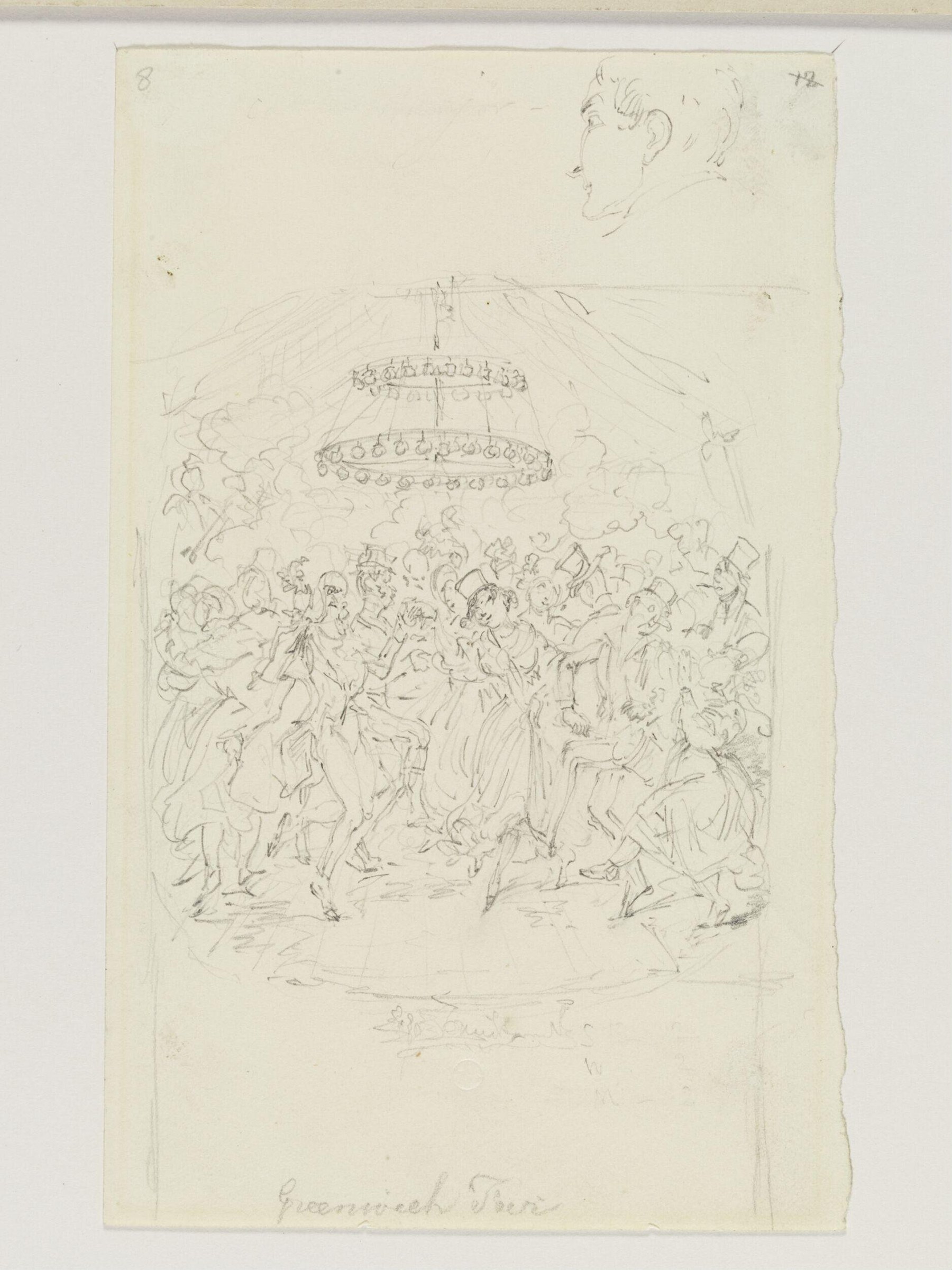
For dance historians, this work is valuable not as a record of dance technique but as evidence of the social context in which dance and other entertainments occurred—the fairs and public gatherings where common people encountered music, movement, and spectacle. Cruikshank's satirical attention to crowd behavior and social interaction reveals how dance and movement functioned as part of broader popular culture rather than as a discrete art form.
What you are looking at
This pen sketch depicts a crowded interior scene beneath a large ornamental chandelier suspended from the ceiling. The space is filled with dozens of figures in 19th-century dress—men in top hats and tailcoats, women in full skirts—arranged in a densely packed, animated composition. The figures are distributed throughout the floor space in no strict formation, suggesting spontaneous movement and social mingling rather than formal choreography. The sketch is executed in rapid, gestural pen strokes that prioritize capturing the energy and confusion of the crowd over precise detail. A profile portrait study of a man's head appears in the upper right corner, possibly a character study. The inscription 'Greenwich Fair' at the bottom identifies this as a scene from the famous fair held in Greenwich, London, known for its popular entertainments and crowded, sometimes chaotic atmosphere.
The dancing
The bodies throughout are drawn in quick, loose strokes suggesting movement and liveliness. Most figures are standing or in upright postures, with arms gesturing variously—some raised, some extended in social engagement. There is no clear paired dancing; instead the composition suggests the crush and mingling of a fair crowd. A few figures appear to be in motion, but the overall impression is of social promenade and casual interaction rather than choreographed dance steps. The variety of poses and the overlapping figures create visual confusion deliberately—the hallmark of Cruikshank's satirical style.
The dance depicted
This is not primarily a dance scene but rather a representation of social activity and popular entertainment at a mid-19th-century fair. While the crowd is animated and the postures suggest movement and gaiety, there is no evidence of formal dance styles or partnered dancing. The scene captures the social mingling, flirtation, and casual movement typical of fair-going. Any dancing that occurred at Greenwich Fair would have been part of the broader popular culture and carnival atmosphere, possibly folk-regional in character, but this sketch emphasizes the social chaos and energy rather than documenting any specific dance form.
How it was made
This is a pen drawing on paper, executed in the rapid, gestural style characteristic of Cruikshank's satirical work. The technique relies on economical line and suggests rather than defines detail—individual faces are barely indicated, drapery is rendered in quick parallel strokes, and the overall effect depends on the accumulation of gestural marks to convey crowd and movement. This approach was typical of Cruikshank's preliminary sketches and satirical illustrations, which were often engraved or lithographed for publication in periodicals and satirical prints. The loose, improvisational quality suggests this may be a working study rather than a finished work intended for direct publication.
About this work
George Cruikshank's sketch of Greenwich Fair is a satirical representation of popular social entertainment in early 19th-century London, capturing the energy and crowding of one of the city's most famous public entertainments. Rather than documenting a specific dance, it records the broader culture of movement, mingling, and leisure that characterized fair-going in the period. The work exemplifies Cruikshank's talent for social observation and his interest in popular and working-class amusements, rendered through a technique that prioritizes liveliness and energy over formal precision.
How to look at it
Notice the density of the composition and how Cruikshank uses overlapping figures and varied postures to suggest the press and energy of the crowd. Look at how individual figures are barely particularized—faces are schematic, drapery is indicated by a few lines—yet the overall effect is of vivid animation. The chandelier overhead anchors the interior space and may allude to the pretension of public entertainments trying to mimic fashionable venues. The rapid, unfinished quality of the sketch itself conveys the spontaneity and chaos Cruikshank saw in fair culture.
The artist
George Cruikshank (1792–1878) was England's foremost satirical artist and illustrator of the early-to-mid 19th century, celebrated for his caricatures, social commentary, and illustrations for major literary works. He was deeply interested in recording scenes of popular and working-class life—fairs, street entertainments, public houses, and celebrations. His rapid pen technique and gift for capturing telling gesture and character made him ideally suited to satirical subjects. Greenwich Fair was a recurring subject in popular prints and literature, and Cruikshank contributed to its representation as a symbol of unbridled popular pleasure, occasionally rowdy behavior, and the vitality of urban leisure culture.
The period
Greenwich Fair, held from the 17th century until its closure in 1857, was a major public entertainment venue famous for its mix of attractions—games, shows, food, and music—and for its somewhat disreputable reputation for drinking and flirtation. In the early 19th century, when Cruikshank was active, the fair represented a space of relative freedom and social mixing, though it was also increasingly criticized by middle-class reformers. The period saw growing anxiety about popular amusements and working-class leisure, reflected in satirical prints that both celebrated and mocked fair culture. Dance and music at fairs were typically folk or popular styles, often accompanied by street musicians and itinerant performers.
Where it lives
The work is recorded as a drawing held in a collection designated 'va', indicating a holding in a major British or American museum or archive, though specific accession details are not provided in the available record.
Questions about this work
What was Greenwich Fair?
Greenwich Fair was a major public entertainment held annually near Greenwich, London, from at least the 17th century until 1857. It attracted thousands of visitors and featured games, shows, food stalls, music, and dancing. By the 19th century it had become notorious for rowdiness and was eventually closed under pressure from middle-class reformers who viewed it as disorderly and morally suspect.
Why didn't Cruikshank show actual dancing?
Cruikshank was a satirist interested in social behavior and character rather than technical accomplishment. His focus was on the crowd, the mingling, the energy, and the chaos of fair culture. Dance, if present, was likely incidental to the broader social scene he wanted to capture.
Is this a finished work?
The loose, gestural quality and lack of finish suggest this may be a preliminary sketch, possibly made as a study for a more finished engraved or lithographed print. Cruikshank often worked in this rapid pen style for initial composition before developing designs for publication.
More dance artwork





