49 works in this view — arrow keys or swipe to move between them.
Dance in Art
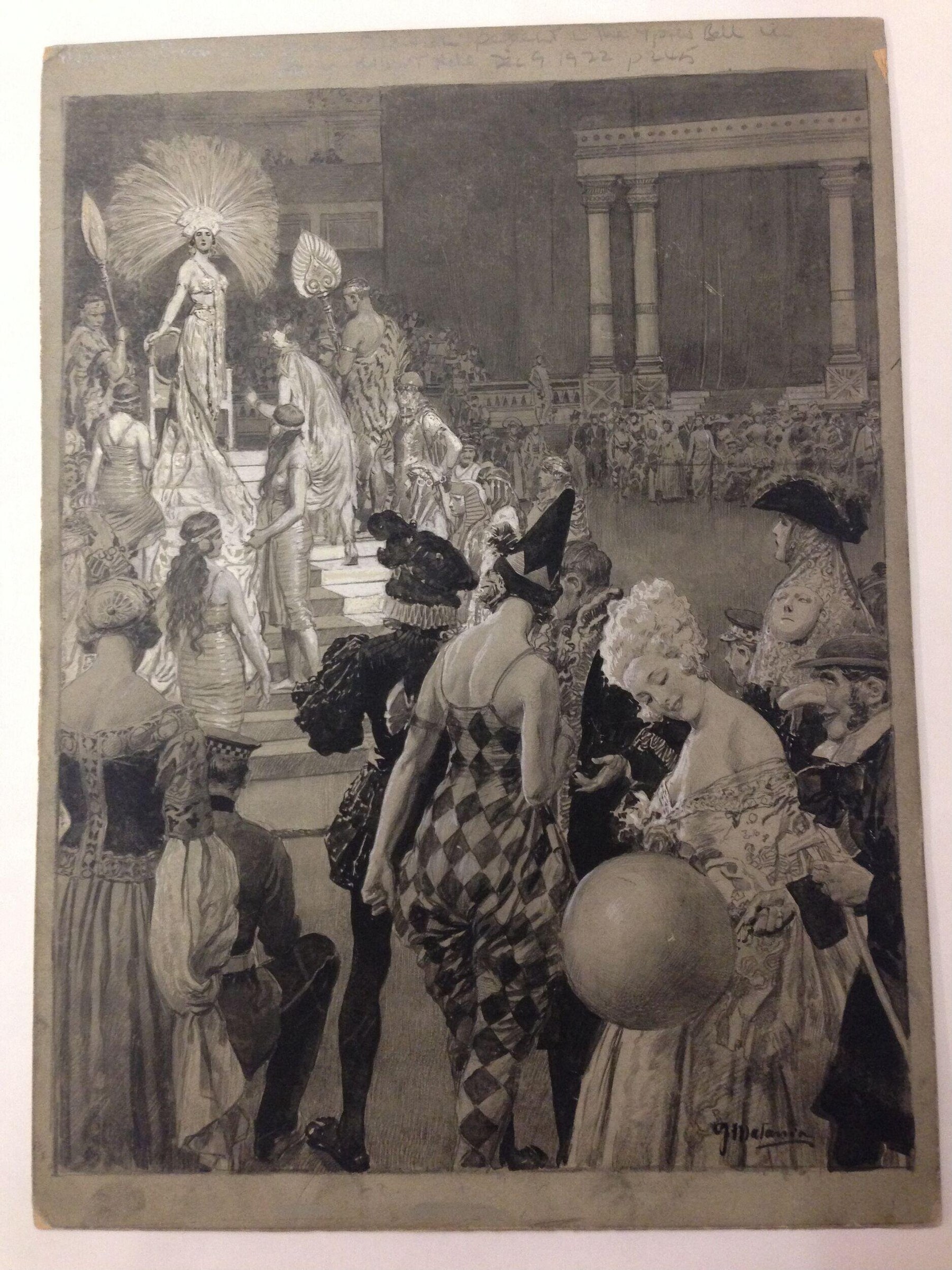
The Queen of Sheba in the "Eastern Question" Pageant
Matania, Fortunino
- Collection:
- Drawing
- Source:
- Victoria and Albert Museum
- Rights:
- Rights vary by item — check the source record before reusing this image. Source record ↗
- Recorded as:
- V&A — check rights per item
This image captures a vanished genre of theatrical entertainment and shows how dance dissolved into costume and spectacle in fashionable Edwardian and inter-war entertainment. It documents the orientalist imagination as it filtered through 1920s society revue, where historical and exotic narrative served as a frame for displaying contemporary fashion and social identity. For historians of theater, dance, and visual culture, it reveals how movement, dress, and setting were orchestrated as unified spectacle before the modernist turn made such eclecticism unfashionable.
What you are looking at
A grand palatial interior stages an elaborate procession centered on a richly costumed female figure—the Queen of Sheba—who stands elevated on a dais wearing a radiating headdress of enormous feathered proportions and a flowing white gown. She is flanked by attendants in classical drapery and orientalist costume. In the foreground, figures in contemporary 1920s evening dress—men in black tail coats and women in beaded, low-waisted gowns with characteristic bobbed hair and cloche hats—process toward her in a stately formation. The architectural setting features monumental columns and a coffered ceiling suggesting an ancient temple or palace. The entire composition moves from foreground modernity into historical pageantry, with massed extras filling the receding space, suggesting this is a theatrical or ceremonial event witnessed by an assembled crowd.
The dancing
The Queen of Sheba dominates through stillness and verticality: she stands upright in a formal, frontal pose with arms positioned to display her costume, a posture of ceremonial presentation rather than kinetic movement. The 1920s figures in the foreground move in processional formation—a slow, orderly progression toward the dais with bodies held upright and dignified, arms at sides or gesturing in formal greeting. One woman in a diamond-patterned costume turns slightly as she approaches. The attendants surrounding the Queen maintain static, posed positions around her figure. This is stately ceremonial movement, not dance in the vernacular sense—processional, hieratic, built on symmetry and formal spacing rather than steps or partnering.
The dance depicted
This depicts a theatrical pageant rather than a recognizable dance form. The 'Eastern Question' pageant was likely a West End revue or society entertainment popular in 1920s London, blending orientalist spectacle with contemporary fashion and social display. The movement shown is processional pageantry in the Belle Époque tradition—a formal, slow advancement of costumed figures in a hierarchical arrangement designed for visual effect rather than choreographic content. No specific dance style is evident; the work documents a moment of fashionable theatrical exhibition where dance has dissolved into costume display and ceremonial staging. The historical and orientalist elements suggest an amateur or semi-professional society entertainment, the kind that combined biblical or historical narrative framing with modern social dancing in interludes.
How it was made
This is a drawing, likely executed in pen or ink with extensive wash or tonal work to build the rich atmospheric effects and deep shadows of the interior space. The technique creates dramatic chiaroscuro—brilliant highlights on the Queen's headdress and the white gowns of the figures contrast sharply with the shadowed recesses of the architecture and crowd. The artist has used fine linear detail in the costumes and architectural ornament while softening the mass of background figures into impressionistic suggestion. This tonal and linear approach was characteristic of theatrical and social documentation in the 1920s press, where such images appeared as supplements to theater reviews and society pages. The sophistication of the technique and the scale suggest this was a professional commission, possibly for an illustrated periodical or theater program.
About this work
This is a record of fashionable theatrical pageantry from 1920s London—a moment from the 'Eastern Question' pageant that staged contemporary high society alongside orientalist fantasy. The work shows the boundary where theatrical costume and display supersede choreographed dance: the movement is processional and ceremonial, the spectacle derives from dress and architecture rather than kinetic invention. It documents an era when London's West End entertainment mixed historical drama, social satire, and modern fashion in spectacular but dramatically thin productions. The drawing's technical sophistication and compositional grandeur suggest it was created as a substantial document of the event, not a casual sketch—evidence that such pageants commanded serious artistic attention and investment.
How to look at it
Look first at the contrast between the two groups of figures: the contemporary 1920s women and men in the foreground, rendered with naturalistic precision and specificity, and the timeless, posed figures of the Queen and her attendants in the background. Notice how the artist uses architectural grandeur and atmospheric depth to overwhelm the procession—the immense columns and shadowed recesses dwarf the figures and make the entire scene a property or backdrop rather than an event with human agency. The Queen's enormous headdress demands visual attention, but her body is static and merely presentational. Watch how the contemporary figures move toward her in orderly, stately progression: this is not dance but ritual, the spectacle of social ceremony framed as historical drama. The technical achievement lies in rendering the scale, the costume detail, and the tonal atmosphere; the movement itself is almost incidental to the orchestration of space and light.
The artist
Fortunino Matania (1881–1944) was an Italian-born illustrator and painter who established himself as a leading society and theatrical illustrator in London from the early 1900s onward. He was known for his technically accomplished drawings of high-society events, theater productions, and pageants, which appeared regularly in The Tatler, The Sketch, and other illustrated periodicals catering to the British elite. His work combined academic draftsmanship with a facility for rendering fabric, costume detail, and architectural space, making him a natural choice to document theatrical spectacles. Matania's practice was deeply embedded in the machinery of fashion and social reporting; his drawings were part of the apparatus through which London society consumed and legitimized its own entertainments.
The period
In the 1920s, London's West End stage was dominated by revues and pageants that mixed music, comedy, social satire, and orientalist fantasy in loose, spectacular formats. The 'Eastern Question' pageant belongs to this tradition of amateur and semi-professional society entertainment, where wealthy patrons and their circles staged elaborate productions combining contemporary fashion display with historical or exotic narrative framing. This was the era before 'serious' modern dance had established institutional presence in Britain; ballet remained Diaghilev's Russian import or music-hall diversion. Theatrical dance was understood primarily as spectacle—the coordination of costume, lighting, massed figures, and architectural effect—rather than as a choreographic or kinetic art. At the same time, the modernist movement in visual art was already rendering such eclecticism and orientalism deeply unfashionable; Matania's meticulous documentation was already capturing a world that would soon seem hopelessly dated.
Where it lives
The work is held as a drawing in the collection of the Victoria and Albert Museum, London. The 'va' source designation indicates it derives from the V&A's extensive holdings of theatrical and social documentation. It likely entered the museum as part of systematic collection-building around British theater history and illustrated media of the early-to-mid twentieth century.
Questions about this work
Was this an actual performance, or a costume fantasy?
It was almost certainly an actual pageant or revue staged in London, likely as a society entertainment or West End production. The presence of a professional illustrator documenting it, and the periodical publication context suggested by the drawing's style and quality, indicates it was a real event of sufficient cultural standing to merit such attention. However, the narrative and characters were theatrical invention—the 'Eastern Question' was a topical reference to ongoing British imperial concerns in the Middle East, deployed here as a frame for spectacle and social display rather than historical accuracy.
Why are there women in modern dress alongside the Queen of Sheba?
This was a standard device in 1920s revue and pageant: contemporary figures (usually fashionable women and men from society) were integrated into historical or exotic scenes, often as witnesses, commentators, or active participants. It allowed the production to display current fashion and social identity while maintaining the fantasy frame of the historical narrative. The contrast between modern and historical costume was itself part of the spectacle and humor.
Is this a dance work?
It is theatrical in nature but movement and choreography are not central to its conception. The image documents a processional, ceremonial moment within a larger pageant—a moment of spectacle and display rather than dance. The work belongs more properly to theater history and the history of social entertainment than to dance history proper, though it reveals how dance was subordinated to costume and visual effect in fashionable Edwardian and inter-war theater.
More dance artwork





