49 works in this view — arrow keys or swipe to move between them.
Dance in Art
Costume
Lefresne, Bernard
- Collection:
- Costume
- Source:
- Victoria and Albert Museum
- Rights:
- Rights vary by item — check the source record before reusing this image. Source record ↗
- Recorded as:
- V&A — check rights per item
Costumes are primary historical evidence for how dance was staged and how dancers moved in period works. This piece reveals the constructed silhouette, fabric choices, and sleeve construction that shaped both the visual appearance and the kinetic possibilities of performance in its era. Understanding costume is inseparable from understanding how the body occupied and moved through historical dance forms.
What you are looking at
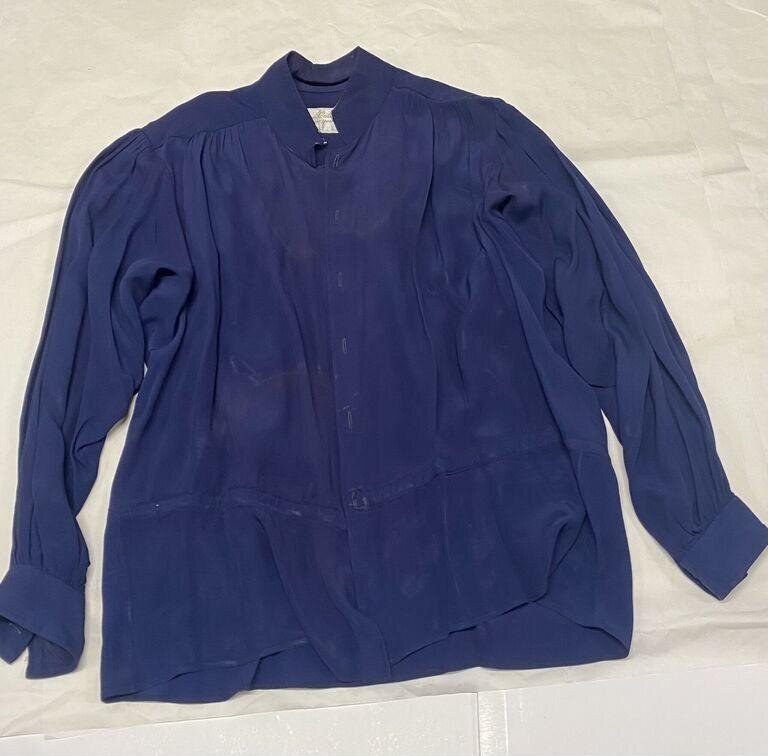
A navy blue garment lies flat on a white surface, photographed from above. The piece is a full-length tunic or loose-fitting dress with long sleeves gathered at the cuffs. The body is gathered generously at the shoulders and upper arms, creating voluminous puffed sleeves characteristic of Romantic-era costuming. The front placket shows a row of small buttons or fastenings running down the center. The fabric appears to be cotton or linen, somewhat rumpled and worn, with visible creases and age marks across the surface. The garment's cut—loose through the body, with minimal fitted waist definition—and the scale of the sleeve volume suggest this is a period stage costume rather than everyday wear.
The dancing
This is not a work depicting figures or gesture, but rather a costume object itself. The garment is displayed flat and unstaged, making it impossible to assess fit or how a dancer would inhabit the piece. No human body is present in the image.
The dance depicted
This appears to be a stage costume, likely from theatrical dance of the 19th or early 20th century. The loose construction and gathered sleeves are consistent with Romantic ballet costuming conventions, though the piece could equally belong to other theatrical dance forms of the era. Without seeing the costume in wear or in performance context, and given only a flat-lay photograph of the garment itself, specific dance form identification is unreliable.
How it was made
This is a three-dimensional costume object—a sewn garment—photographed directly in flat lay. The photograph is digital color, likely museum documentation of a textile object in the collection. The condition of the fabric shows age, creasing, and wear consistent with a working stage costume. Photography of this type serves archival and educational purposes, allowing viewers to study construction details, fabric quality, and wear patterns that reveal performance history.
About this work
This is a navy blue stage tunic with voluminous gathered sleeves, documented as a costume object dated to 1983 in the collection. The style and construction suggest Romantic-era theatrical dance costuming traditions. The flat-lay photograph is a museum documentation of a textile artifact, recording the physical object for preservation and study. As a costume piece itself rather than an artwork depicting dance, it represents the material culture of dance practice and performance.
How to look at it
Observe the sleeve construction carefully: the way the fabric is gathered at the shoulder and controlled at the cuff would have allowed the dancer to move the arm freely while maintaining visual volume and silhouette. Notice the rumples and creasing in the fabric—these are traces of use. The centerline button placket and the complete lack of fitted waist definition distinguish this from everyday 20th-century dress and mark it as theatrical costume. The navy color suggests a secondary or supporting character role in classical ballet tradition.
The artist
Bernard Lefresne is credited as the artist or creator of this costume. Without additional documentation, the nature of his role—whether designer, maker, or documenter—cannot be established from the image alone. The costume is held within a collection identified as 'Costume' in the catalogue record.
The period
The 1983 date in the record is surprising given the garment's apparent 19th-century construction and styling. The voluminous puffed sleeves and loose tunic cut are consistent with Romantic ballet costuming of the 1830s–1860s, suggesting either that this is a reproduction or recreation of a historical costume, or that the date in the record may refer to acquisition or documentation rather than creation. The Romantic era privileged ethereal, loose-fitting costumes that suggested otherworldly or exotic subjects.
Where it lives
The costume is held in a collection identified as 'Costume' with source marked 'va'. The piece was catalogued in 1983, though whether that represents the creation date, acquisition date, or accession date is unclear from the record.
Questions about this work
Is this a Romantic ballet costume?
The styling—particularly the voluminous gathered sleeves and loose tunic cut—is consistent with Romantic-era theatrical dance costuming. However, the 1983 date in the catalogue record complicates attribution. This could be an original period garment, a later reproduction, or a costume created in a Romantic style for 20th-century performance. Only additional documentation would confirm.
What would a dancer wear under this?
In Romantic ballet, such a tunic would typically be worn over a fitted undergarment or corset that shaped the torso, with legs covered in tights. The loose outer garment created silhouette and allowed leg movement while the gathered sleeves framed the upper body. The navy color suggests this was not a lead role costume, which would typically be lighter or more elaborate.
Why is it photographed flat instead of on a dress form?
Flat-lay photography of textile objects allows documentation of overall construction, fabric condition, seaming details, and evidence of wear and repair. This archival approach captures the object as a historical artifact and working garment, showing how age and use have marked it.
More dance artwork





