49 works in this view — arrow keys or swipe to move between them.
Dance in Art
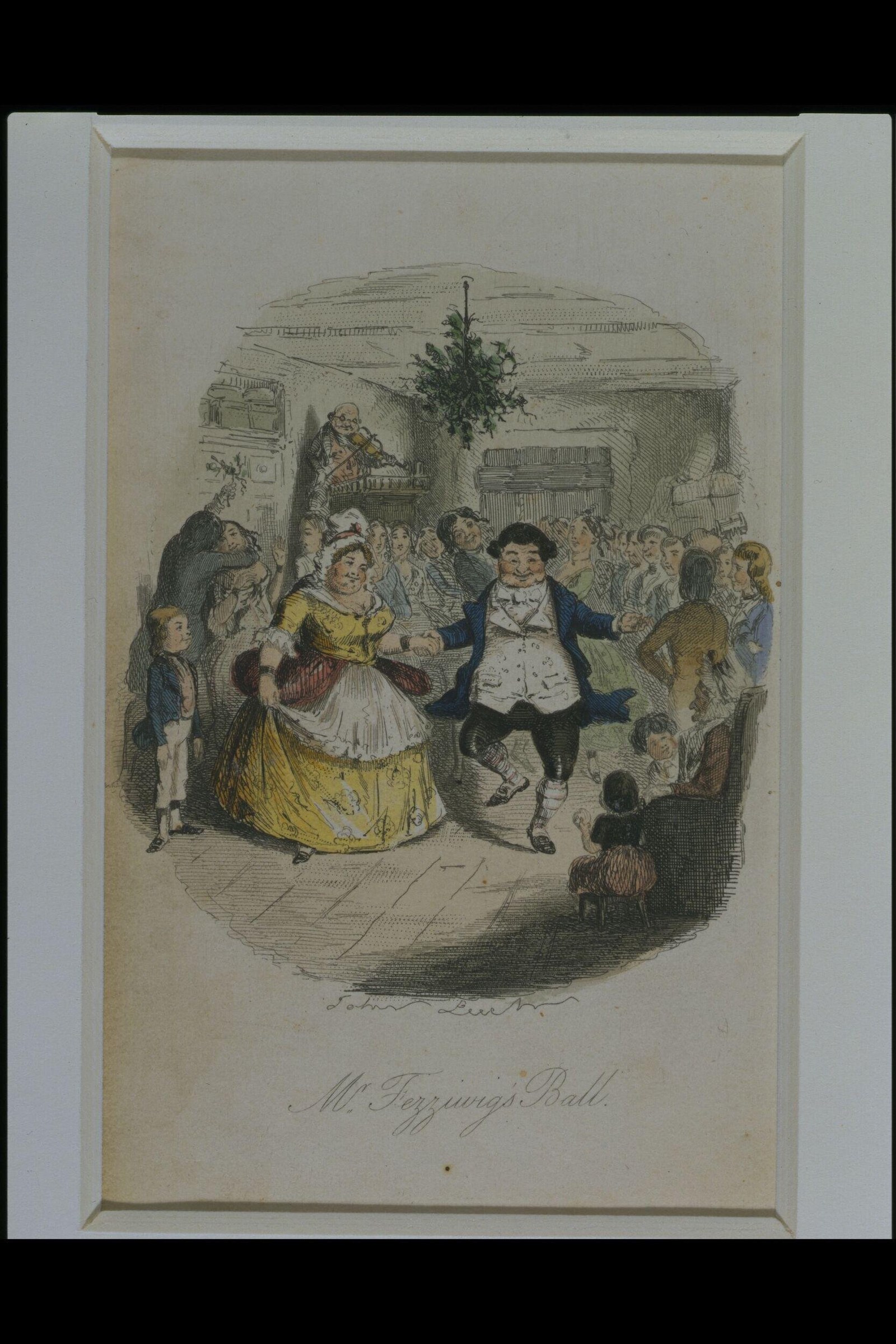
Mr. Fezziwig's Ball
John Leech
- Collection:
- Source:
- Victoria and Albert Museum
- Rights:
- Rights vary by item — check the source record before reusing this image. Source record ↗
- Recorded as:
- V&A — check rights per item
This is among the most recognizable dance images in English popular culture, repeated in countless editions and adaptations, shaping how generations have imagined Christmas festivity. For dance historians, it documents the form and spirit of 19th-century English country dancing and the role of dance in creating social cohesion and marking seasonal celebration. The work also shows an artist of genuine ability observing real bodies in motion—the postures are believable, the spatial relationships clear, and the moment chosen is dramatically alive.
What you are looking at
A crowded ballroom scene rendered in colored engraving shows a festive Christmas assembly. The composition centers on a rotund gentleman in dark coat and white waistcoat, mid-dance with a woman in a yellow dress with white apron, her arms raised in animation. The room is packed with onlookers—children, servants, adults in various dress—lining the walls and clustered in the background. Mistletoe hangs prominently from the ceiling beams. The setting is clearly domestic rather than aristocratic: wooden floorboards, simple architectural detailing, and the intimate scale of the gathering all suggest a merchant's or tradesman's house. The moment is one of collective pleasure: the dancing couple are the focus of attention, but the crowd's engagement—watching, gossiping, waiting their turn—is the real subject. Light falls evenly across the scene, typical of the engraver's practice.
The dancing
The central male dancer stands in an open, weight-forward posture with one arm extended toward his partner in invitation or support; his stance is informal and energetic rather than ballroom-formal. His partner mirrors his animation with raised arms and an open body position suggesting rapid movement or a turn. Both figures are caught mid-step in what appears to be a country dance or reel rather than a closed-hold waltz. The surrounding figures are static observers—children sitting or standing against walls, women in bonnets, men in coats—creating a gallery effect around the dancers.
The dance depicted
This is a country dance or reel, most likely a Christmas reel or cotillion of the kind common in English domestic gatherings of the early 19th century. The open positioning, the raised arms of the woman, the informal energy, and the domestic setting all point to folk-regional or historic-gilded-age social dance—a convivial group dance rather than aristocratic ballroom practice. The mistletoe and the season signal Christmas festivity; the crowd and the enthusiasm suggest this is a moment of collective participation, with dancers rotating through and others awaiting their turn. The artist has chosen to freeze a moment of genuine exuberance rather than formal correctness.
How it was made
This is a hand-colored wood engraving or steel engraving of the kind Leech pioneered for mass reproduction in the 1840s. The fine cross-hatching visible in the background and shading, combined with the restrained hand-coloring in yellow, red, and flesh tones, is characteristic of the wood-engraving process that allowed both detail and economic printing for periodical publication. The technique's precision in rendering facial expression and social nuance suited Leech's gift for observational social comedy. Works of this type were produced for illustrated journals and later collected into bound volumes, reaching a broad middle-class audience.
About this work
This is 'Mr. Fezziwig's Ball,' the artist John Leech's engraved illustration of a scene from Charles Dickens' *A Christmas Carol*, published in 1843. The work is one of the most celebrated Christmas images in English visual culture. It depicts not elite ballroom dancing but the democratic, inclusive festivity of a merchant's Christmas revel—a moment of social leveling in which the master and his employees dance together. The engraving captures both the specific narrative moment (Scrooge's memory of his kindly employer's generosity) and a broader cultural ideal of Christmas as a time when social hierarchy dissolved into shared pleasure. It belongs in a gallery of dance in art because it shows dance as a social technology, a means of binding a community together, and because the artist's understanding of movement and mass psychology was precise enough to make the scene convincing and moving.
How to look at it
Look first at the composition: the two dancers are framed and elevated by the packed crowd around them, making the act of dancing itself an object of collective attention and pleasure. Notice the woman's raised arms and open posture—these are the marks of exuberant social dancing, not the constrained elegance of ballroom form. The artist has chosen the moment of maximum animation, not the formal preparation or the resolution. Observe also how Leech has rendered the variety of faces and postures in the crowd—this is a crowd with individuality, not a generic mass, which heightens the sense of a real gathering where everyone knows everyone else. The mistletoe above frames the scene as a moment of permitted license, where ordinary social rules are suspended.
The artist
John Leech (1817–1864) was a London-born wood engraver and illustrator, celebrated for his social satire and his gift for rendering contemporary life with sympathy and humor. He was closely associated with *Punch* magazine and illustrated numerous books, most famously the 1843 first edition of Dickens' *A Christmas Carol*, for which he created four wood engravings. His practice combined the engraver's precision with a caricaturist's eye for character and social observation. Leech's work was widely circulated and imitated, and his images became canonical representations of Victorian domestic life and festivity.
The period
The 1840s saw a revival of English folk customs and seasonal traditions, partly driven by Romanticism and partly by Dickens' powerful literary reinvention of Christmas. Dance in this period was bifurcated: the ballroom was the domain of formal, codified dances (waltz, quadrille, cotillion) performed by the gentry; country dances, reels, and informal group dances belonged to working and merchant classes and to rural tradition. The publication of illustrated literature in this decade—in periodicals and bound volumes—created a new kind of visual audience and made images like this one primary documents of how Victorians understood their own social life. Christmas dancing was increasingly associated with democratic sentiment and moral renewal.
Where it lives
This engraving is from the first edition of Charles Dickens' *A Christmas Carol* (Chapman & Hall, London, 1843), one of four illustrations Leech created for the novella. It is held as a print in a collection described as 'va,' which is not fully clear from the catalogue record provided.
Dance in this work
Questions about this work
Is this a real Christmas dance or a Dickens invention?
The dance itself is real—English country reels and cotillions were the standard social dances in merchant and working-class households in the early 19th century. Dickens and Leech are depicting an actual custom. What is invented is the narrative moment and the characters; the *form* of the festivity is authentic to the period.
Why are they not waltzing?
The waltz was fashionable among the gentry by the 1840s, but country dances and reels remained the norm for ordinary households and for public occasions. Dickens and Leech are showing us Scrooge's youth (set in the 1790s–1800s), when reels and cotillions dominated. The open positioning and raised arms are characteristic of country dance, not ballroom style.
What is the yellow-dressed woman's role in the narrative?
In Dickens' text, this is Mrs. Fezziwig. The engraving shows her dancing with her husband, which is part of Leech's point: the masters are participating in the same festivity as their employees, temporarily suspending hierarchy. The woman's evident pleasure is part of the image's moral argument about Christmas as a time of democratization and joy.
How was this engraving made and reproduced?
Leech drew the design onto a polished wood block (or steel plate), and a professional engraver cut away the non-printing areas. The print was then hand-colored, likely by teams of colorists working in sequence, each applying one color. Thousands of copies could be printed from the same block, making this image accessible to a mass audience—which is why it became so iconic.
More dance artwork





