49 works in this view — arrow keys or swipe to move between them.
Dance in Art
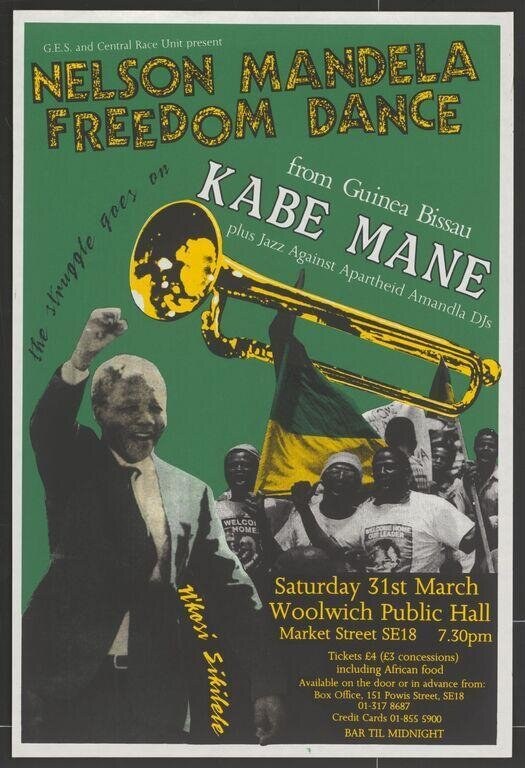
Nelson Mandela Freedom Dance
Greenwich Mural Workshop
- Collection:
- Poster
- Source:
- Victoria and Albert Museum
- Rights:
- Rights vary by item — check the source record before reusing this image. Source record ↗
- Recorded as:
- V&A — check rights per item
The poster captures a pivotal moment in anti-apartheid activism in Britain, showing how musicians and visual artists mobilized culture for political change. For dance historians, it demonstrates the historical entanglement of dance, music, and liberation movements, and how 'freedom' and 'dance' became linked metaphors in late twentieth-century resistance culture.
What you are looking at
A political poster in bold graphic design, dominated by a green background with large gold lettering announcing a 'Nelson Mandela Freedom Dance.' The composition centers on a photograph of Nelson Mandela in a dark suit with his fist raised in salute, positioned on the left. To his right, a large brass trumpet in gold tones extends diagonally upward, its bell prominent. Below and to the right, a group of figures in white t-shirts are shown with raised fists and what appear to be protest gestures. The poster credits 'Kabe Mane from Guinea Bissau' and mentions 'Jazz Against Apartheid Amandla DJs.' Typography is energetic and militant, with the word 'Amandla' (Zulu for 'power') repeated. Event details place this at Woolwich Public Hall on Saturday 31st March, with ticket and venue information in gold text at the bottom.
The dancing
The figures visible are rendered as photographic elements rather than drawn dancers. Mandela's raised fist is a symbol of resistance and solidarity rather than a dance gesture. The group below displays raised fists and clustered postures suggesting collective political action or protest rather than coordinated dance movement. No formal dance hold, frame, or footwork is visible. The bodies are positioned to convey political unity and defiance rather than the technical vocabulary of any specific dance form.
The dance depicted
This is not a depiction of dance in the conventional sense, but rather a protest poster using the rhetoric of 'freedom dance' as a metaphor for liberation struggle. The event advertised includes jazz and DJ performance ('Jazz Against Apartheid Amandla DJs') in support of Nelson Mandela and anti-apartheid activism. The term 'freedom dance' here refers to cultural celebration and political resistance as embodied practice, not to a specific choreography or style. The trumpet and music references suggest jazz and world music performance rather than theatrical dance.
How it was made
This is a silkscreen poster, a technique well-suited to political graphics and mass production. The bold, limited color palette—primarily green, gold, black, and white—creates high contrast and visual impact suitable for street distribution and rapid recognition. Silkscreen allowed for quick, affordable reproduction of multiple copies, making it an ideal medium for grassroots political organizing. The photomontage approach, combining Mandela's portrait with the trumpet and crowd images, was typical of liberation movement graphics of the late 1980s and early 1990s.
About this work
This is a political event poster from 1990 advertising a fundraiser concert and cultural celebration organized in solidarity with Nelson Mandela and against apartheid in South Africa. Created by the Greenwich Mural Workshop, a socially engaged arts collective, the poster uses the language of 'freedom dance' metaphorically to link cultural performance with political liberation. The work belongs in a dance gallery not because it documents a specific dance practice, but because it demonstrates how dance and music function as symbolic language within political movements, and how artists have used performance and cultural events as tools of resistance and solidarity.
How to look at it
Attend to how the poster combines portraiture, symbol (the raised fist, the trumpet), typography, and color to create a politically legible image in seconds. The trumpet, oriented upward and outward, functions as both a literal reference to jazz music and a visual metaphor for voice, proclamation, and call to action. Notice how the photographer's choice to isolate Mandela's fist and the group's clustered energy creates a sense of unified momentum. The green background was commonly used in South African and Pan-African graphics, adding cultural specificity to what might otherwise read as generic protest aesthetics.
The artist
The Greenwich Mural Workshop was a London-based collective practicing community and political art from the 1970s onward. They created large-scale murals and posters addressing social justice, anti-racism, and political resistance, working closely with grassroots organizations and protest movements. Their practice exemplified how visual art and graphic design could serve activist ends and reach audiences beyond gallery walls.
The period
Mandela was released from prison on 11 February 1990, and this poster was created in March 1990 as South Africa moved toward the end of formal apartheid. In Britain, anti-apartheid activism had been sustained for decades, with cultural events and fundraisers a standard form of solidarity. The early 1990s saw an explosion of celebratory and protest culture marking the transition to post-apartheid South Africa. Jazz and world music had become associated with anti-racist and anti-colonial politics, making the invocation of 'Jazz Against Apartheid' and Kabe Mane's Guinea Bissau connection part of a broader Pan-African and internationalist cultural moment.
Where it lives
This poster is held as an object of political and cultural history in what appears to be a British institutional collection (the VA or Victoria & Albert Museum). It functions as both a graphic design artifact and as documentary evidence of grassroots anti-apartheid activism in Britain in 1990.
Questions about this work
Is this a dance poster?
Not in the sense of advertising a dance performance or depicting choreography. It is a political protest poster using 'freedom dance' as metaphorical language for liberation and resistance. The event included music performance (jazz and DJs) but the poster's primary function was to mobilize support for Mandela and anti-apartheid activism.
Who was Kabe Mane?
The poster credits a musician 'from Guinea Bissau,' suggesting Kabe Mane was likely a world music or pan-African jazz artist performing at the event. Guinea Bissau, a Portuguese-speaking African nation, had strong cultural ties to liberation movements and diaspora communities in Europe.
What does 'Amandla' mean?
Amandla is a Zulu word meaning 'power,' used as a rallying cry in South African anti-apartheid activism. The phrase 'Amandla Awethu' ('Power to Us') was central to liberation movement rhetoric, and its repetition on this poster connects British solidarity activism to South African struggle language.
Why was there a 'freedom dance' event in London in 1990?
Anti-apartheid activism was a major focus of British left and anti-racist organizing throughout the 1980s and into the 1990s. Mandela's release in February 1990 sparked celebrations and fundraising events across Europe. Cultural events—concerts, dance performances, rallies—were standard ways activists mobilized solidarity and raised money for anti-apartheid organizations.
More dance artwork





