49 works in this view — arrow keys or swipe to move between them.
Dance in Art
Drawing
Alfred Stevens
- Collection:
- Drawing
- Source:
- Victoria and Albert Museum
- Rights:
- Rights vary by item — check the source record before reusing this image. Source record ↗
- Recorded as:
- V&A — check rights per item
This work exemplifies the 19th-century European fascination with reconstructing classical dance from visual evidence, a practice that shaped both art-making and performance. It demonstrates how artists used careful observation of drapery and body position to investigate the aesthetics of movement in idealized form, making visible the relationship between costume, gesture, and rhythm that defined classical performance.
What you are looking at
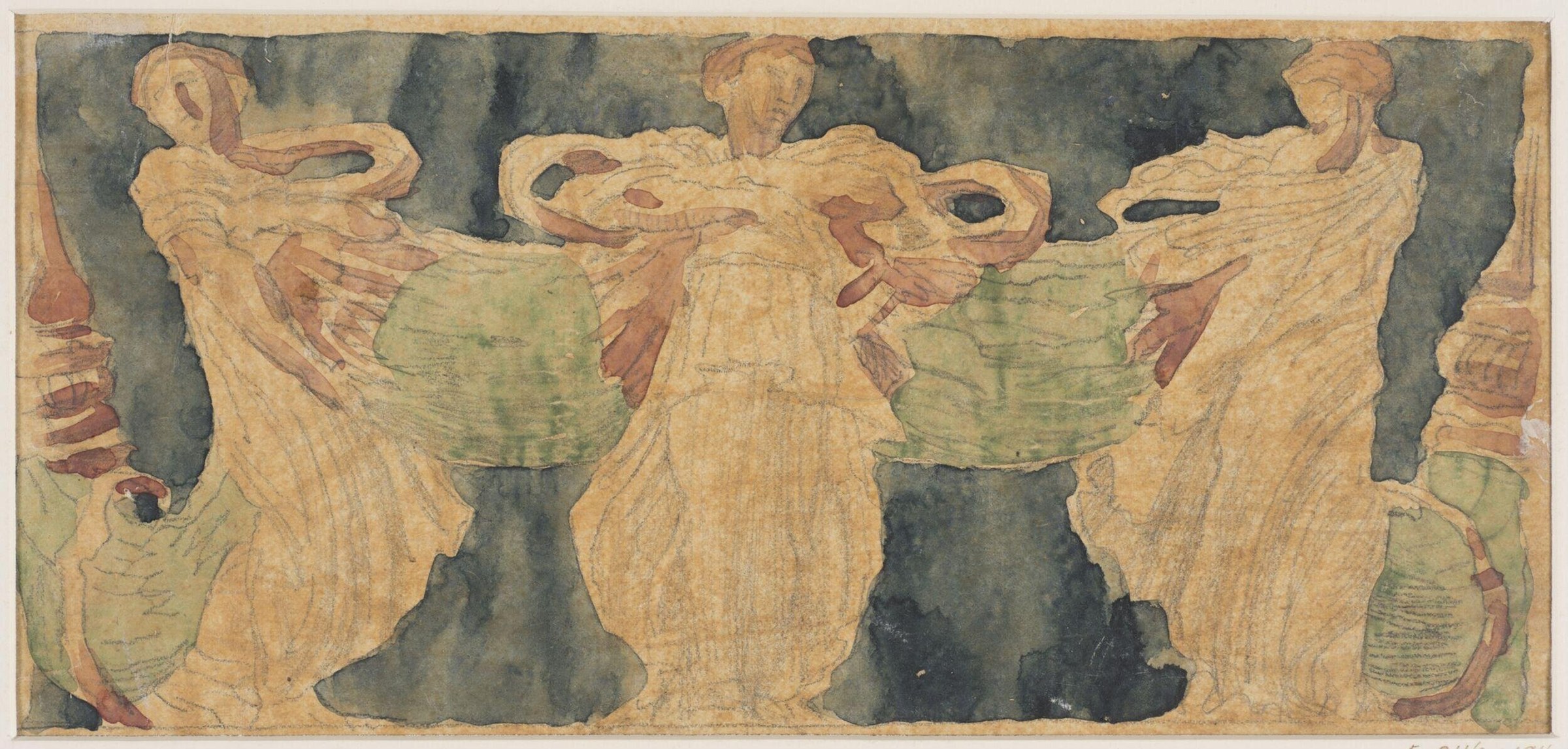
Five draped female figures occupy a frieze-like composition against a dark greenish-grey background. Each wears a flowing, columnar garment rendered in warm ochre and cream tones, with drapery that pools at the ankles. The figures are arranged in a processional line, each in a distinct pose of rhythmic motion. The leftmost and rightmost figures turn their bodies outward; the three central figures face forward or turn inward. Their arms are raised and extended in sweeping, expressive gestures—some lifted to shoulder height, others extended to the sides. The drapery creates a sense of undulating movement, with the fabric appearing to billow and swing as though the bodies beneath have just shifted weight or pivoted. The pale flesh tones of the heads and arms contrast sharply with the darker background, focusing attention on the flowing lines of the bodies. There is no setting beyond the background wash; the composition is purely concerned with the human figure in motion.
The dancing
Each of the five figures stands in a distinct contrapposto stance, with weight shifted to create asymmetry between the torso and limbs. The arms are consistently raised and extended—some in broad, swinging arcs across the body, others lifted in open, celebratory gestures. The heads are tilted or turned, suggesting momentum and direction of gaze. The bodies are elongated and idealized, with the drapery clinging to and articulating the underlying form. The figures are spaced as individuals rather than in coupled contact, each absorbed in her own expressive movement yet clearly part of a unified visual rhythm.
The dance depicted
This appears to represent a processional or ceremonial dance, most likely from ancient or classical Greece based on the drapery, idealized bodies, and frieze composition. The raised arms and turning torsos suggest a ritualized movement, possibly part of a sacred ceremony or theatrical performance. The arrangement recalls Greek vase painting and relief sculpture depicting maenads, nymphs, or dancers in Dionysian or religious contexts. The flowing chiton and the emphasis on expressive arm and torso movement are consistent with classical dance reconstruction based on visual sources. Without an inscription or signature, the artist's specific reference cannot be confirmed, but the iconography and style suggest engagement with classical antiquity.
How it was made
The work is executed in what appears to be watercolor or gouache on paper, with a careful underdrawing visible in places. The artist has used fluid, gestural brushwork to render the drapery, with layered washes creating depth and movement in the fabric. The technique emphasizes line and contour as much as tone; the pale figures emerge from the darker ground through contrast rather than modeling. This is a drawing or study rather than a finished painting—economical in means but demonstrating sophisticated understanding of form, drapery, and compositional rhythm. The medium and technique suggest a work made for private study or as a preparatory study for a larger work.
About this work
This is a classical study of five draped female figures in rhythmic motion, executed in watercolor or gouache in a style informed by Greek and Roman art. The artist has created a frieze-like composition that emphasizes the expressive potential of the human body in idealized dress, rendered with particular attention to the way drapery articulates movement. The work belongs to a long European tradition of studying classical dance and ritual from visual sources. It represents a moment in art history when dancers and artists were deeply engaged with reconstructing and reinterpreting the movement vocabularies of ancient civilizations, using historical garment and pose to access ideas about rhythm, gesture, and the aesthetic possibilities of the body.
The significance of such drawings lies in their role as visual bridges between historical source material (ancient sculpture and vase painting) and contemporary artistic practice. By carefully studying and replicating the poses, drapery, and spatial arrangements found in classical sources, artists like Stevens created works that informed both fine art and performance. This drawing would have circulated among artists, dancers, and patrons interested in classical revival, serving as both an aesthetic object and a document of embodied practice.
How to look at it
Observe how the artist has used drapery to suggest the movement of the bodies beneath—notice the folds that follow the curve of the torso, the way the fabric swings outward as if caught in a turn, and the contrast between the weight-bearing leg (where drapery clings) and the lighter gesture of the arms. The raised arms and turned heads suggest a moment in a continuous action: the bodies are not static poses but frozen instants from a flowing sequence. Pay attention to how the five figures create a visual rhythm across the page—each is distinct in pose and gesture, yet together they form a unified composition, like a quotation from an ancient relief.
The artist
Alfred Stevens (1823–1906) was a Belgian painter and sculptor active primarily in Paris. He was best known for genre scenes of contemporary Parisian life and interior domestic subjects, particularly pictures of elegant women in fashionable dress. Stevens was also interested in historical subjects and classical themes, and created numerous drawings and studies exploring drapery, figure composition, and allegorical content. His practice included both large narrative paintings and smaller studies like this one, which demonstrate his sustained interest in the expressive qualities of the human form and textile.
The period
This drawing dates from the 19th century, a period of intense scholarly and artistic interest in ancient Greek and Roman civilization. The academic art world—particularly in Paris, where Stevens worked—was dominated by classical training and historical subject matter. Artists studied antique sculpture and vase painting intensively, and many created works explicitly engaging with classical themes. In performance, this was also the era of classical ballet revival, when choreographers and dancers looked to classical sources for both inspiration and authenticity. The figure of the classical woman in flowing drapery became an icon of idealized beauty and expressive movement.
Where it lives
The work is catalogued as a drawing in a collection designated as 'va' (likely an abbreviation for a specific institutional archive or collection). The bare catalogue entry provides no date, medium, dimensions, or exhibition history, suggesting the work may be part of a larger group of unstudied or partially catalogued material.
Dance in this work
Questions about this work
What dance is this?
The specific dance cannot be identified from the image alone. The classical Greek dress, idealized bodies, and frieze composition suggest the artist is representing or interpreting a ritual, ceremonial, or theatrical dance from ancient Greece—possibly a Dionysian procession or sacred ceremony. Without an inscription or clear attribution, we cannot determine whether Stevens was copying a specific ancient source or creating an imaginative reconstruction.
How do I know these are dancers and not just women in motion?
The composition itself signals danceability: the figures are arranged in a deliberate spatial and rhythmic relationship; their poses repeat and echo one another in ways that suggest coordinated movement rather than random activity; the raised arms and turned torsos form a visual pattern of alternating directions. The frieze format—a horizontal band of repeated figures in various attitudes—is the classical convention for depicting processions, ceremonies, and collective ritual movement.
Why would an artist make a drawing like this in the 19th century?
Nineteenth-century artists and scholars were passionate about reconstructing classical civilization from visual and textual sources. Drawings like this served multiple purposes: they were studies in figure drawing and drapery; they were intellectual exercises in historical interpretation; they were preliminary studies for larger works; and they were contributions to the broader cultural project of understanding and reviving classical aesthetics in contemporary art and performance.
More dance artwork





