49 works in this view — arrow keys or swipe to move between them.
Dance in Art
Caricature
Cooke, George
- Collection:
- Caricature
- Source:
- Victoria and Albert Museum
- Rights:
- Rights vary by item — check the source record before reusing this image. Source record ↗
- Recorded as:
- V&A — check rights per item
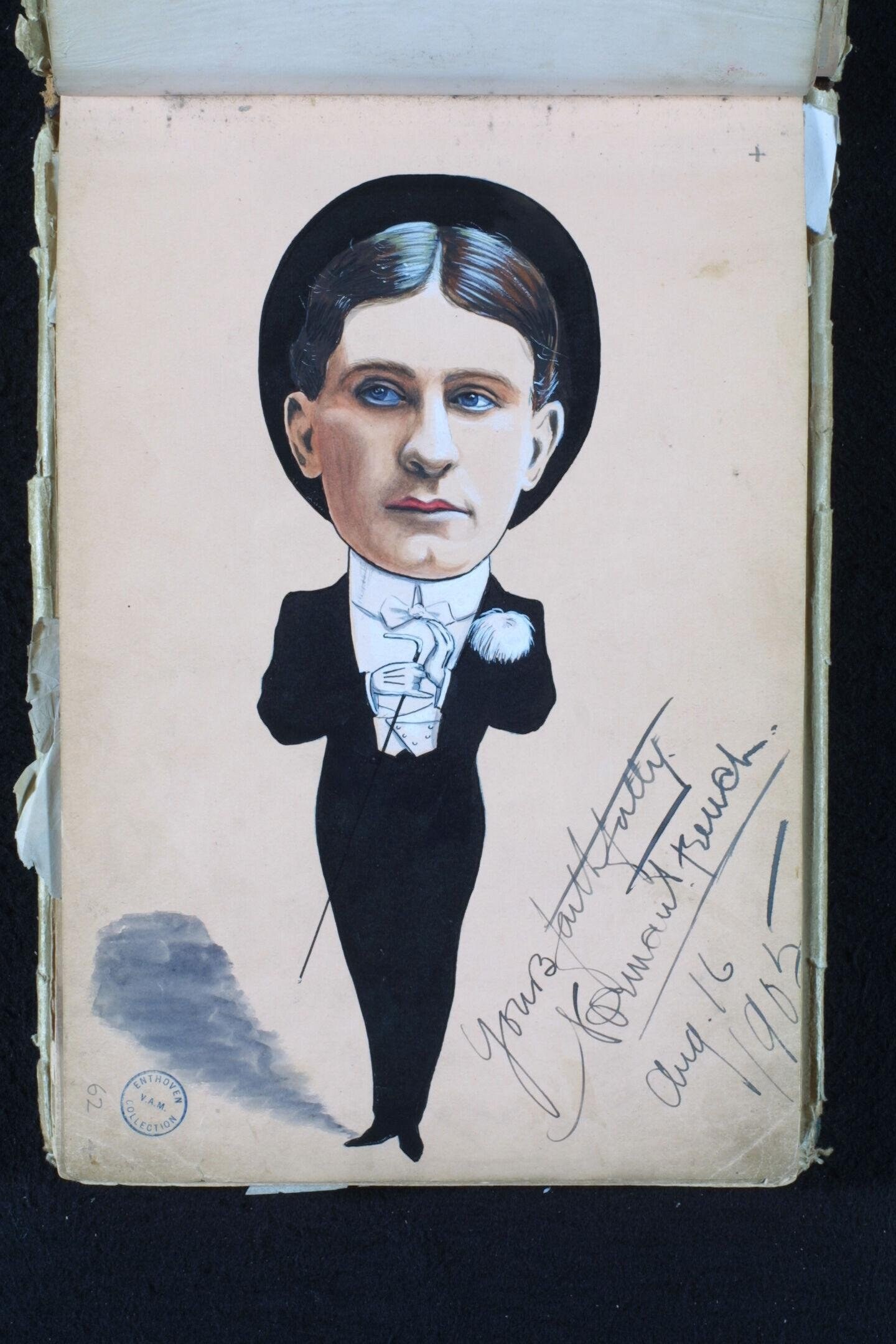
For historians of theatrical and ballroom culture, this caricature preserves exact detail of male formal evening dress in 1905—the tailcoat, shirt, bow tie, and boutonnière that would have been worn at society balls, theater galas, and exclusive clubs where dancers performed. The identity and significance of the subject remain opaque without further research, but the work documents the visual conventions of Edwardian masculine formality at the precise moment when ballroom dance, musical theater, and social dancing were undergoing rapid change.
What you are looking at
A caricature portrait of a man in formal evening dress, shown from the waist up against a cream background. The figure is rendered in exaggerated proportions typical of caricature—an elongated body with an enormous, pendulous torso beneath a relatively small head. The man wears a black tailcoat with white shirt front and a formal bow tie or cravat, along with what appears to be a white boutonnière or corsage. His dark hair is slicked back, and his pale blue eyes gaze directly outward with a serious, composed expression. The artist has paid meticulous attention to facial features and formal dress while distorting the body's proportions for comic or satirical effect. The work shows signs of age and handling; the paper is lightly foxed and the image bears what appears to be a library or collection stamp at lower left.
The dancing
The single standing figure fills the frame from approximately waist to head. There is no suggestion of active movement or dance position—the body is static and frontal, with arms presumably at the sides (not visible below the frame edge). The exaggerated elongation of the torso and the formal, upright posture suggest an air of pomposity or self-importance, a common mode of caricatural critique. The direct gaze and composed expression convey authority or stubbornness rather than animation.
The dance depicted
This is not a depiction of dance. It is a formal portrait caricature of a gentleman in evening dress. There is no evidence of movement, musical context, or dance training in the figure's stance or gesture.
How it was made
Hand-colored lithographic or photomechanical print, evidenced by the crisp outlines, graduated color application, and characteristic halftone or crayon-work finish on the face and hair. The medium allowed for rapid production and distribution of caricatures to the press and the collecting public. The print has been hand-signed in pen (in cursive script at lower right), and the aging and foxing of the paper suggest it has been kept in an album or portfolio for over a century.
About this work
This is a portrait caricature of an unidentified gentleman, dated 1905 and attributed to the caricaturist George Cooke. The work exemplifies the British or American tradition of society portraiture through exaggeration, popular in newspapers, theatrical programs, and private collections during the Edwardian era. Although formally dressed in evening wear suitable for ballroom or theatrical attendance, the figure himself is not engaged in dance; he is presented as a subject of social or public interest, likely a figure of note in theater, politics, or society. The work belongs in a dance archive primarily as documentary evidence of Edwardian formal dress and the social contexts in which dancers and patrons moved, rather than as a representation of dance itself.
How to look at it
Observe first the precision of the formal dress and the cosmetic detail—the bow tie, the shirt front, the boutonnière are rendered with clarity and respect for their social meaning. Then see how the body beneath distorts radically from nature: the torso has been stretched and swollen into an absurd shape that reads as greed, pretension, or indulgence. This contrast between sartorial propriety and bodily excess is the engine of the caricature's humor and critique. Note also the directness of the gaze and the slight tension in the facial expression—this is a man of power or conviction, not a figure of ridicule for incompetence, but for hypocrisy or excess.
The artist
George Cooke is recorded as a caricaturist active in the early 20th century. Little is publicly documented about his career, training, or output. The hand-signed notation and the print's presence in a VA (likely Victoria & Albert Museum or similar British institutional) collection suggests he worked within the British tradition of society caricature—a commercially viable and culturally significant practice in that era. The quality of draftsmanship and the refinement of the coloring indicate professional standing.
The period
In 1905, the portrait caricature was a thriving commercial and artistic form, especially in Britain. Society journals, theater programs, and private collections circulated thousands of such images annually. This was the era of the Gibson Girl and the aesthetic idealization of the ballroom dancer on one hand, and the satirical critique of upper-class manners through exaggeration on the other. The formal dress depicted was the uniform of the ballroom and the theater box—the social spaces where dance was displayed and consumed by the wealthy and prominent.
Where it lives
The work is held in a caricature collection, catalogued under VA (likely a British institutional source such as the Victoria & Albert Museum). The hand-signed inscription and the presence of what appears to be an institutional stamp indicate it has been part of a formal collection for many decades. The age and condition of the paper suggest it has been stored in archival conditions.
Questions about this work
Is this a dancer?
No. The figure is posed in formal evening dress in a static, frontal stance with no indication of movement or dance training. He is a subject of social or theatrical interest—possibly a patron, impresario, or public figure of 1905—but not a dancer himself.
Who is the man in the caricature?
The catalogue record does not identify him. The handwritten inscription is difficult to read in reproduction and should be examined in person at the holding collection. Local theater or society records from 1905 might yield identification.
Why is the body so distorted?
Caricature exaggerates a subject's physical characteristics—in this case, the torso—to express a satirical or moral critique. The bloated form may suggest wealth, indulgence, vanity, or pomposity. The technique was a standard mode of political and social commentary in the early 20th century.
What does the white flower on the chest mean?
The boutonnière or corsage was formal evening-wear decoration for gentlemen attending balls, theater galas, and exclusive social events. It indicates the man's place in fashionable society and his participation in the social and cultural institutions where dance was performed and patronized.
More dance artwork





