49 works in this view — arrow keys or swipe to move between them.
Dance in Art
Drawing
Alfred Stevens
- Collection:
- Drawing
- Source:
- Victoria and Albert Museum
- Rights:
- Rights vary by item — check the source record before reusing this image. Source record ↗
- Recorded as:
- V&A — check rights per item
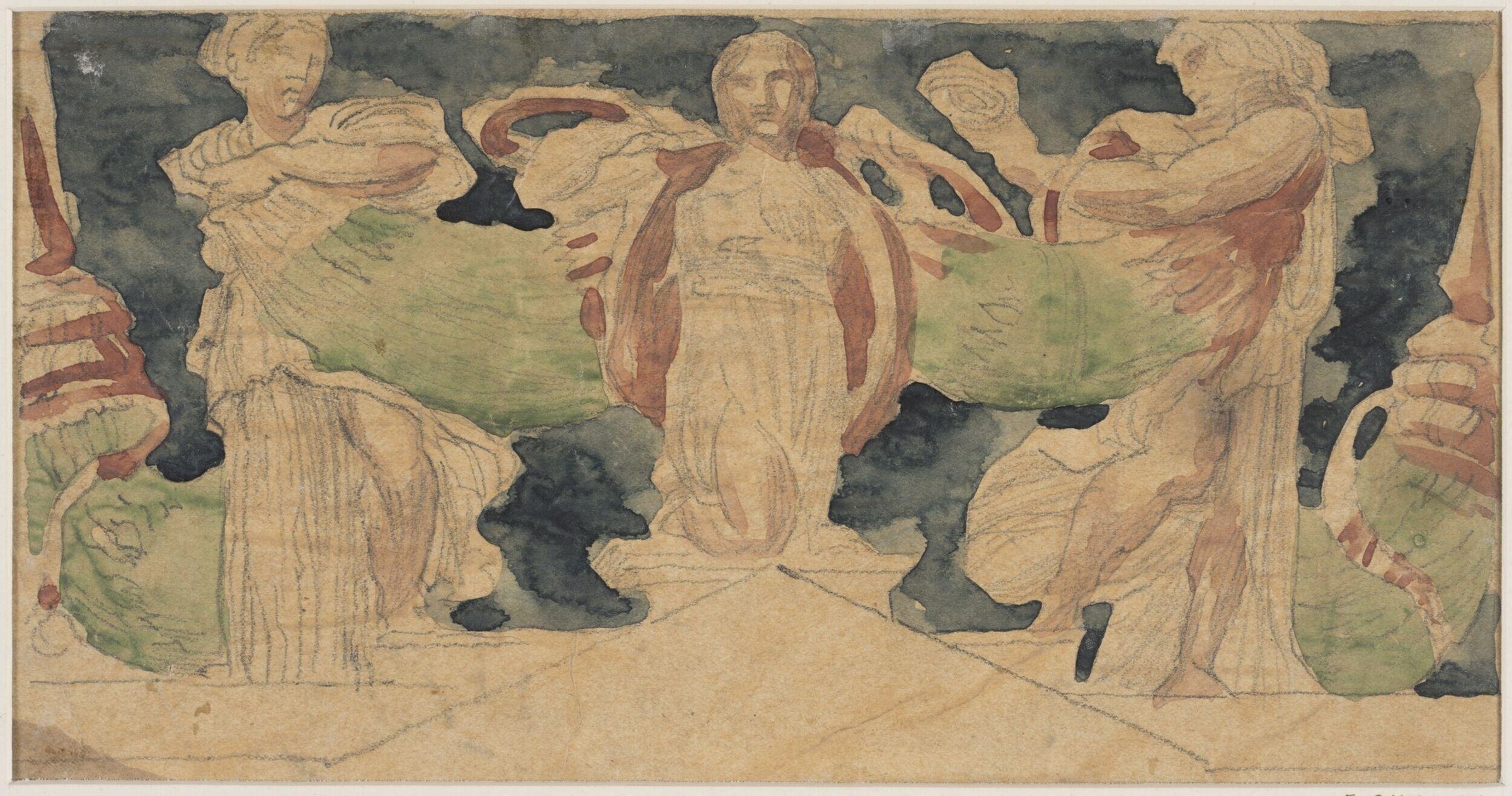
This drawing captures the moment when European artists and dancers began to look backward to ancient Greece as a source of liberation from rigid academic forms. The bodies here reject the turnout, verticality, and lifted quality of classical ballet in favor of a more grounded, drapery-conscious movement vocabulary. For anyone studying the origins of modern dance and the modernist critique of ballet, this work is a visual record of how that critique was articulated through drawing.
What you are looking at
Five draped female figures occupy a shallow stage-like space defined by a dark background and a pale foreground. The women wear classical chitons or simple high-waisted gowns in cream and pale tones, with green and terracotta-brown shawls or himations draped across their bodies. Their poses suggest fluid, graceful movement—some lean forward, others stand with weight shifted, one reaches or gestures with an arm extended. The composition is frieze-like, with the figures distributed across the width of the composition in varying depths, creating a sense of processional or choral movement. The watercolor and ink medium has left the paper luminous in places, with pigment applied in soft washes that give the drapery both weight and transparency. The scene captures a moment of collective, unhurried motion—perhaps a processional, a ritual pause, or a choral moment in which the bodies are not isolated performers but parts of a unified spatial event.
The dancing
The five figures display a vocabulary of classical contrapposto and flowing, weight-shifted poses. Arms are extended or held at varied heights; heads are shown in profile or three-quarter view with contemplative expressions. The drapery follows the body's movement, falling in vertical folds from the hips and swinging across shoulders and torsos in ways that suggest gentle, sustained motion rather than sharp attack. No rigid holds or frames are evident; instead, the bodies move through space with a lyrical, almost processional quality. The spacing and overlapping of the figures create depth without crowding, allowing each body its own arc of movement.
The dance depicted
This appears to be a representation of classical or neoclassical dance, most likely from the late 19th century when artists were engaged with Greco-Roman subject matter and ideals of flowing, drapery-based movement. The dress, pose vocabulary, and frieze-like arrangement suggest either a rehearsal or performance drawing inspired by classical Greek chorus or Isadora Duncan-era interpretive dance, both of which valued draped garments and unhurried, emotionally expressive gesture. The absence of pointe shoes, formal ballet vocabulary, or rigid academic posture argues against classical ballet; the work instead reflects a turn toward ancient Greek ideals and modernist rejection of the corseted body. Without an inscription or documented title, the specific dance cannot be confirmed, but the visual language points clearly to a classical or pseudo-classical idiom of early modern dance.
How it was made
This is a drawing executed in watercolor and ink, with graphite underdrawing visible in places. The technique allows soft tonal modulation and layering of transparent washes—the green and terracotta drapery floats over the pale bodies with a luminous quality that would be difficult to achieve in oil or pastel. The paper left visible in highlights gives the composition air and lightness. This is the kind of working drawing or study made by an artist concerned with movement and drapery; the scale and finish suggest it was made for exhibition or collection, not as a preliminary sketch. The medium was accessible, portable, and valued among late 19th-century figure artists exploring classical themes.
About this work
This is a late 19th-century drawing of five female figures in classical or Greco-Roman dress, arranged in a frieze-like composition that suggests choral or processional movement. The bodies display a post-academic vocabulary emphasizing fluid weight-shifts and graceful gesture over rigid formal pose—a modernist inflection of classical reference. The work sits at a historical moment when European artists and dancers were reviving interest in ancient Greek movement ideals as a way to escape the constraints of academic ballet and corsetry. For a dance gallery, it documents a key artistic preoccupation: the attempt to imagine how ancient bodies moved, and to use that imagining as a critique of contemporary dance practice.
How to look at it
Attend to the drapery first: observe how the fabric moves independently of the body, suggesting a moment in time where cloth is still in motion after the body has shifted. Notice the feet and lower legs, which are barely indicated—the artist's interest is in the upper body, arms, and face. The composition is anticlimactic: there is no central axis, no obvious narrative, no moment of climax. Instead, the eye travels across the frieze gathering impressions of weight and ease. This is how a late 19th-century draughtsman looked at ancient movement—not as a sequence of positions but as a quality of flow and drapery.
The artist
Alfred Stevens (1823–1906) was a Belgian-born French painter and sculptor specializing in academic figure studies, historical subjects, and interior scenes. He was trained at the Brussels Academy and the Atelier Couture in Paris, and exhibited regularly at the Salon. Stevens was known for his technical mastery of the human figure, his exploration of drapery, and his ability to render contemporary and historical scenes with equal facility. In the later 19th century, he engaged with classical and oriental subjects as well as scenes of modern leisure and intimacy. His drawings demonstrate a sustained interest in movement, fabric, and the psychology of the posed figure.
The period
This work dates from the later 19th century, a period of intense engagement with classical revival across European art, music, and dance. In the 1880s and 1890s, artists and dancers began to look to ancient Greece as an alternative to both academic ballet and the newly emerging popular dance forms. Isadora Duncan, who would pioneer barefoot, drapery-based interpretive dance, was developing her practice during this period. Simultaneously, painters and sculptors like Stevens were exploring classical drapery and the female body in motion as a way to access an imagined past uncorrupted by industrialization. The watercolor medium itself was experiencing a revival in status, particularly for figure studies and historical subjects.
Where it lives
The work is catalogued as a drawing held in a collection, with attribution to Alfred Stevens. The sparse record suggests it may be part of a institutional holding such as a museum or academy collection, though the exact provenance is not detailed in the available record.
Dance in this work
Questions about this work
Is this classical ballet?
No. There are no pointe shoes, no turnout, no lifted verticality. The artist has rejected academic ballet vocabulary in favor of a classical-inspired idiom that emphasizes draping, weight-shifts, and graceful asymmetry. This reflects a late 19th-century modernist critique of ballet as too rigid and corseted.
Could this be from an actual ancient Greek performance?
No. This is a 19th-century artist's imagining of ancient movement, made centuries after Greek theater forms had vanished. The watercolor medium, the poses, and the overall aesthetic are unmistakably modern. It is an act of historical imagination, not documentation.
Why are the figures so minimal and the background so dark?
The artist has concentrated all attention on the bodies and drapery, using the dark background to isolate them and the pale foreground to ground them. This compositional choice emphasizes movement and form over narrative or setting—typical of drawing studies made for their own sake or for exhibition.
Is this connected to Isadora Duncan?
Not necessarily directly, but it reflects the same cultural moment. Duncan and artists like Stevens were both drawing on classical ideals and rejecting academic norms. The work documents the intellectual and artistic current in which modern dance emerged.
More dance artwork





