49 works in this view — arrow keys or swipe to move between them.
Dance in Art
The Bad Taste of the Town, or 'Masquerades and Operas'
Hogarth, William
- Collection:
- Source:
- Victoria and Albert Museum
- Rights:
- Rights vary by item — check the source record before reusing this image. Source record ↗
- Recorded as:
- V&A — check rights per item
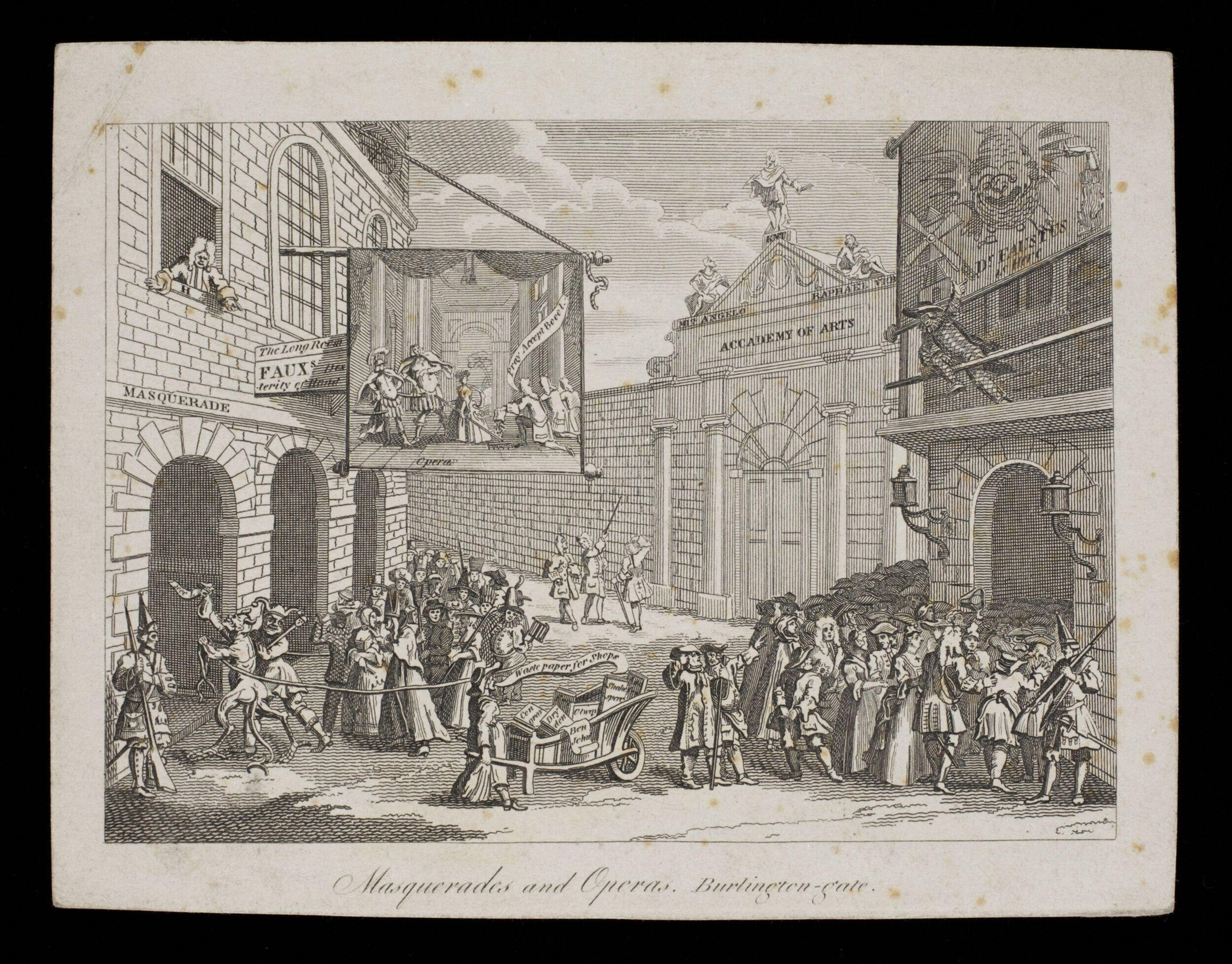
Hogarth's engraving is invaluable evidence of how masquerade and opera—both intimately connected with dance—were perceived in early 18th-century society: as fashionable, morally questionable, commercially driven entertainments. The work reveals contemporary anxieties about new entertainment forms and their social effects at the precise historical moment when public, commercial dance entertainment was becoming a significant cultural phenomenon.
What you are looking at
This is a crowded urban street scene centered on three large classical buildings identified by inscriptions as locations of fashionable entertainment: the opera house, a masquerade venue, and an academy of arts. The composition is packed with figures in 18th-century dress moving between these buildings—some entering, some exiting, many gesticulating animatedly. A wheeled cart or sedan chair dominates the foreground. The architectural setting is rendered in precise linear perspective with classical arches and rustication; the sky above shows hatched clouds typical of period engraving technique. The print is a satirical commentary on contemporary taste, with the proliferation of figures suggesting the fashionable frenzy surrounding these entertainments. Shop signs visible on the left advertise "Masquerade" and "Faux" (false/fraudulent). The scene is alive with motion: figures lean from windows, clusters gather in doorways, individuals stride purposefully across the pavement, and the overall effect is one of visual chaos masquerading as sophistication.
The dancing
The figures are depicted in varied poses suggesting animated conversation and purposeful movement rather than coordinated dance. Most wear formal 18th-century dress—coats, breeches, gowns, and hats. Several figures gesture expansively with raised arms, others converse in pairs or small groups. The bodies are rendered in profile or three-quarter view; posture ranges from stiff formality to exaggerated theatrical attitude. No visible closed holds or partnered dance frames appear. The scale and positioning suggest social mingling and promenading rather than the structured formations of courtly dance, though the theatrical nature of the scene—with figures posed as if on a stage—implies performed or performative behavior.
The dance depicted
The print does not depict active dancing, but rather satirizes the social world of 18th-century fashionable entertainment—the spaces where dance occurred and the people who patronized them. The title "Masquerades and Operas" and the labeled buildings indicate that opera and masquerade (where dancing was integral) are the subjects of satire. No specific dance form is shown in execution. The work functions as social commentary on taste and fashion rather than as documentary evidence of how a particular dance was performed.
How it was made
This is an engraving on paper, identifiable from the fine parallel hatching lines used to create shading and volume. The technique allows for precise architectural detail and considerable depth—the linear perspective draws the eye back through multiple planes of the composition. Engraving produced durable, reproducible images suitable for wide distribution, indicating this was intended as a public commentary on contemporary fashion, not a private work. The signature or inscription in the lower right margin is characteristic of print publication practice of the period.
About this work
Hogarth's "The Bad Taste of the Town" (1724) is a satirical engraving that portrays the fashionable urban culture of early 18th-century London, with masquerade balls and opera performances as central targets of ridicule. Rather than depicting dance itself, the work captures the social ecosystem surrounding dance and musical entertainment—the buildings where these activities occurred, the mixed crowds they attracted, and the performative affectation of fashionable society. As a print, it circulated widely and functioned as both artistic commentary and social critique, revealing anxiety about new forms of entertainment and changing public morals.
For dancers and historians, this work documents not technique or style but the social positioning of dance within an emerging commercial entertainment culture. It shows masquerade and opera as spaces of considerable public interest and fashion, yet treats them with skepticism. The work belongs in a dance history gallery because it illuminates the contexts in which dance existed and was perceived, rather than because it records movement itself.
How to look at it
Attend first to the labels on the three central buildings: they guide the satire. Then trace the movement of figures—notice how they swirl between the buildings and cluster at entrances, suggesting the magnetic pull of fashionable entertainment. Look at individual figures' faces and gestures: many wear expressions of exaggerated solemnity or theatrical affect, which Hogarth uses to mock pretension. The architectural precision and orderly perspective contrast with the chaotic crowd, heightening the satire. Hogarth has frozen a moment of social frenzy, inviting the viewer to stand back and judge the scene's folly. The composition rewards slow looking: inscriptions on shop signs, details of dress, and the play of gestures contain layers of satirical meaning.
The artist
William Hogarth (1697–1764) was an English painter and printmaker celebrated for narrative sequences and satirical social commentary. He pioneered the 'modern moral subject'—scenes of contemporary life arranged to critique manners, morality, and taste. Hogarth's prints circulated widely and were highly influential; his visual satire shaped 18th-century public discourse. He worked across painting, engraving, and print publication, and his prints were affordable enough to reach a broad middle-class audience, making them powerful vehicles for social criticism. His works often contained embedded inscriptions, labeled buildings, and pointing figures that guided viewers toward his satirical point.
The period
The 1720s in London saw the rise of public masquerade balls, particularly those organized by John Heidegger at the King's Theatre. These events sparked moral panic among clergy and conservative critics, who condemned them as occasions for vice, seduction, and moral corruption. Opera too was a novelty, often imported from the continent and associated with foreign, aristocratic excess. Hogarth's print appeared at the height of this cultural anxiety. The growth of public, commercial entertainment—replacing older court-based performance—unsettled traditional social hierarchies. Dance was integral to both masquerades and operas, yet neither form was yet codified as 'art' in the way ballet would later become. The period saw English culture wrestling with new forms of pleasure and their social meaning.
Where it lives
The record identifies this as a print in a collection at an institution with the source code 'va.' The work is characteristic of Hogarth's published print outputs, which were commercial products designed for middle-class consumption and public circulation.
Questions about this work
Does this print show actual masquerade or opera dancing?
No—the print is a satirical commentary on the social world surrounding these entertainments, not a depiction of dance in action. It shows fashionable crowds entering and exiting the buildings where masquerades and operas took place, but does not render dance itself. The work is valuable for understanding how these dance-centered entertainments were perceived and positioned socially, rather than for what it reveals about dance technique or style.
What is Hogarth satirizing?
Hogarth mocks fashionable taste, vanity, and the frenzy surrounding new commercial entertainments. The title "Bad Taste of the Town" signals that the crowd rushing to masquerades and operas represents misplaced values. The crowded, chaotic composition and the exaggerated gestures of the figures convey Hogarth's view that these fashions are excessive and morally suspect. Contemporary conservative critics shared this anxiety about masquerades in particular, seeing them as occasions for moral transgression.
Why were masquerades controversial?
Masquerade balls, which became fashionable in London in the 1710s–1720s, featured masked guests, dancing, and an atmosphere of anonymity that critics feared encouraged seduction and vice. The mask enabled social transgression—servants could mingle with nobles, men could dance with women of dubious reputation. Clergy condemned masquerades as sinful; moralists saw them as symptoms of cultural decay. Yet they were enormously popular and profitable, making them a perfect target for Hogarth's satire.
How does Hogarth's print technique affect the message?
The engraving's fine hatching creates an orderly, precise visual field—the classical architecture is rendered with geometric clarity. Yet this orderly technique contains a chaotic crowd, creating a productive tension between form and content. The print medium allowed Hogarth to reach a broad audience and comment on contemporary life in real time, making his satire a form of public discourse rather than a private work.
More dance artwork





