49 works in this view — arrow keys or swipe to move between them.
Dance in Art
Fancy dress costume design
Jules Marre
- Collection:
- Fancy dress costume design
- Source:
- Victoria and Albert Museum
- Rights:
- Rights vary by item — check the source record before reusing this image. Source record ↗
- Recorded as:
- V&A — check rights per item
This drawing preserves a specific moment in the history of costume design and the material culture of fancy dress entertainment. It shows the level of professional artistry applied to ballroom and theatrical dress, and offers concrete evidence of women's fashion and the aesthetics of performance costume in the 1860s.
What you are looking at
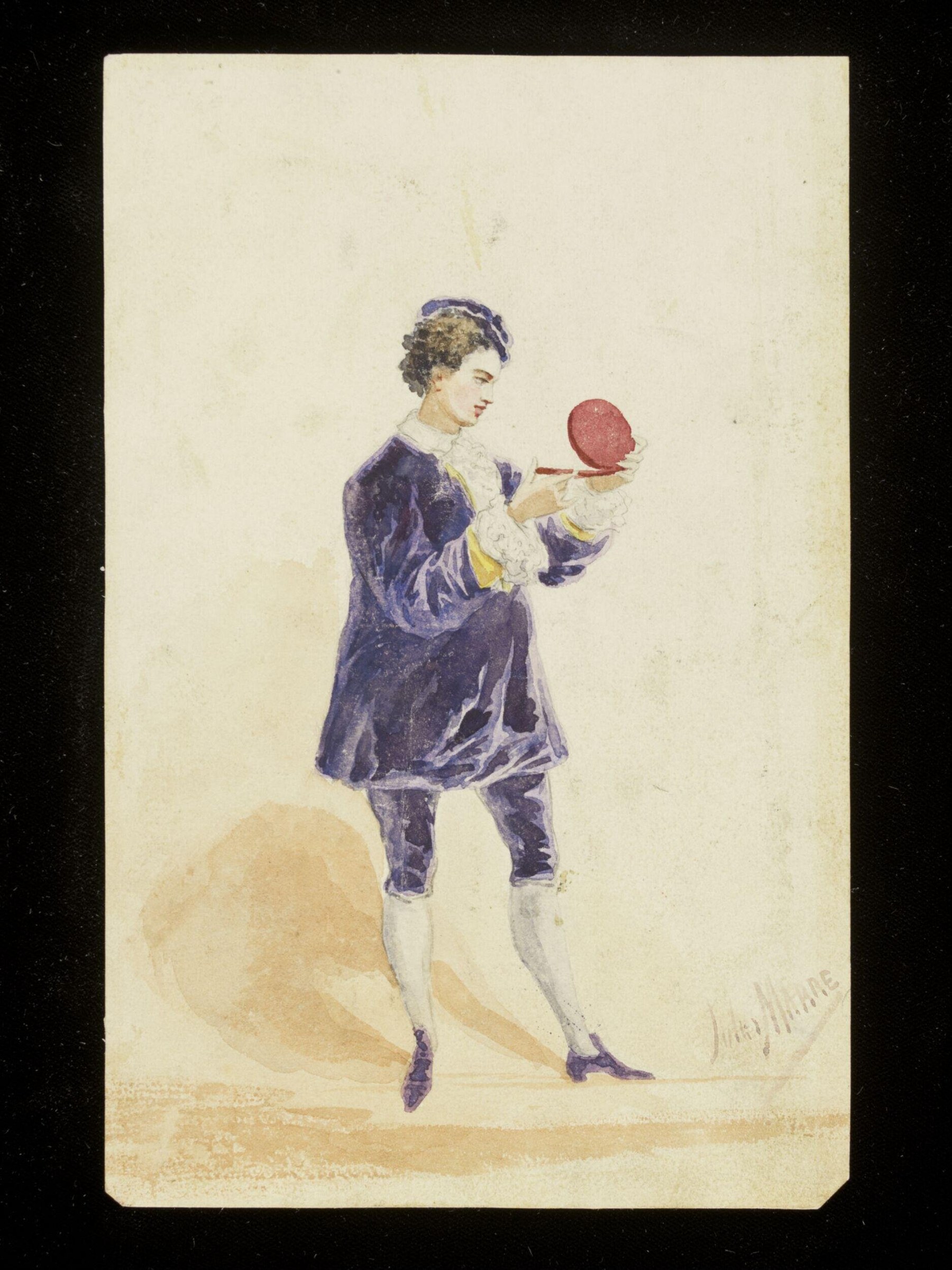
A young woman in a purple velvet dress stands in three-quarter view against a pale cream background, holding a large red ball on her extended right hand. She wears a white lace collar and cuffs, a yellow silk or satin ribbon at her waist, and a purple headband or cap adorned with a blue jewel. Her pose is poised and elegant, with weight settled on her left leg while her right leg extends slightly forward. The figure is rendered in watercolour or gouache with delicate washes of tone, particularly in the ochre shadow beneath her feet. The style is typical of mid-nineteenth-century fashion illustration: the dress, hair treatment, and accessories place this in the 1860s. The ball is rendered in saturated red and appears almost prop-like—an object to be displayed rather than thrown or caught in play.
The dancing
A single standing figure in a relaxed, presentational pose. Her torso faces slightly left while her head turns gently toward the viewer. The right arm extends forward at approximately waist height, hand open and flat to support the ball. Her legs are nearly straight with minimal flexion; the pose suggests standing still rather than moving through space. There is no dynamic weight shift or the suspended quality of mid-leap. The overall frame is formal and statuesque rather than athletic or kinetic.
The dance depicted
This does not depict dance in the strict sense of organized movement to music or rhythm. The pose and costume suggest theatrical or ballroom fancy dress—the label "fancy dress costume design" confirms this is a design for masquerade or costume ball wear rather than a choreographed piece. The ball may indicate a reference to a character or theme (possibly Venus with an apple, or a symbolized virtue), but the standing, static pose shows no evidence of dance technique, footwork, or the conventions of any recognizable dance form. The work documents fashion and costume rather than movement.
How it was made
Watercolour or gouache on paper, with fine detail work in the face and dress. The technique allows for transparent washes in the background and lower garment, while opaque pigment creates the jewel-like intensity of the purple velvet and red ball. This medium and style are characteristic of nineteenth-century fashion and costume illustration, a commercial art form made for tailors, dressmakers, and theatrical wardrobe departments. The delicate precision suggests a professional hand trained in fashion drawing, where the garment and its construction were the primary subject.
About this work
This is a costume design drawing by Jules Marre from approximately 1860, showing a woman's fancy dress outfit in purple velvet trimmed with lace and silk ribbon. The figure stands in a poised, presentational stance, holding a prominent red ball. The work belongs to the tradition of theatrical and ballroom costume design that flourished in the mid-nineteenth century, when fancy dress balls were a fashionable entertainment among the upper classes. While it documents performance and masquerade culture, it does not depict choreographed dance but rather the static display of costume as theatrical or social costume.
How to look at it
Attend to the precision of the dress details—the construction of the collar, the fall of the velvet, the ribbon at the waist—which would have served as a technical guide for a dressmaker. Note the restraint of the pose: it is not a dance movement but a deliberate display stance, feet planted, body still. The red ball is an accessory, possibly symbolic (a reference to a historical or allegorical character), and the artist has rendered it with dramatic colour intensity to make it a focal point. The overall effect is one of formal presentation rather than action.
The artist
Jules Marre was a French costume and fashion designer active in the mid-nineteenth century, known for theatrical and ballroom costume designs. His practice exemplifies the commercial marriage of fine art and fashion design typical of the period, where skilled draughtsmen produced detailed working designs for tailors and theatrical costumers. Little is recorded of his biographical details, but his style places him among the professional fashion illustrators of Paris during the Second Empire.
The period
The 1860s saw a boom in fancy dress balls and masquerade entertainment among European aristocracy and wealthy bourgeoisie, particularly in Paris and London. These events required custom-designed costumes, and professional costume designers like Marre created detailed drawings to guide tailors and seamstresses. At the same time, theatrical ballet was at a high point of popularity—the Romantic era of Taglioni and Cerrito had given way to the more spectacular, technically demanding classical ballet of the 1860s. However, this drawing sits at the intersection of ballroom fashion and theatrical costume rather than in ballet itself.
Where it lives
Held in the Victoria & Albert Museum collection (indicated by source "va" in the record). The work is catalogued as a costume design, one of thousands of such drawings produced by professional designers for the theatrical and ballroom trades in the nineteenth century.
Questions about this work
Is this a ballet costume?
No, this is a fancy dress costume—theatrical wear for a masquerade or ballroom event, not a ballet costume. The style, purpose, and static pose indicate it was designed for a costume ball or theatrical performance where the wearer would stand and be admired, not execute choreographed movement. Fancy dress was a distinct social and theatrical practice from ballet training or performance.
What does the red ball represent?
The record does not specify. The ball may be an attribute of a particular character or allegorical figure (such as Venus with an orb), or it may simply be a fashionable accessory for the masquerade. Without additional context or inscription, its symbolic meaning remains uncertain.
Who was Jules Marre?
A French costume designer of the mid-nineteenth century whose work is documented in major museum collections. Very little biographical information survives, but his drawings show him to be a skilled professional trained in fashion illustration and tailoring, working in the Paris theatrical and ballroom costume market.
Why is this in a dance gallery?
Fancy dress balls were a form of entertainment and social performance in the nineteenth century, and costume design for these events was closely related to theatrical dress and performance culture. While this particular drawing does not show choreographed dance, it documents a material and visual culture in which dancers and performers also participated, and costume design was an essential discipline within the theatrical world.
More dance artwork





