49 works in this view — arrow keys or swipe to move between them.
Dance in Art
Fancy dress costume design
Jules Marre
- Collection:
- Fancy dress costume design
- Source:
- Victoria and Albert Museum
- Rights:
- Rights vary by item — check the source record before reusing this image. Source record ↗
- Recorded as:
- V&A — check rights per item
Costume design drawings like this are essential historical documents for understanding how nineteenth-century performers looked, what materials and techniques were used, and how theatrical aesthetics shaped fashion. For dance historians, such designs reveal the visual spectacle that attended Romantic ballet and operatic performance—the plays of color, texture, and ornamentation that framed the dancer's body. Marre's precision allows us to understand not just the finished silhouette but the actual construction of theatrical costume.
What you are looking at
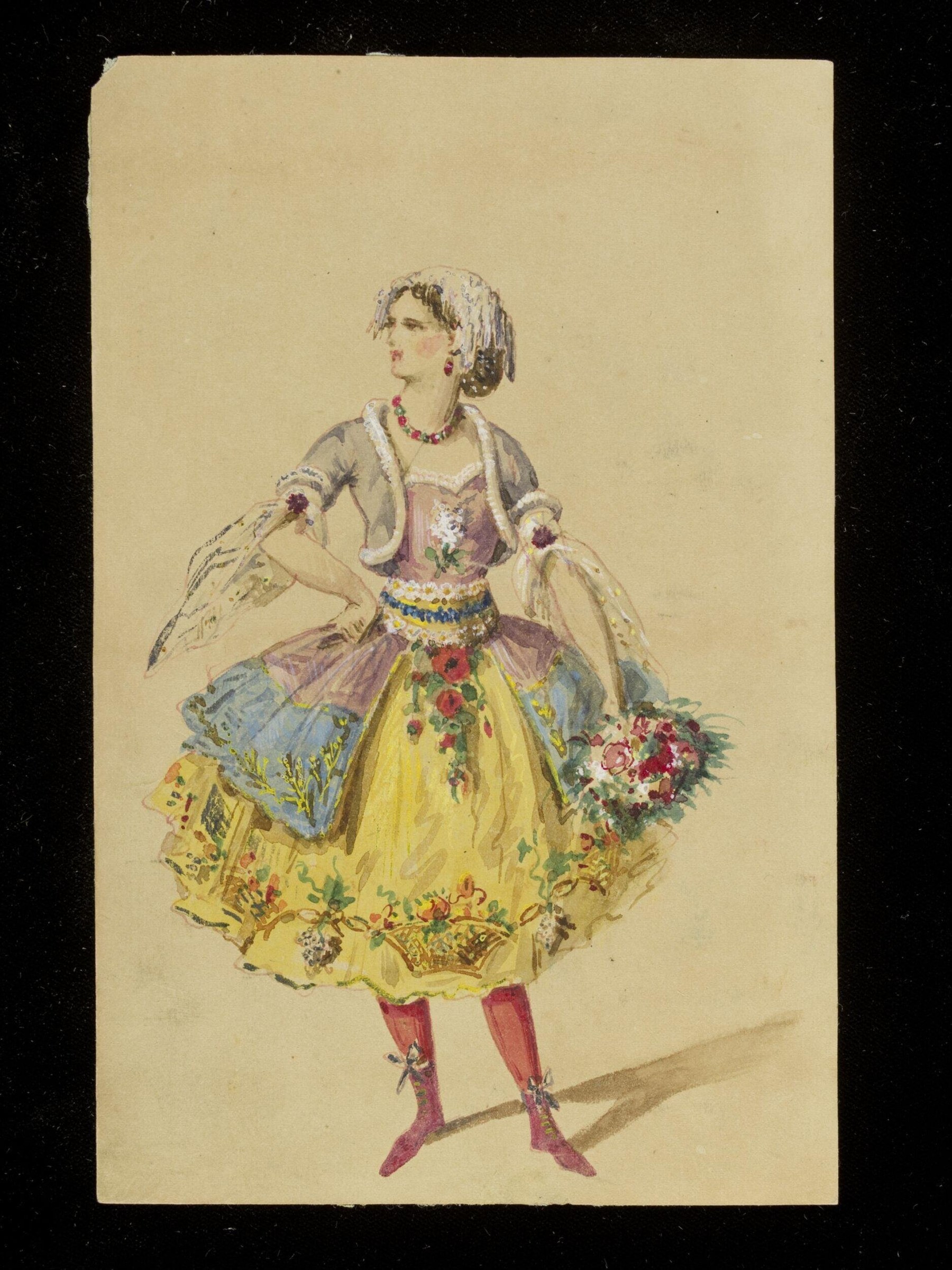
A single female figure stands in a three-quarter pose against a cream ground, dressed in an elaborate costume of the mid-nineteenth century. She wears a short yellow skirt decorated with floral embroidery and red rosettes, layered over what appears to be blue silk underskirts. A fitted bodice in mauve or purple is visible at the waist, adorned with a jeweled belt in yellow and blue beads. Over her shoulders falls a long cape or shawl of patterned silk in cream and blue, held casually in one hand. Her upper arm is encircled by a red pom-pom or decoration. She wears a decorative beaded necklace in red and gold, and her hair is styled in the period fashion with a white net or snood, with curled ringlets framing her face. Her feet, clad in red boots with buckled fastenings, are visible below the hem. The figure stands in a relaxed, elegant pose suggestive of display or performance, gazing to the left. The color palette—bright yellow, reds, blues, and golds against the neutral ground—is rich and theatrical.
The dancing
The single figure is composed in a standing pose with weight evenly distributed, one leg slightly forward in a casual stance. Her shoulders are relaxed and squared, with the right arm holding the edge of the silk cape and the left arm falling naturally. There is no evidence of active dancing movement—no lunge, turn, or extended leg—but rather a posed presentation stance. The body is arranged for display and visibility of costume, typical of theatrical or performance costume portraiture.
The dance depicted
This is a costume design study for fancy dress or theatrical performance, not a depiction of dance in motion. The work documents the visual elements of a costume worn for performance or social entertainment in the 1860s, when fancy dress balls and theatrical productions were important social and cultural events. The elaborate layering, jeweled ornaments, and theatrical silhouette suggest this was intended for a performer or high-society guest. The style evokes the aesthetics of mid-nineteenth-century ballet and operatic costume, with influences from Romantic ballet's taste for exoticized, fantastical dress.
How it was made
This is a watercolor and ink drawing on paper, likely hand-colored. The technique employs fine pen or ink outlines defining the costume elements with precision, while watercolor washes in cream, yellow, blue, mauve, red, and gold create the chromatic richness. The rendering is meticulous in detail—individual beads are suggested, fabric textures differentiated, and embroidered floral motifs carefully rendered. The hand-coloring and finish suggest this was a presentation drawing, likely created for a costume designer, theatrical company, or wealthy patron commissioning a fancy dress or performance garment. Such drawings were part of professional practice in theater and were also circulated as fashion or theatrical documentation.
About this work
This is a costume design drawing by Jules Marre, likely from the 1860s, documenting an elaborate fancy dress or theatrical costume. The work is a study in chromatic richness and textile display, arranged to showcase every element of an ornate ensemble—the embroidered skirt, layered silks, jeweled belt, decorative cloak, and boots. Marre's drawing style emphasizes clarity and precision, delineating each costume component so that a seamstress or performer could understand the construction and effect. The work belongs in a dance gallery because it documents the material conditions of mid-nineteenth-century performance culture, revealing the visual language performers and audiences expected from theatrical and fancy dress entertainment. While the figure is not depicted dancing, the costume itself was designed for performance, and the drawing records taste and practice in theatrical dress during the Romantic era.
How to look at it
Notice how Marre has organized the costume in layers, so that each element is clearly visible: the base yellow skirt, the blue underskirts, the mauve bodice, the jeweled belt, and finally the draped cape. The figure is posed to display these elements frontally and in profile simultaneously, a convention of costume design drawings that prioritizes legibility over naturalism. Observe how the artist uses line to define form and watercolor to suggest texture and sheen—the silks appear to have different weights and finishes. The red boots are carefully rendered to show construction and buckle detail, because such elements mattered to seamstresses and wearers.
The artist
Jules Marre was a mid-nineteenth-century French costume and fashion designer. His practice encompassed both theatrical costume design and fashionable dress for wealthy patrons. His drawings are characterized by meticulous detail, fine line work, and skilled watercolor rendering. He worked in the tradition of French fashion and costume illustration, producing designs for theatrical companies and private clients during a period when Paris was the center of European fashion and theatrical production.
The period
In the 1860s, fancy dress balls and costume entertainment were fashionable among European and American high society. Simultaneously, Romantic ballet was at its height, celebrated for its spectacular visual effects and exotic themes. The theatricality of costume—the layering, the color, the ornament—reflected broader mid-Victorian taste for visual abundance and narrative costume. Costume design drawings were professional tools circulated among theater companies, dressmakers, and wealthy clients. The particular style of this costume—with its emphasis on color, embroidered ornament, and exotic silhouette—echoes the aesthetics of Romantic ballet while also responding to fashionable fancy dress conventions.
Where it lives
The work is held in a collection identified as 'Fancy dress costume design' in the catalogue record, suggesting it may be part of a series or archive of theatrical and costume designs. The source is listed as 'va', which likely indicates a Virginia institution, though this cannot be confirmed from the catalogue record alone.
Questions about this work
Is this a drawing of an actual dancer, or a design?
This is a design study, not a portrait of a particular performer. It is a costume proposal rendered in meticulous detail so that a seamstress could construct the garment and a performer could understand its final appearance. Such drawings were professional tools in theater and fancy dress culture.
What would this costume have been worn for?
The elaborate ornamentation and theatrical silhouette suggest it was designed for either a fancy dress ball (a popular entertainment among wealthy Europeans and Americans in the 1860s) or for theatrical performance—possibly operatic or ballet. The style evokes Romantic ballet's taste for exotic, fantastical dress.
How do we know this is by Jules Marre?
The catalogue record attributes it to Jules Marre, a mid-nineteenth-century French costume and fashion designer. His working style—meticulous line work, skilled watercolor, and detailed costume documentation—is consistent with known examples of his design practice.
What is the cape made of?
The cape or shawl appears to be silk, rendered in cream and blue with a patterned or embroidered surface. Marre's watercolor technique suggests different fabric weights: the skirt and bodice appear to be structured fabrics, while the cape is meant to look softer and more draped.
More dance artwork





