49 works in this view — arrow keys or swipe to move between them.
Dance in Art
Peacock
Charles Frederick Worth
- Collection:
- Fancy dress costume design
- Source:
- Victoria and Albert Museum
- Rights:
- Rights vary by item — check the source record before reusing this image. Source record ↗
- Recorded as:
- V&A — check rights per item
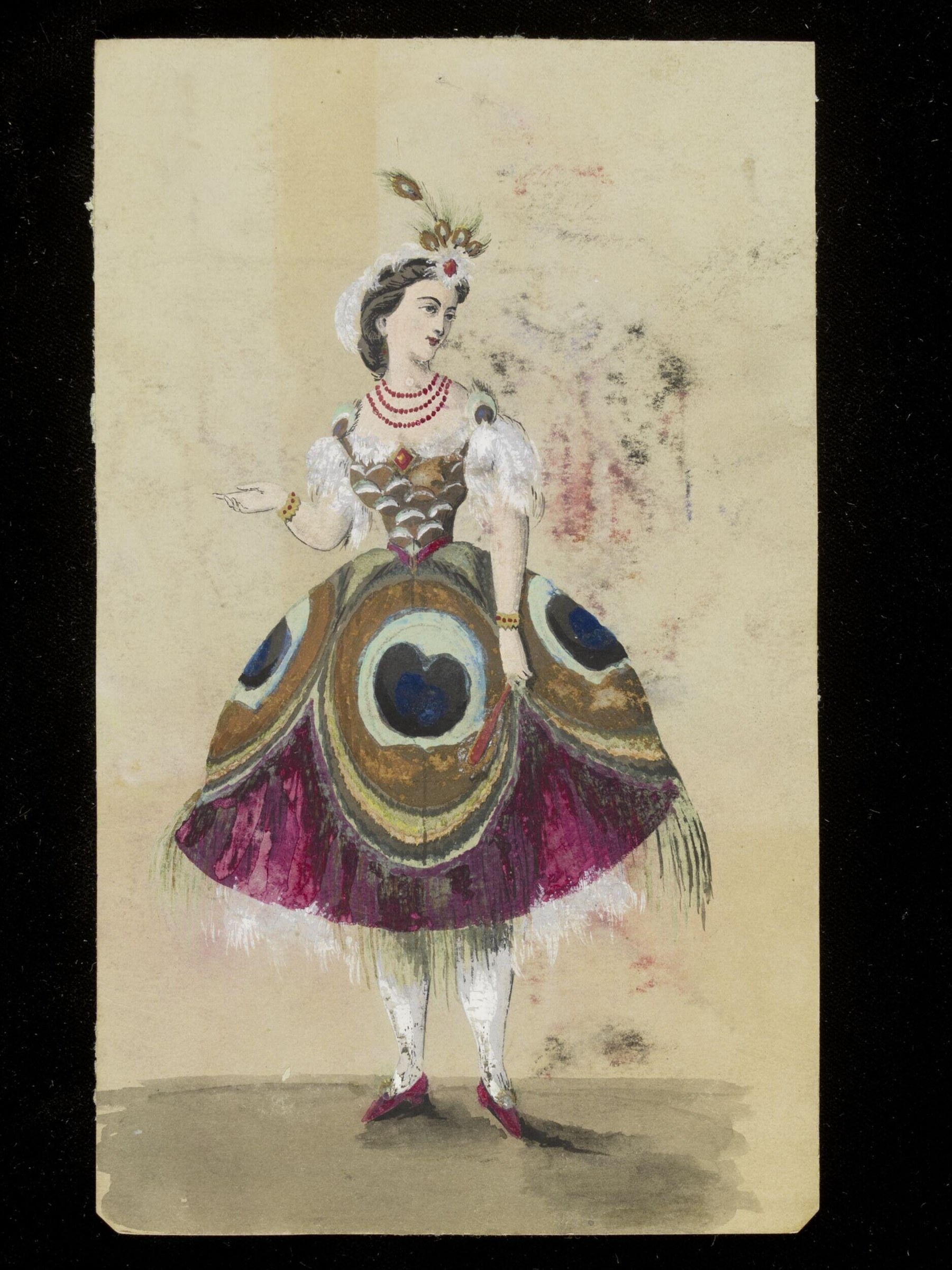
Costume design drawings like this reveal how dance and theatre were experienced through spectacle and visual display in the mid-19th century, and how the most celebrated fashion houses of the era engaged with performance culture. Worth's meticulous rendering demonstrates the technical sophistication expected of a couturier serving the highest social circles, where fancy-dress balls were significant social events often featuring choreographed pageantry.
What you are looking at
A single figure stands against a neutral cream background in a three-quarter pose, facing left with the body angled to display costume detail. The dancer wears an elaborate fancy-dress ensemble: a fitted bodice with a brown or olive corset front laced with jeweled ornament, white puffed sleeves, and a red beaded necklace. The skirt is the work's visual centerpiece—a voluminous construction in magenta silk with deep pleating, overlaid with brown silk decorated in oculi (large eye-like circular motifs) in blue and cream. Gold linear ornament frames each eye. The hem is trimmed with white fringe. The figure wears white stockings and red heeled shoes. A white cap or headpiece sits atop dark hair, and the figure holds a fan in the right hand. Feathered plumes crown the head. The pose is static and frontal, designed to showcase the costume construction rather than capture movement.
The dancing
The figure stands in an upright, supported stance with weight evenly distributed, neither engaged in active movement nor in a recognizable dance position or hold. The arms are relaxed, one holding a fan. There is no partnering, no dynamic frame, and no indication of footwork or weight shift. The body is presented as a display object for the costume rather than as a performing dancer in motion.
The dance depicted
This is not a depiction of dance in the sense of captured movement or choreography. This is a costume design for theatrical fancy dress, possibly for a masquerade or costume ball, and the title 'Peacock' indicates the costume concept derives from the bird's distinctive eye-marked plumage. The peacock eye motif dominating the skirt is the visual pun at the work's centre. While masquerade balls and fancy-dress balls of the 1860s could involve dancing, this image records the costume itself rather than its use in performance.
How it was made
The work is a watercolour and gouache design on paper, establishing it from the visual qualities: the translucent washes, the opaque white highlights (particularly on the stockings and cap), and the delicate linear detail in pen or ink used to outline the eye motifs and ornament. The technique is that of a commercial costume design—precise enough to communicate construction and detail to a dressmaker, but rendered with the fluency and colour sense expected in high-end theatrical or couture illustration. The holding institution identifies it as a fancy-dress costume design, situating it within the practice of haute couture documentation.
About this work
This is a costume design by Charles Frederick Worth, the dominant Paris dressmaker of the Second Empire, rendered as a watercolour study for a fancy-dress ball gown. The work exemplifies the mid-19th-century fashion for theatrical costume and masquerade wear among the wealthy, and Worth's practice of producing finished design drawings for his most ambitious commissions. The costume itself—structured, ornamental, and visually witty in its peacock-eye conceit—is the subject, not the dancer wearing it. The work belongs in a dance gallery not because it depicts choreography or performance technique, but because it documents the material culture and visual imagination that framed social dance and theatrical costume in the 1860s.
How to look at it
Read the costume as a composition of motifs and materials: note how the eye pattern on the skirt reads as both ornament and as a visual metaphor (the peacock's famous display feature), how the colour distribution (browns, gold, and magenta) creates a focal point in the skirt while the upper body remains restrained, and how the white stockings and cap create framing lines that direct attention to the silhouette. The artist has chosen to present the figure in a static, frontal pose—the mode of fashion illustration—rather than capturing a moment of actual movement or dance, which makes the work primarily a document of costume design practice.
The artist
Charles Frederick Worth (1825–1895) was an English-born dressmaker who founded the House of Worth in Paris in 1851 and became the most influential and sought-after couturier of the Second Empire and early Third Republic. He is credited with transforming dressmaking from artisanal craft to haute couture as a recognized creative profession, and with establishing the designer's name—his signature—as the mark of prestige and authorship. His clientele included empresses, aristocrats, and wealthy socialites across Europe. Worth produced detailed design drawings like this one both as commission documentation and as records of his house's aesthetic innovations. He was also known for his theatrical designs and his collaborations with Paris Opera productions.
The period
The 1860s were the height of the crinoline era, when elaborate ball gowns and fancy-dress costumes reached peak visual complexity and cost. Masquerade balls and costume galas were fashionable entertainments among European nobility and wealthy bourgeoisie. In theatre and ballet, Romantic costume aesthetics—emphasizing fantasy, spectacle, and ornamental detail—remained influential even as Realism began to affect dramatic arts. Worth's practice of creating costume designs for social occasions reflected the blurred line between theatre, fashion, and social performance that characterized this period.
Where it lives
The work is held in the collection at the Victoria and Albert Museum (indicated by source 'va' in the record) as part of its costume design holdings. It is catalogued as a fancy-dress costume design and forms part of the museum's documentation of 19th-century fashion and theatrical dress practice.
Questions about this work
Is this a painting of a dancer, or a design?
It is a design drawing—a working document created by the couturier to communicate the costume to client and dressmakers. The figure is presented as a display for the garment rather than as a person in motion. Costume design drawings were essential tools in haute couture practice, especially for elaborate commissions.
What is the peacock eye motif on the skirt?
The large circular eye-like shapes (oculi) in blue and cream, framed in gold, directly reference the peacock's distinctive tail plumage. This visual wordplay—clothing a dancer or wearer in the very feature the peacock is famous for—is the costume concept. It demonstrates the wit and sophistication Worth brought to theatrical and fancy-dress design.
Who wore costumes like this?
Wealthy European socialites and aristocrats who attended masquerade balls and fancy-dress galas in the 1860s. These events were important social entertainments where costume, spectacle, and dancing intersected. A Worth commission of this calibre would have been extremely expensive and marked its wearer's status.
Why is Worth important to dance history?
Worth's influence on theatre and ballet costume helped shape how performers' bodies were presented and perceived on stage. His work with the Paris Opera and his designs for fancy-dress balls show how couture and performance culture were interdependent. He elevated costume design to a recognized creative profession.
More dance artwork





