49 works in this view — arrow keys or swipe to move between them.
Dance in Art
Fancy dress costume design
Charles Frederick Worth
- Collection:
- Fancy dress costume design
- Source:
- Victoria and Albert Museum
- Rights:
- Rights vary by item — check the source record before reusing this image. Source record ↗
- Recorded as:
- V&A — check rights per item
This work shows that fancy dress—the theatrical, imaginative end of costume—was the province of serious designers and was documented with the same care as court dress or evening wear. It reveals what dance historians and costume historians need to know: the material reality of what performers wore when they stepped into fantastical roles, whether at masquerade balls, theatrical events, or staged dances of the period.
What you are looking at
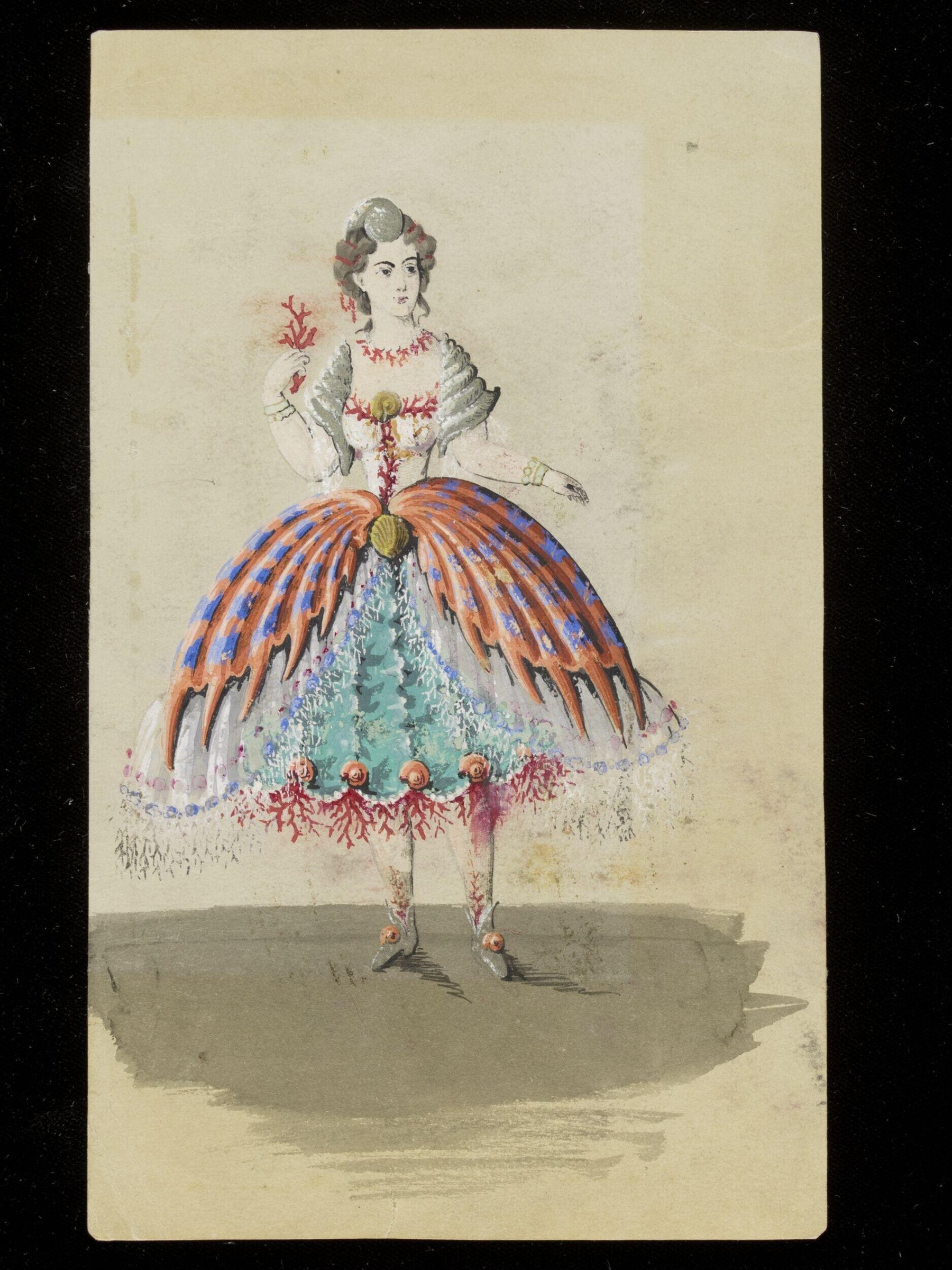
A young woman stands alone against a neutral ground, posed in profile with her weight on her back leg in an attitude of elegant display. She wears an elaborate fancy-dress costume: a fitted bodice with puffed sleeves trimmed in red coral ornament, over a voluminous skirt constructed from what appears to be natural materials—sections of orange-red pleated or fluted fabric alternate with panels of soft green, creating a dramatic tiered bell shape that extends to mid-calf. The skirt is edged with red coral trim and studded with spherical golden ornaments at intervals. Her hair is styled up in the fashion of the 1860s with a decorative circlet or comb, and she holds a small spray of red coral in one hand. The costume reads as a fantastical hybrid: part theatrical, part zoological, with the fluted sections suggesting either stylized feathers or fins.
The dancing
The figure stands in a three-quarter turn, her body held upright in a formal, display-like posture rather than one suggesting active movement. Her weight is on her back leg; her forward leg is nearly straight but not locked, and her free arm is extended at a natural angle holding the coral spray. The pose suggests a moment of presentation or display rather than dance proper—the stance of a model being shown, or a performer pausing mid-act for the viewer's inspection.
The dance depicted
This is a costume design rather than a record of dance in motion. The work documents the material culture and visual spectacle of fancy-dress balls or costume theatre of the 1860s. No specific dance is depicted; the figure is posed statically for the designer's purposes. The costume itself—with its hybrid morphology mixing human dress, animal forms, and natural ornament—suggests the kind of fantastical conceits that would appear in masquerade balls, theatrical entertainments, or the elaborate tableaux vivants that were fashionable in the mid-nineteenth century. The coral motifs and organic materials point toward a 'nature' or 'sea creature' theme, popular in period costume imagination.
How it was made
This is a watercolour and ink design drawing on paper, showing the hand-tinted technique typical of nineteenth-century costume design documentation. The artist has used precise line work to define the bodice and profile, then added selective watercolour washes—predominantly the orange-red and green of the skirt, with delicate touches of purple-blue shading. The technique was standard for costume designers creating records to be kept in workshops, shown to patrons, or used by seamstresses and tailors. The sketch quality and working notes visible suggest this is a working design rather than a finished artistic print.
About this work
Charles Frederick Worth (1825–1895) was the dominant couturier of the Second Empire and beyond, essentially inventing the modern fashion house. This costume design, dated 1860, documents the intersection of high fashion and theatrical spectacle in the mid-nineteenth century. Fancy-dress balls were central to elite social life, and costume design was a serious creative enterprise; this sketch demonstrates how Worth—known for his elegant day wear and evening gowns—also occupied the fantasy end of dress design. The work sits at the boundary between fashion documentation, theatrical design, and the visual imagination of the period. Worth's designs set the standard for what was possible and desirable in dress; even a costume conceived as fantastical still bears his signature clarity of line and proportion.
How to look at it
Look at the pose first: the figure is not moving, but posed for inspection. The costume is the subject, not the body within it. Observe how the designer has managed the visual weight of the enormous skirt—how the alternating panels of colour create rhythm and prevent bulk, and how the spherical ornaments anchor the eye at intervals. Notice the precision with which the bodice and sleeves are drawn in comparison to the looser, more suggestive rendering of the skirt's texture and volume. This contrast reflects the designer's priorities: the fitted upper half is cut and sewn; the lower half is about material, drape, and decorative effect. The pose—turned slightly away, holding a small prop—was a standard convention for fashion and costume illustration, allowing the viewer to see both profile and three-quarter view and to assess the total silhouette.
The artist
Charles Frederick Worth (1825–1895) was an English couturier who established himself in Paris in the 1850s and became the arbiter of fashion for European and American elites. He pioneered the concept of the fashion house with a recognizable design signature, cultivated aristocratic and royal clients, and insisted on the designer's name as a marker of quality and desirability—essentially inventing haute couture as a profession and a brand. Beyond day and evening wear, Worth also designed for theatre, opera, and fancy-dress occasions, treating these commissions with the same attention to structure, silhouette, and ornament. His surviving design drawings, of which this appears to be one, show his working method: precise observation of the figure, careful notation of construction and trim, and a gift for dramatic silhouette.
The period
In the 1860s, fancy-dress balls were at their height in elite European society, particularly in Paris and London. These were elaborate theatrical events where costume was as much a statement of taste and imagination as of wealth. The same period saw the rise of spectacle in ballet—the Romantic era was waning but still influential, and the technological possibilities of stage machinery and lighting made increasingly elaborate fantasy scenes possible. Costume design was thus a high-stakes visual art. Worth's work in this register shows how the most prestigious designers of the day approached the problem of creating costume that was both wearable and visually stunning. The coral and organic motifs in this design reflect the period's fascination with natural history, exoticism, and the aesthetic of nature as a source of ornament and fantasy.
Where it lives
The work is held by the V&A (Victoria and Albert Museum), where it forms part of the collection of costume and fashion designs. The holding designation 'Fancy dress costume design' suggests it was catalogued as a theatrical or masquerade design rather than as a haute couture garment, indicating its creators and early keepers understood it as costume for display and performance rather than everyday wear.
Questions about this work
Is this a real costume that was actually worn?
This is a design drawing, not a photograph of a finished garment. It documents Worth's design for a fancy-dress costume—a garment intended for masquerade balls or theatrical events. Whether this specific design was executed and worn is not established by the record, though Worth's designs were regularly made up for his clients. The sketch itself is a working document created by or for the designer to clarify the concept and construction.
What is the costume supposed to be?
The design appears to be inspired by natural or marine forms—the coral trim, the organic materials, and the fluted or feathered texture of the skirt suggest a sea creature, a fantasy water nymph, or a nature-inspired masquerade figure. The exact narrative or character is not labeled in the surviving record, and fancy-dress costumes of the period often played with visual impression and ornament rather than literal character portrayal.
Why would a fashion designer make costume designs?
Fancy-dress balls were major social events for Worth's aristocratic and wealthy clientele, and costume design was a lucrative and prestigious part of a couturier's business. It allowed designers to experiment with silhouette, material, and ornament without the constraints of daywear or even evening wear. It also demonstrated the designer's creative range and reinforced the idea that a Worth design elevated any occasion.
What does this tell us about how people dressed for dance in the 1860s?
For formal ballroom dancing of the period, dancers wore conventional evening dress—the fitted bodice and full skirt shown here would have been typical. But for fancy-dress balls and themed events, costume allowed much greater fantasy and spectacle. This design shows that when dancers and society figures stepped outside everyday or even formal evening dress, they wore costumes that were highly constructed, ornamental, and often hybrid in their reference—mixing human fashion, animal or natural forms, and theatrical conceits.
More dance artwork





