49 works in this view — arrow keys or swipe to move between them.
Dance in Art
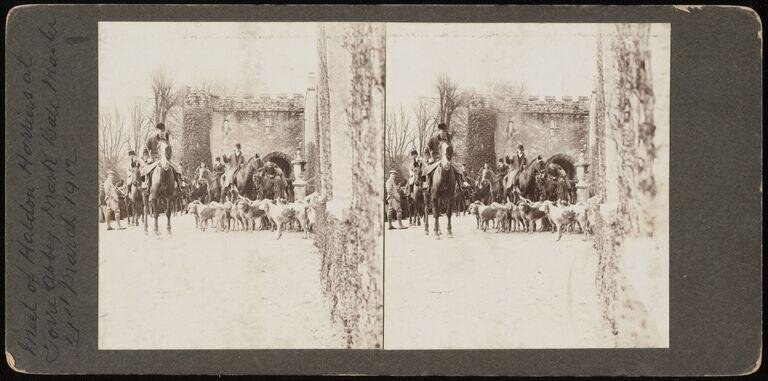
A meet of Haldon Harriers at Torre Abbey
Unknown
- Collection:
- Photograph
- Source:
- Victoria and Albert Museum
- Rights:
- Rights vary by item — check the source record before reusing this image. Source record ↗
- Recorded as:
- V&A — check rights per item
This image is valuable precisely because it is not a dance—it demonstrates the line between formalized ritual, sporting tradition, and choreographed movement. The assembly of the hunt has its own protocol, its own codes of dress and bearing, and its own social meaning; understanding why we do not call this a dance clarifies what we mean when we do.
What you are looking at
A stereoscopic photograph showing a fox hunt meet assembled before Torre Abbey, a ruined medieval gatehouse with crenellated walls visible in the background. The Haldon Harriers gather in the open space before the gate: mounted huntsmen in formal riding dress occupy the center, while a pack of hounds mills about their horses' legs and beneath them. The ground is bare earth or grass, suggesting late autumn or winter. The composition is typical of Victorian sporting photography—the hunt positioned to present itself formally to the camera, neither in action nor in pure stillness, but in the moment of assembly before the day's riding begins. This is a documentary record of a social institution, not a narrative of motion: the photographer has captured the ritual gathering rather than the chase.
The dancing
The riders sit erect and stationary in their saddles, positioned symmetrically across the frame in the manner required for formal group portraiture. The hounds are on the ground, some standing, some resting, creating a loose mass beneath and around the horses. No dancer's frame is relevant here—this is horsemanship and animal husbandry, not choreographed movement. The riders' posture is upright and formal, the traditional seat of the English hunt, but the image captures no moment of active riding, collection, or transition.
The dance depicted
This is not a dance photograph. Fox hunting, though ritualized and governed by formal conventions, is a sport and not a dance. The Haldon Harriers is a hunt club—a social and sporting organization—and this image documents its assembly, not a choreographed movement or performance. The poses are formal and composed for the camera, but that formality is the formality of group portraiture, not the formality of dance notation or convention.
How it was made
This is a stereoscopic photograph, printed on a card mount typical of Victorian stereoscope card stock. The stereograph format—a double image side by side, designed for viewing through a handheld stereoscope—indicates this was produced for mass circulation and domestic consumption. The even lighting and careful composition suggest it was taken outdoors in daylight, likely with a dedicated stereoscopic camera. The slight fading and tone are consistent with albumen print processes of the early 20th century. Stereoscopic cards like this were enormously popular for travel views, sporting scenes, and documentary subjects between 1850 and 1920.
About this work
This is a stereoscopic photograph of a fox hunt assembly at Torre Abbey in 1912. It documents a social ritual of the English countryside—the formal gathering of the Haldon Harriers hunt club before a day's riding. The image is composed as formal group portraiture, with mounted riders and hounds arranged before a medieval ruin. Though not a dance, it belongs in a gallery about dance as a record of human ritual, formal assembly, and the bodily conventions of a particular class and time. It shows how groups were pictured when they gathered for an organized, socially significant collective activity.
How to look at it
The viewer should note the careful symmetry of the composition, with the riders arranged as if for a formal portrait rather than in the loose, scattered arrangement that would occur in actual hunting. The Abbey gate frames the group and adds historical depth—these are not modern sportspeople but inheritors of an ancient tradition. The presence of the hounds is essential to the image's meaning: this is not just a gathering of riders, but the assembly of the hunt as a collective organism, animal and human together. The stillness is itself informative: this is the moment before action, the ritual pause that precedes the chase.
The period
Stereoscopic photography was at the height of its popularity in 1912, though the form itself dated to the 1850s. By the early 20th century, stereoscope cards documenting British country life, sporting traditions, and social institutions were widely circulated. This photograph sits within a documentary tradition of sporting photography that treated hunting, riding, and field sports as subjects of national and class interest. The Edwardian and early Georgian period saw increasing formalization and codification of hunting traditions, even as mechanization and social change began to threaten rural sporting life.
Where it lives
This is a stereoscopic card from the collection held at the V&A (Victoria and Albert Museum), catalogued under sporting and documentary photography. Stereoscope cards survive in the thousands and were produced industrially; this one was likely distributed through commercial channels as part of a series on British country life or Devon sporting traditions.
Questions about this work
Why is a fox hunt in a gallery about dance?
It is not a dance, but it records a formalized ritual—a structured, repeated, socially meaningful gathering governed by rules and conventions. Understanding what is not a dance helps define what is. The fox hunt assembly also demonstrates how groups were posed and pictured in early 20th-century photography, and how formal group identity was expressed through collective posture and arrangement.
What is a stereoscope card?
A stereoscopic card is a photograph printed twice side by side, each image taken from a slightly different angle. When viewed through a stereoscope (a handheld device with a lens for each eye), the two images fuse into a single three-dimensional image. Stereoscope cards were enormously popular from the 1850s through the 1920s and were mass-produced and widely circulated, making them a major form of home entertainment and visual education.
What is the Haldon Harriers?
The Haldon Harriers is a hunt club, a traditional English sporting organization. 'Harriers' hunt hares (rather than foxes), though the terms are sometimes used interchangeably in English hunting tradition. Hunt clubs were—and in some places still are—central to rural social life, bringing together landowners, farmers, and gentry for a day of riding and sport.
More dance artwork





