49 works in this view — arrow keys or swipe to move between them.
Dance in Art
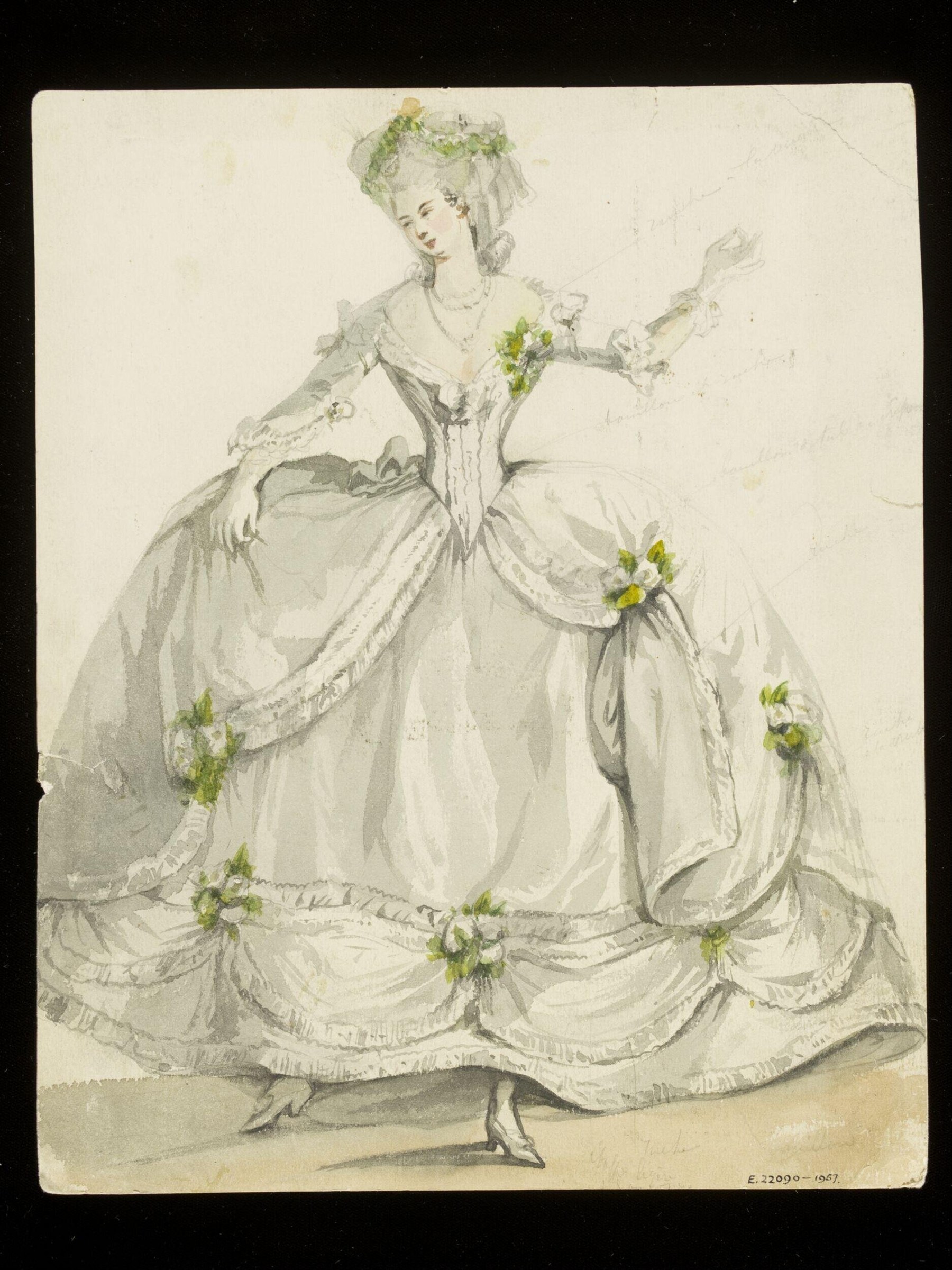
Fancy dress costume design
Jules Marre
- Collection:
- Fancy dress costume design
- Source:
- Victoria and Albert Museum
- Rights:
- Rights vary by item — check the source record before reusing this image. Source record ↗
- Recorded as:
- V&A — check rights per item
Costume designs like this document the visual and material context in which 18th-century social and theatrical dance took place. The extreme fullness of the skirt, the fitted bodice, the raised sleeves, and the ornate headdress all determined how a woman could move—how she would stand, turn, and gesture in the minuet, contredanse, and other formal dances of the period. Understanding what dancers wore is essential to understanding how they danced.
What you are looking at
A single female figure in an elaborate cream and pale grey silk gown stands in a three-quarter pose against a neutral background. The dress features an extremely full skirt with multiple layers of scalloped swags or drapes, each adorned with small clusters of flowers in yellow-green and white tones—likely primrose or similar spring blooms. The bodice is fitted with a corset front, and the sleeves are of sheer fabric with ruffled edges. The figure wears her hair up in an ornate style typical of the mid-18th century, decorated with flowers and feathers or ribbons. Her left arm is raised in an elegant, open gesture; her right hand rests near her waist. Her posture is graceful and composed, the body slightly curved, suggesting a moment of refined pause rather than active movement. The soft watercolor technique and delicate hand-coloring create a luminous, ethereal quality characteristic of fashion design documentation.
The dancing
A single standing figure with an upright but relaxed carriage. The raised left arm extends outward in an open, welcoming gesture with fingers gently curved. The head turns slightly to the viewer's right, with a serene expression. The body weight appears balanced and centered, the posture suggesting refinement and stillness rather than dynamic movement. There is no partnering or interaction with other figures; this is a presentation of the costume itself through a graceful, static pose.
The dance depicted
This is not a depiction of dance in action, but rather a costume design for formal court or theatrical dress of the mid-18th century. The garment appears intended for a woman of rank in a social or ceremonial context, possibly for a formal ball, garden fête, or theatrical performance. The pose is conventional to fashion and costume design of the period—a display of the garment's construction and beauty rather than a record of choreographed movement. The flowers integrated into the design suggest a pastoral, festive, or summer context, common in Rococo aesthetics.
How it was made
This is a watercolor and ink drawing on paper, a common medium for fashion and costume design in the 18th century. The artist has used fine pen or ink for the underlying sketch, particularly visible in the folds of the skirt and the outline of the figure, and then applied delicate watercolor washes in greys, creams, and flesh tones. The flowers are hand-colored in bright greens and yellows, standing out against the pale gown. This technique was standard for costume documentation intended for tailors, performers, and patrons, allowing fine detail and color accuracy while remaining relatively quick to produce. The small scale and careful finish suggest this was a working design document rather than a finished presentation piece.
About this work
This is a mid-18th-century costume design by Jules Marre, a specialist in theatrical and fashion dress documentation. The drawing records an elaborate formal gown of the Rococo period, presented through the figure of an idealized woman in an elegant, static pose. While not itself a depiction of dance, it belongs in a dance history context as evidence of the garments worn by dancers, courtiers, and society women in the formal ball and theater culture of the period. The integration of live flowers into the design and the pastoral aesthetics reflect the courtly pastimes and social rituals in which dance played a central role.
How to look at it
Notice the extreme silhouette created by the scalloped swags draped across the skirt—each swag would have required boning or additional layers of fabric to hold its shape, and would have moved as a unit when the wearer walked or turned. The placement of the flowers at the points of these swags draws attention to the architecture of the garment rather than to the body beneath. The raised arm and open gesture are typical conventions of fashion illustration of the period, designed to show the line of the sleeve and the proportions of the torso without awkward foreshortening. The serene, almost statuesque quality of the pose reflects the ideal of aristocratic reserve and refinement that governed formal movement in this era.
The artist
Jules Marre (also known as Marre or Marré) was a French fashion and costume designer active in the mid-18th century. He specialized in detailed watercolor designs for theatrical costumes and formal dress, producing work for theater companies and aristocratic patrons. His designs are characterized by careful attention to fabric, construction, and ornamental detail, rendered in a refined, economical style suited to production documents. Several examples of his work are held in museum collections, including the Victoria and Albert Museum, indicating his recognition as a skilled professional in the costume trades.
The period
The 1760s were the height of the Rococo period in fashion and design. Women's formal dress had reached an extreme of ornamentation and fullness; the panniers (side hoops) that created the silhouette were at their widest, and skirts were laden with trimmings, ribbons, and applied ornaments. This was the era of the sophisticated minuet and the formal contredanse in aristocratic circles. Costume design as a documented art form was flourishing, driven by the expansion of professional theater and the intense interest of the nobility in fashion. Watercolor costume designs were a standard product of Parisian ateliers and were highly valued by makers and patrons alike.
Where it lives
The work is held in a collection (recorded as source 'va' in the catalogue) dedicated to fancy-dress costume designs. The catalogue record identifies it as a design document rather than a finished artwork, consistent with its function as a maker's specification and a record of a realized garment.
Questions about this work
Is this a drawing of a real person or an imagined design?
This is an idealized design figure, not a portrait. Fashion designs of this period typically presented the garment on a generic, graceful female form that showed off the construction and ornaments to best effect. The figure's serene expression and perfect posture are conventions of the medium, not records of an actual person.
What are the flowers sewn into the dress for?
Fresh flowers were a luxury ornament for formal dress in the 18th century, especially for summer balls and outdoor festivities. They would have been attached to the gown shortly before wearing and replaced throughout the evening. The choice of modest spring flowers—primrose or similar blooms—suggests this was a daytime or garden occasion rather than a grand ball.
How does a skirt this full even move?
The fullness was achieved with wide panniers (hoops) sewn into the skirt, which held it out rigidly at the sides and front. A woman wearing this would move slowly and carefully, gliding rather than stepping, with her feet taking tiny steps beneath the fabric. The minuet and other dances of the period were choreographed to accommodate this constraint, creating the illusion of floating rather than walking.
More dance artwork





