49 works in this view — arrow keys or swipe to move between them.
Dance in Art
Fancy dress costume design
Jules Marre
- Collection:
- Fancy dress costume design
- Source:
- Victoria and Albert Museum
- Rights:
- Rights vary by item — check the source record before reusing this image. Source record ↗
- Recorded as:
- V&A — check rights per item
Costume designs are primary sources for understanding how nineteenth-century dancers and ball-goers actually dressed, and what theatrical and exotic fantasy they aspired to embody. This drawing shows the care and colour-coordination that went into creating a single costume, and testifies to the importance of visual spectacle—not just movement—in the social and theatrical dance events of the Romantic era.
What you are looking at
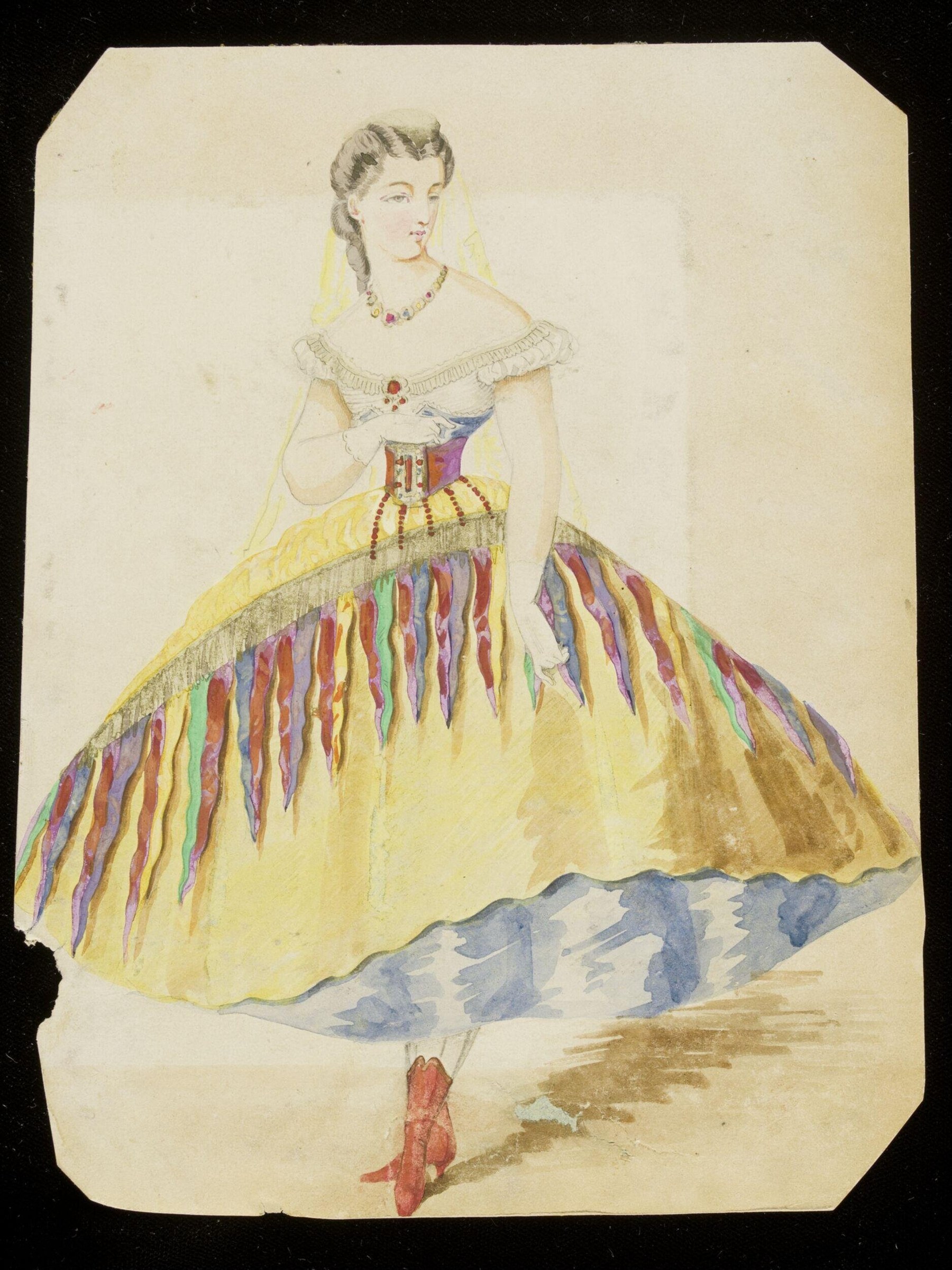
A young woman in an elaborate ball gown stands in a three-quarter pose against a plain cream background, her body angled to suggest movement or presentation. She wears a strapless gown of pale yellow with a fitted bodice featuring a purple-blue corset and ornamental jewelled clasp at the centre front. The skirt is voluminous and dramatically decorated with deep fringe in alternating colours—rust, purple, yellow, green, and pink—that hangs from a decorative band at the waist. A yellow veil trails from her head and flows down her back. She is adorned with a ruby necklace and matching jewelled ornament at her shoulder. Her pose is elegant and upright, with one arm held at her side. At her feet, visible against a shadow suggesting ground or stage, are red boots or slippers. The costume reads as theatrical rather than street wear—this is fancy dress in the nineteenth-century sense, created for a ball or masquerade.
The dancing
A single standing female figure, shown full-length in a composed, frontal-to-three-quarter stance. Her weight appears balanced and her posture is refined and upright, with shoulders back and head held high. One arm rests at her side; the other is not distinctly posed. There is no active movement captured—this is a costume display figure rather than a dancer in motion. Her body language suggests formal presentation or parade rather than the dynamic engagement of active dance.
The dance depicted
This is not a depiction of dance in action, but of fancy-dress costume suitable for a ball or masquerade of the mid-nineteenth century. The figure is a fashion and costume study, likely prepared for reference during a fancy-dress event. While the Romantic era—when this was drawn—included formal ballroom dances such as the quadrille, waltz, and polka, this image captures the wearer at rest, showcasing the theatrical costume rather than choreography or the moment of dancing. The dramatic colour and fringe suggest a fantastical or exotic theme, possibly drawing on orientalist fashion of the period.
How it was made
Watercolour and ink on paper, executed as a fashion illustration or costume design drawing. The technique is precise and controlled: ink outlines define the figure and garment structure, while watercolour (in pale yellow, purple-blue, pink, green, and rust) is applied in flat and semi-transparent washes. The fringe and decorative details are drawn in fine line rather than heavily modelled. This is a working design document—the kind used by costumers, milliners, or for reference by the wearer—intended for private consultation rather than large-scale reproduction. The paper has aged to cream, and the corners are trimmed to rounded rectangles, a common format for design sheets of the period.
About this work
This is a costume design drawing by Jules Marre, dated 1860, for a fancy-dress ball gown of the mid-Victorian period. It records a single figure in a theatrical gown of pale yellow silk trimmed with deeply fringed decoration in jewel tones, worn with a yellow veil and ruby ornaments. The drawing is a functional design document—the kind that would have been consulted during the creation or wearing of the costume—rather than a narrative scene or representation of dance in motion. It belongs in a gallery of dance in art because fancy-dress balls were a significant social and theatrical practice in the nineteenth century, and because costume design is integral to the history of dance performance and social dancing.
How to look at it
Attend to the radical colour and the engineering of the costume: the way the bright fringe is structured to move and shimmer as the wearer danced, and the contrast between the fitted, corseted bodice and the expansive volume of the skirt. The artist has chosen to show the figure standing still, not mid-movement, which tells us this is a costume design document rather than a record of dance; but the costume itself—especially the trailing veil and the structured fringe—was designed to be dynamic and visually striking in motion. The pale yellow base and the jewel-coloured accents are typical of mid-Victorian theatrical colour theory.
The artist
Jules Marre was a French costume and fashion designer active in the mid-nineteenth century. His work appears in the holdings of the V&A Museum as costume designs and fashion illustrations, suggesting he worked for the theatre or for private clients commissioning elaborate dress for balls and social events. The precision and elegance of his draughtsmanship and his attention to decorative detail are consistent with professional costume design practice of the Second Empire period in France.
The period
The 1860s was the height of the Victorian fancy-dress ball, a social ritual in which the wealthy and fashionable commissioned elaborate costumes inspired by historical periods, exotic cultures, or theatrical fantasy. The Romantic ballet, which had dominated the stage for three decades, had celebrated sylphs, sylphs, and otherworldly femininity; fancy-dress balls brought elements of that aesthetic into the ballroom. At the same time, the Industrial Revolution had made vivid synthetic dyes available, and gas lighting in ballrooms made bright colours visible and dramatic. The fringe and jewel tones in this costume reflect the new possibilities for theatrical colour and texture. Social ballroom dances—the waltz, polka, quadrille, and galop—were the norm at such events, and the costume would have been worn while dancing these forms.
Where it lives
Held by the Victoria and Albert Museum, London, as part of its costume and design collections. It is catalogued as a fancy-dress costume design, a category that reflects the museum's interest in recording the material culture of nineteenth-century social and theatrical life.
Questions about this work
What dances would someone have danced in this costume?
At a fancy-dress ball in 1860, the wearer would have danced the waltz, polka, quadrille, and galop—the standard ballroom dances of the Victorian period. The voluminous skirt and the structured fringe would have moved dramatically with the wearer's turns and steps, creating visual spectacle. The costume was designed to be both beautiful when standing and striking when in motion.
Why is this a document of dance history?
Costume designs record not only the aesthetic ideals of a period but the practical realities of how dancers and ball-goers actually dressed. This drawing shows what an upper-class woman in 1860 aspired to wear to a major social event, how colour and fringe were orchestrated for visual effect, and what theatrical fantasy—in this case, possibly orientalist—was embodied in the ball gown.
Who was Jules Marre?
Jules Marre was a French costume designer of the mid-nineteenth century whose work is held in the V&A collections. He appears to have worked for theatre productions and private clients commissioning elaborate dress for balls and social events. Little biographical information is publicly documented.
Is this a painting or a drawing?
This is a watercolour and ink drawing on paper—a working costume design document, not a finished painting intended for display. The technique is typical of professional costume design practice of the period: ink outlines with watercolour washes for colour reference.
More dance artwork





